
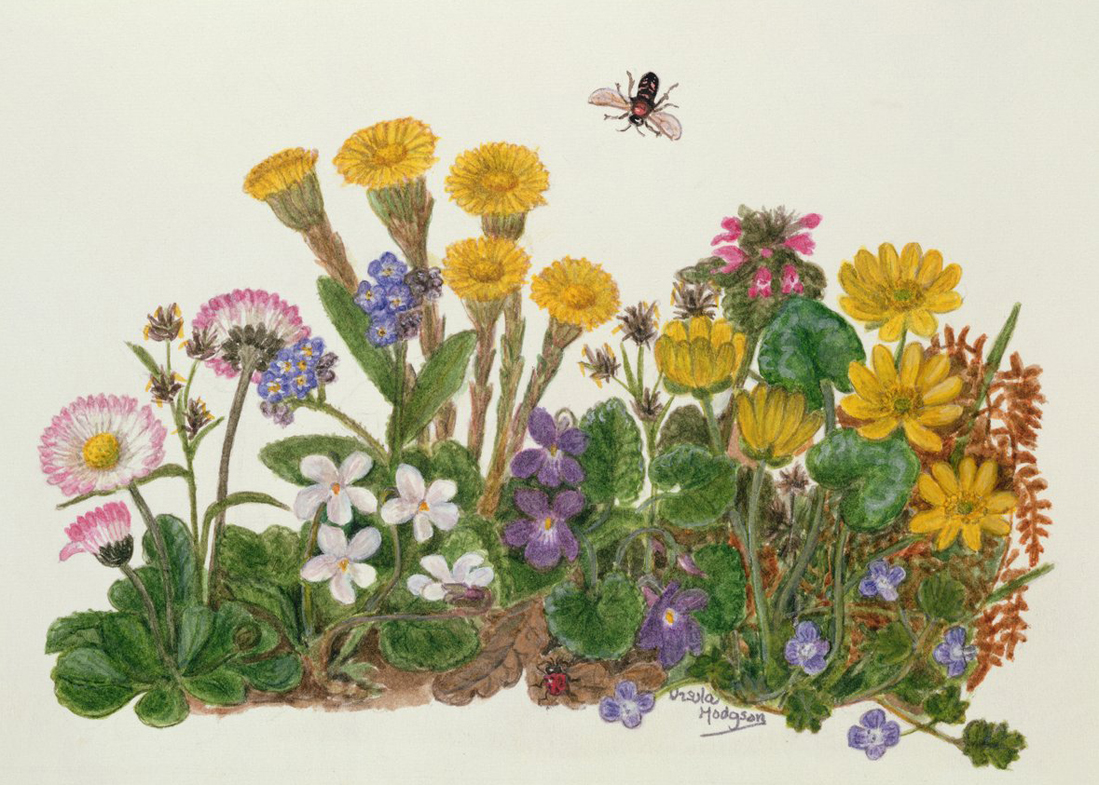
“Ring Worm. Many people in the district have this cure (Mrs Duignan & Mrs Miggin Coolronan, and Miss Dixon Cloneycavan). As these families are related, the cure seems to have come from the Dixon family. There is no prayer or charm with this cure, it consists of the leaves and roots of the Celandine mixed and heated on the pan and then mixed with unsalted butter, cream or other grease.”
Pádraig Mac Eocaidh, County Meath, Irish Folk Duchas
Cover art by Ursula Hodgson
Celandine or Chelidonium majus is also called greater celandine, swallowwort, swallow herb, nipplewort, tetterwort, kenning wort and devil’s milk. This is hopefully not to be confused with ‘lesser celandine, Ficaria verna’ which is not closely related and poisonous but simply shares a similar name. This plant with the same name makes it a bit more challenging to sort out which plant was used medicinally from folk records but typically it was only used externally due to its poisonous nature. It’s called aonscoth in Gaeilge and aon-sgoch or lach-ceann ruadh in Scots Gaelic.
Subscribe to get access – $5 a month

Isla Skye
Isla Skye is an American Celtic scholar, a mother of 3, elementary teacher for 21 years as well as an author and herbalist that splits her time between the States and Ireland. She has studied the druids and related practices for over 20 years. She is a published author of children’s books as well as other folkloric literature and is currently working through an M.A. in Celtic Studies. Her hobbies are family time, camping, hiking, reading, writing and research.
Leave a Reply