
“For an epileptic fit it was customary to anoint the soles of the feet, nostrils and nape of the neck with “Oil of Kites”. It was claimed this remedy would prevent the fits, if applied “three days before and after the full and new moons”. To prepare it, it was necessary to take four young kites from the nest and, after plucking them, to boil them in a mixture of black-cherry water, peony roots, castor, rue, rosemary, lavender, St. John’s-wort flowers, valerian root and olive oil. They were to be boiled until they came to a mash and then were to be pressed.”
C.J.S. Thompson, Magic and Healing, 1942
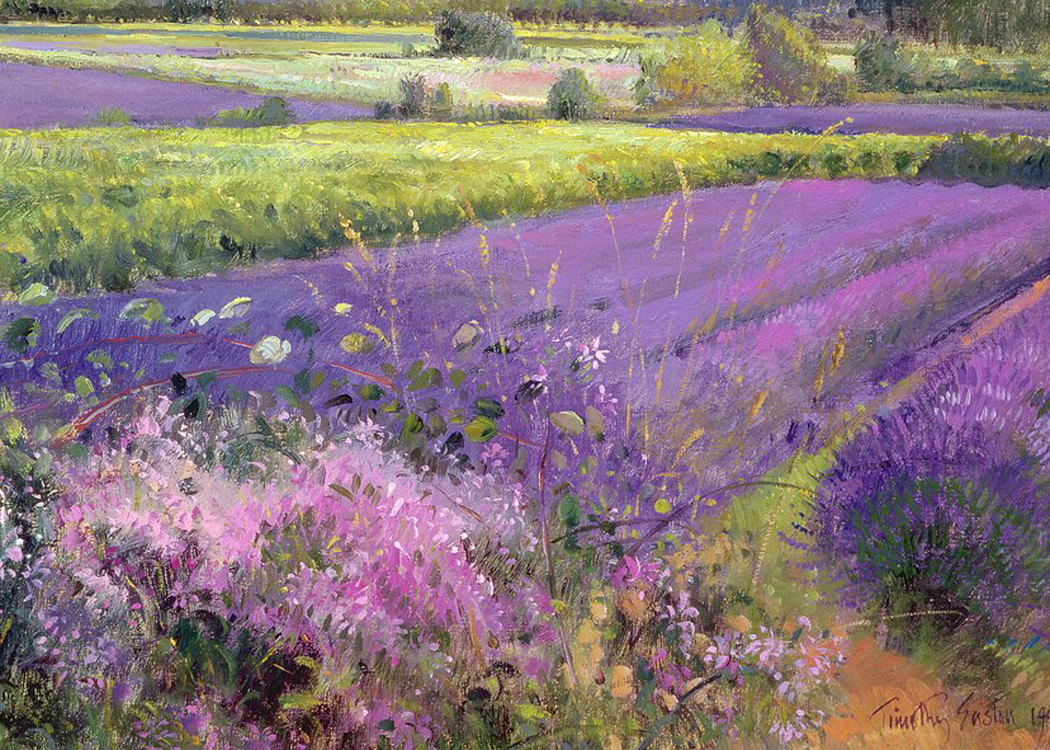
Cover art by Timothy Easton
Lavender, or Lavandula angustifolia or Lavandula officinalis is also called Lavandula, Garden lavender, English lavender or French lavender. It’s called labhandar in Gaeilge and lus-liath in Scots Gaelic. The name Lavender derives from the French word ‘lavandre‘ which means ‘to wash’ referring to the use of infusions of the plants in laundry. I personally find the flower and scent captivating and include it quite frequently in smoke bundles and pillow or drawer satchels.

Dioscorides mentioned lavender being called stoechas by the Gauls living in Galatia near Messalia and being used to treat disorders of the chest. In Ireland, it was used to treat jaundice, stomach ailments1, liver complaints2, sleeplessness3, anxiety4, asthma5, burns6, baldness7 and to improve complexion8 or chapped hands in lotion form9 and use as a perfume10. Additionally it was said to provoke urination, menstruation and expel the afterbirth of a still-born child.11
In England, it was recommended to take as an infusion to treat chest pain12 as well as pains of the head, and brain which proceed from cold, apoplexy, falling-sickness, tiredness, cramps, convulsions, and faintings.13 It became incredibly popular during the Middle Ages and spread rapidly across Europe mostly with a unanimous use at minimum, for washing clothes and linens due to its popular scent. It was during this time period that western herbalists such as John Gerard and Nicolas Culpeper expanded and promoted lavender’s medicinal properties, likely based on the Greeks. It was said by writer John Timbs in 1859 that…“Great Bonfires used to be lighted this evening, as well as on the eve of St. John the Baptist. Garlands of roses,of lavender,or rosemary,and of woodroof, were also worn and used to decorate the churches on St. Barnabas’ Day, as we find by many old entries and church- books ; and they were often paid for by the parish.” Overall, it was mainly used as an aromatherapy to induce relaxation, which continues today.

Lavender is in the Lamiaceae family and native to Europe, the Mediterranean as well as parts of Asia, India and Africa. Lavender has small individual smooth shaped pointed leaves and clusters of light purple flowers that grow in whorls that typically bloom in the spring as well as again from midsummer through autumn and it may have been associated with the Summer Solstice or Lughnasadh. It’s a perennial in zones 5 through 8, grows up to 60 cm or 24 in tall and does well in full sun and partially sandy or well drained soil. Lavender’s energy is warm and dry. The leaves and flowers are edible and have a pungent yet subtly sweet flavor. It’s most commonly used as an infusion, oil or in a smoke bundle and steam bath.
Benefits
analgesic, antibacterial, antifungal, anti-inflammatory, antioxidant, antispasmodic, anxiety alterative, blood tonic, diuretic, hair tonic, hypnotic, vulnerary
Recipe
Lavender (Sweet Marjoram and Meadowsweet) Massage Oil
Ingredients: 2 oz. or ¼ cup of lavender flowers or leaves, 2 oz. or ¼ cup of sweet marjoram, 2 oz or ¼ cup of meadowsweet flowers, 8 – 12 oz. of olive oil, glass jar.
Instructions: Place your herbs in a glass jar and cover in your oil. Leave it to sit in a shaded and cool location, shaking once daily for 2 weeks. Strain through a fine cloth and store in an amber bottle. Use on your face or body as a moisturizer.
References
- Irish Folk Duchas, The Schools’ Collection, Volume 0559, Page 142
- Irish Folk Duchas, The Schools’ Collection, Volume 0029, Page 0360
- Irish Folk Duchas, The Schools’ Collection, Volume 0403, Page 299
- Irish Folk Duchas, The Schools’ Collection, Volume 0659, Page 235
- Irish Folk Duchas, The Schools’ Collection, Volume 1010, Page 316
- Irish Folk Duchas, The Schools’ Collection, Volume 0146, Page 559
- Irish Folk Duchas, The Schools’ Collection, Volume 0828, Page 173
- Irish Folk Duchas, The Schools’ Collection, Volume 0580, Page 147
- Irish Folk Duchas, The Schools’ Collection, Volume 0776, Page 377
- Irish Folk Duchas, The Schools’ Collection, Volume 0570, Page 088
- K’Eogh, John. Edited by Michael Scott, 1986. An Irish Herbal. 1735. Pg. 90.
- Van Arsdall, Anne, Medieval Herbal Remedies, The Old English Herbarium and Anglo-Saxon Medicine, New York, 2002 (5th century original text), pg. 214.
- Culpeper, Nicolas. Culpeper’s Complete Herbal. W. Foulsham & Co, London, 1654, page 210.

Isla Skye / The Druid's Cauldron Historical Society
We are a registered non-profit, The Druid’s Cauldron Inc. 501(c)(3) The Druid’s Cauldron is an independent journal established in 2016, dedicated to the preservation and exploration of the druids, filid/poets, culture, native wisdom, and the living traditions of the isles. We exist to recover folklore, herbalism, spiritual philosophy, and ecological knowledge embedded in the whispers of our ancestors.
Through deep research into traditional folklore, herbalism and mythology as well as personal artistic endeavors, we seek to cultivate a deeper relationship with the land, the seasons, and to one another. We are committed to serious inquiry and evidence-based information, or it is alluded that it’s personal philosophy and labeled as such. The Druid’s Cauldron is a space for the curious, the contemplative, and those who feel called to remember older ways of being in right relationship with the land and each other.
Leave a Reply