
“Local Cure for Eczema. Coltsfoot is a wild herb common to most places and is used locally for this disease. The roots of this plant are washed and boiled into a jelly. Black soap and sulphur are added and the mixture is applied with a feather. It is applied everyday and prayers are recited while doing so, no washing of the face or affected part is allowed and the person with the disease must not remain away from mass while getting the treatment. This cure is a family one and the secrets of some herbs used, are only known to one member of the family. Before this person dies, he or she tells the secret to some remaining member.”
Annie Costello, The Schools’ Collection, County Dublin, 1930’s
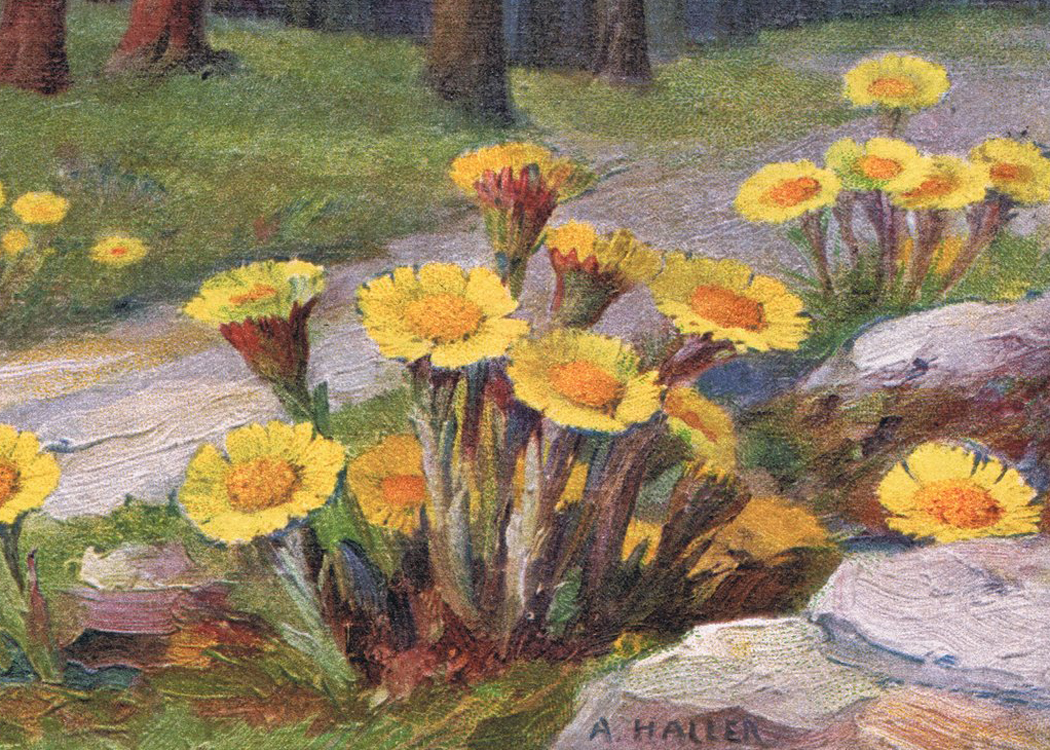
Cover art by Anna Haller
Coltsfoot or Tussilago farfara is also called foal’s foot, tash plant, coughwort and farfara. It’s called sponc in Gaeilge and athan, fathan or cluas liath in Scots Gaelic. The botanical name Tussilago stems from the Latin word tussis and ago meaning cough and to act on. The common name refers to the way the leaves resemble a colt’s foot. Coltsfoot is a wonderful harbinger of spring and very loved by pollinators and myself alike. I can’t help but touch and look closely at them when one decides to pop up randomly in the yard or local wildflower field as I’m foraging.

Dioscorides mentioned coltsfoot being used to treat skin infections, inflammations as well as being inhaled to cure cough and cold. In Ireland, it was used to treat coughs1, sore throats2, tuberculosis3, ringworm4, ulcers5, inflammations6 and it was specifically smoked to treat asthma7 and often given as candy to children.8 Additionally, it would have been common to include in a wine to deliver the remedy.9 Tadgh O’Cuinn recommended Coltsfoot to induce sleep and treat fevers as well as to treat cracked and dry skin. It was commonly referenced as a terrible annoyance by farmers although the white undersurface of the leaves were often found useful as tinder before the availability of matches.10,11,12 Coltsfoot was also smoked as a replacement for tobacco and used to treat coughs in Scotland, particularly by miners.13,14 In England and Wales, it was used again for cough and cold, inflammations of the skin, smoked to treat asthma or coughs and as a poultice to treat pain in the legs.15,16

Coltsfoot is in the Asteraceae family and native to Europe, Asia and North Africa but has become naturalized in North and South America. Coltsfoot has horse foot shaped serrated leaves with bright yellow flowers that typically bloom from late spring through mid summer and it may have been associated with the Spring Equinox or Bealtaine. It’s a perennial hardy in zones 3 through 7, grows up to 30 cm or 1 ft tall and does well in full sunlight and moist soil. Coltsfoots’s energy is cold and wet. The leaves are edible and have a subtly bitter flavor. It’s most commonly used as an infusion, poultice or herbal smoke. Use caution with this plant as there are some concerns of the levels of pyrrolizidine alkaloids, substances that have been linked to liver disease and failure. Use only as necessary and intermittently.
Benefits
antiasthmatic, anti-inflammatory, antitussive, astringent, emollient, expectorant, demulcent
Recipe
Coltsfoot Sore Throat and Cough Infusion
Ingredients: 1 tbsp. coltsfoot, 1 tsp. mullein, 1 tsp. marshmallow, 1 tbsp. molasses
Instructions: Boil 16 oz. of water, remove from heat and add your herbs. Let it simmer for 10 to 20 minutes. Strain, stir in molasses and sip throughout the day.
References
- Irish Folk Duchas, School Collection – Volume 1011, Page 030
- Irish Folk Duchas, School Collection – Volume 758, Page 415
- Irish Folk Duchas, School Collection – Volume 604, Page 071
- Irish Folk Duchas, School Collection – Volume 27, Page 116
- Irish Folk Duchas, School Collection – Volume 936, Page 182
- K’ Eogh, John, Botanologia Universalis Hibernica, or An Irish Herbal, Cork, 1735, edited by Michael Scott, 1986, pg. 49.
- Irish Folk Duchas, School Collection – Volume 750, Page 294
- Irish Folk Duchas, School Collection – Volume 1087, Page 253
- Irish Folk Duchas, School Collection – Volume 731, Page 287
- Irish Folk Duchas, School Collection – Volume 1087, Page 252
- Chonchubhair, Máirín Uí, Flóra Chorca Dhuibhne : aspects of the flora of Corca Dhuibhne, Baile an Fheirtéaraigh: Oidhreacht Chorca Dhuibhne, 1995, pg. 225.
- Joyce, P.W., A Social History of Ancient Ireland, Vol. 2, M. H. Gill & Son, Dublin, 1920, pg. 161.
- Beith, Mary, Healing Threads: Traditional Medicines of the Highlands and Islands, Birlinn Ltd., 2004, pg. 246.
- Rorie, David, Folk Tradition and Folk Medicine in Scotland ed. David Buchan, Edinburgh, Canongate, 1994.
- Culpeper, Nicholas, The Complete Herbal, London, 1653.
- Myddvai, Meddygon, Pughe, John and Williams, John, The Physicians of Myddvai, Wales, 1861.

Isla Skye / The Druid's Cauldron Historical Society
Isla Skye is a writer, photographer, herbalist and teacher of 20 years who lives in Mayo, Ireland.
We are a registered non-profit, The Druid’s Cauldron Inc. 501(c)(3) The Druid’s Cauldron is an independent journal established in 2016, dedicated to the preservation and exploration of the druids, filid/poets, culture, native wisdom, and the living traditions of the isles. We exist to recover folklore, herbalism, spiritual philosophy, and ecological knowledge embedded in the whispers of our ancestors.
Through deep research into traditional folklore, herbalism and mythology as well as personal artistic endeavors, we seek to cultivate a deeper relationship with the land, the seasons, and to one another. We are committed to serious inquiry and evidence-based information, or it is alluded that it’s personal philosophy and labeled as such. The Druid’s Cauldron is a space for the curious, the contemplative, and those who feel called to remember older ways of being in right relationship with the land and each other.
Leave a Reply