
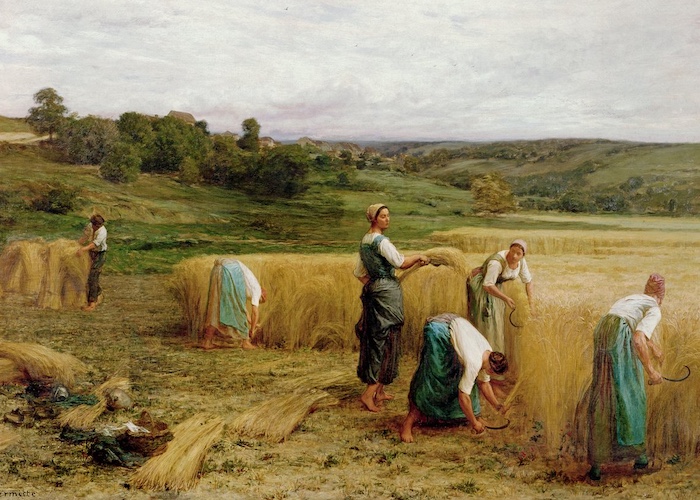
“Three abundances in Ireland: an abundance of ears of corn, an abundance of flowers, and an abundance of fruit.”
Triads of Ireland
Cover art by Leon-Augustin Lhermitte, 1874
July 31 – August 1st (astronomical date varies) however historical festivals and other events happened throughout the entirety of August
The word Lughnasadh, Lugnasad or Lúnasa is pronounced loo-nas-ah. Lughnasadh means ‘Lugh’s assembly’ while Lúnasa means the month of August in Gaeilge. August is also called Lùnastal in Scots Gaelic.

Lughnasadh marks the beginning of autumn and the harvest season. Farmers began reaping their crops and bringing the animals in from their distant pastoral wanderings. Given the long days and warm weather, people likely may have traveled great distances at this time to visit neighbors and relatives or otherwise go on pilgrimages. It was the perfect time to sort out commerce and trading affairs and they may have traveled a great distance to sell or trade items for extra coin to provide needed food items or materials for the coming winter season. Various fruit and berries would have been harvested from now through Samhain. Bilberry, hawthorn and elderberry are common examples.
“The three fairs of Ireland: the fair of Teltown, the fair of Cruachán, the fair of Colmán Elo – Trecheng Breth Féne” – Triads of Ireland
While Imbolc is clearly representative of slightly more feminine aspects, Lughnasadh seems to have symbolized the masculine. The many highland games organized at this time of the year gave everyone a chance to both participate in commerce and test out or ripen their skills. Testing one’s skills was possibly somewhat symbolic of the crops ripening as well and being ‘ready’. Horse races around this time were also very common. The Puck Fair which takes place in County Kerry in August has survived into the present and is thought to be a remnant of Lughnasadh but officially started as an identifiable fair in the 16th century. It is a three day festival which is quite auspicious and includes a parade, dancing, music and of course, the essential presence of horse and cattle.

“The day the people began to reap the corn was a day of commotion and ceremonial in the townland. The whole family repaired to the field dressed in their best attire to hail the God of the harvest. Laying his bonnet on the ground, the father of the family took up his sickle, and facing the sun, he cut a handful of corn. Putting the handful of corn three times sunrise round his head, the man raised the Iolach Buana, the relating salutation. The whole family took up the strain and praised the God of the harvest, who gave them corn and bread, food and flocks, wool and clothing, health and strength, and peace and plenty.” – Alexander Carmichael, Carmina Gadelica, 1900
Trial marriages were conducted around Lughnasadh, often at festivals that would last a year and a day. If at the end of the year it wasn’t working out, couples agreed to go their separate ways and at the following Lughnasadh would do this by standing back to back and then walking forward and away from one another. It was said that when asking a woman to marry him, a man would send his friends to the woman’s house with a gallon of whisky as a gift and she was asked by his friends on his behalf. If she said yes, the man would then visit her house in person and they would determine the future date of their marriage.1

Other common activities were driving cattle or horses through bodies of water as a blessing and for their continued health verses driving between two fires at Bealtaine. This was often done on horseback by men in the nude.2 This was recorded traditionally as happening near Galway Bay. It was said that unmarried girls would often decorate hoops with ribbons and flowers and set them up to watch the dancing and festivities, often at grave sites. This seems to be a tradition based in continued ancestor worship, inviting ancestors to witness the events (similar to Samhain in saving a chair at dinner) or ask them for blessings by leaving them an offering. Again, we see a marriage in customs relating with both agrarian and funerary concepts.3
One favored activity at this time was as mentioned, the pilgrimage, which included walking long distances, usually at least in part with the intention to climb to the top of a specific hill or mountain or to visit holy wells where the first fruits of the harvest may have been laid in offerings. The custom of climbing hills or mountains survived well into modern times and the best known example of this is the Christianized “Reek Sunday” pilgrimage to the top of Croagh Patrick on the last Sunday in July. It should also be noted, Lammas is the Saxon, largely Christianized version of this harvest festival. Slieve Callan has been referenced as one of the original folk destinations.4 This is just one example of many, both widely and locally known.
“Lughnasa was the agrarian harvest festival celebrated for a month between mid-July and mid-August. Cereal grain was the mainstay of daily life, and so highly regarded that ears of grain are depicted on Celtic coins and stone carvings… Sheaves of corn and barley are still displayed, as are the traditional Corn-Dollie and Corn-maiden, both made from the last cutting of grain. These straw figures were symbolic of fertility. At both sowing and harvest times they were carried around the fields in procession, signaling commencement of the harvest feast.” – Victor Walkley, Celtic Daily Life, 1998

Dinners would have been held where the first fruits of the harvest would have been eaten. Corn dollies of Lugh (similar to Brigid during Imbolc) may have been made to use in ritual processions or to display in the home and families might have set up their own Altóir na Greine, Altar to the Sun where summer flowers would have been strewn around.5 A description of an altar…
“I saw Altoir na Greine in 1844 – ’45 The altar was a rude construction much in the form of a large bin or chest, but empty underneath. The altar past was composed of seven large grey flags – four upright flags standing in the ground, two at either end, about four feet apart, and one great flag reaching down upon them, and two upright flags standing in the ground behind them on the western side and rising about two feet or eighteen inches above the table stone of the altar. there were some stones of various shapes and sizes around it, at the back and at the ends and an elevation or mound of clay and small stones.”
A reference to the reverence of Lugh and Brigid continuing in the present…
“At the foot of Sleive Foy nestles the present town of Carlingford, with all its ruins and abbeys. Thousands of years ago, between Sleive Foy and Sleive Ban, where Carlingford Lough is now, the town of Carlingford used to stand. This city used to be situated on the bank of a pool in which the people bathed before entering the twmple to make offerings to Lugh and Brigit, the god and goddess of fire, because the people then were worshipers of fire. The city was sometimes called the golden city on account of the golden domes on tip of the temple which glittered in the sunlight. It was a very rich city because pilgrims brought riches for offerings to Lugh and Brigit, and the temple had hundreds of jewels in it.
On an altar in the high temple a fire was kept lighting the whole year round, except for one day, in which it was allowed to go out and the day after it was lit again by the volcano on Slieve Terrine, now called Slieve Foy. Upon this alter Lugh, the god of fire sat, looking down on the people with gleaming eyes. The people thought it right to worship fire because they thought that the center of the earth was one big furnace, and that the volcano was a sort of chimney leading from it. Before a person became a member of the society that worshipped Lugh and Brigit, they had to prove their worth by dancing through the fire on top of the alter. The people there were very superstitious, and they used to remain for hours looking in the fire, and they imagined they could see all sorts of things in it.” – George Cunningham, County Louth, The Schools’ Collection, Volume 0662, Page 018

Additionally… “The town of Carlingford is at the foot of Slieve Foy where all the old ruins of abbeys and castles used to be. Thousands of years ago between Slieve Foy and Slieve Ban where the wares of Carlingford now roll was the old town of Cahir Linn the city of the Pool. The city was situated at the banks of a pool. Their pool was fresh water and the people used to bathe there before worshiping their gods, Lugh and Brigit the god and goddess of fire. The city was called the golden city because the domes of the temple used to shine brightly in the sunshine. The fire was on the altar in the high temple and all the priests and people were around the fire. Above their hears were the gods and goddess of fire. The fire was kept burning every day of the year except one day and on that day it was put out. On the next day the fire was lighted again. The people imagined that they could see different kinds of animals in the fire. No people were allowed to join these sermonies the priests had unless they could dance right through the fire.” – Violet Armstrong, County Louth, The Schools’ Collection, Volume 0657, Page 176
There is another fanciful legend concerning this location in relation to a local volcano that was active for millions of years but is now dormant…
“The Destruction of Carlingford… Carolan king of the sacred city of Cahir Linn had a daughter named Aete. She was one of the chief priestesses of the temple. From the time she was a young girl she made a vow that she would keep all the laws of the temple. This was the only work she had to do and liked to do. One day a young man came from a foreign country to worship Lugh and Brigit the god and goddess of fire. He became so interested in the priestesses work that he forgot what he had come for. He was especially interested in Aete. His name was Balla and he was one of the Greece champions. One day he climbed into the forbidden grave and luckily met Aete. They continued meeting each other every day and as she was one of the chief priestesses she had a special room of her own. In this room they could hide themselves and make plans without anybody knowing it. One day however they were seen talking and it was told to the priest. Aete was put in jail but Colla escaped. One day a king came from a foreign country and King Carolan laid a feast for him.

Everybody forgot about Aete and during the feast Colla went to where Aete was imprisoned. He managed to free her and they ran away without being seen. Unfortunately their escape was soon found out and they were caught and brought back again. They were put in prison and a big fire was lit outside so that if anybody toughed the bars they would burn their fingers. Colla made attempts to get out but he only burnt his fingers. They were suffocated with the heat but could do nothing. They tried to go to sleep but as the ground was hard and the heat was unbearable they could not. At last the day came when they should die. They were condemned to death by being put in the volcano. They were brought on two stretchers, bound hands and foot and thrown into the volcano as a sacrifice to the god and goddess of fire. As soon as they were thrown in they were dead. The volcano poured out lava and the heat was intense, the people ran to the shelter of their houses but before they could get there most of them were killed. Some of them got away but there was more in store for them. The houses and the temple were destroyed and the ground was split open. The people that got away from the burning lava were killed also and a tidal wave covered the city and that was the end of it. The place where it was is now covered by Carlingford Lough.” – Mervin Webster, Ardee Terrace, County Louth, The Schools’ Collection, Volume 0662, Page 022
There were Ogham stones discovered near a traditional burial ground in Cill Tíre, a townland situated in Dromore, County Down by Professor McAllister in 1934 that read, ‘Collabot descendant of Lugh,’ ‘Medusos son of Lu,’ and ‘Descendant of Lugha’.
The story of Lughnasadh as a celebration begins with a goddess by the name of Tailtiu. According to the Lebor Gabála Érenn, The Book of the Taking of Ireland, Tailtiu was the daughter of the king of Spain and the wife of Eochaid mac Eric, last Fir Bolg High King of Ireland. When the Tuatha Dé Danann invaded Ireland, she managed to survive and became the foster mother of Lugh and someone he cared for deeply. Tailtiu is said to have died from exhaustion after clearing and readying the plains of Ireland for agriculture. Lugh established a harvest festival and funeral games, Aonach or Óenach Tailteann, in her honor or what would become the festival of Lughnasadh. In these accounts, the festival was a time of playing games or exhibiting skills, dancing, religious ritual, trading, arranging trial marriages, telling old tales and having mock battles.

Lugh himself was very skilled in many areas of craft and these competitive games or battles could have been representative of additionally testing out skills in general. Reenactments were possibly given of the famous mythological battle in which Lugh puts out the eye of his grandfather Balor and kills him. This legend may have been where the idea of suffering from the “evil eye” originated. Up through the 18th century, many people believed that if your eye was infected, it was due to a witch placing a spell on you and they had various rituals they would use to heal the evil eye. The Irish town Teltown in County Meath named after Lugh’s mother is where Irish high kings officially celebrated Lughnasadh. It was renamed the Tailteann Games in more recent years. One of the last traditional gatherings organized by an Irish king was held there by Ruaidrí mac Tairrdelbach Ua Conchobair in 1169 CE. However, many unofficial celebrations were carried out well into the present time. This was likely the precursor to the modern Scottish and Irish highland games with many different names and titles. These were such popular events that they were carried with Irish and Scottish settlers around the world.

Irish folklorist Máire MacNeill also published a wonderful account of a traditional Lughnasadh custom. According to MacNeill, the main theme that emerges from the folklore and rituals of Lughnasadh is a struggle for the harvest between two gods. One god – usually called Crom Dubh – guards the grain as his treasure. The other god – Lugh – must seize it for mankind…
“A solemn cutting of the first of the corn of which an offering would be made to the deity by bringing it up to a high place and burying it; a meal of the new food and of bilberries of which everyone must partake; a sacrifice of a sacred bull, a feast of its flesh, with some ceremony involving its hide, and its replacement by a young bull; a ritual dance-play perhaps telling of a struggle for a goddess and a ritual fight; an installation of a [carved stone] head on top of the hill and a triumphing over it by an actor impersonating Lugh; another play representing the confinement by Lugh of the monster blight or famine; a three-day celebration presided over by the brilliant young god [Lugh] or his human representative. Finally, a ceremony indicating that the interregnum was over, and the chief god in his right place again.” – Máire MacNeill, The Festival of Lughnasa: A Study of the Survival of the Celtic Festival of the Beginning of Harvest, Oxford University Press, 1962. p.426
Lugh was the son of Cian (son of Danu), a member of the Irish Tuatha Dé Danann while his mother was Ethniu the daughter of Balor, member of their enemy the Fomorians. His very birth represents a joining of two opposing groups and the circumstances surrounding his birth are wrought with foreshadowing and destiny. He was thought to be a warrior associated with light, fire, art, crafts, commerce, oaths and honor. The cognate word lug in Old Irish meant warrior, hero or fighter. He is thought to be the possible Irish equivalent of the Gaulish Lugus but also possibly, Welsh Lleu of the Skillful Hand, German Wotan, English Woden and Norse Odin although this is greater speculation. His name appears on a rock inscription on the hilltop of Penalba de Villastar in what would have been ancient Celtiberia near Spain. There are approximately ten inscriptions addressing a multiple set of gods called Lugoves in Celtiberia as well as Avenches, Switzerland but they are arguably female. There are also many place names associated with him such as Lugudunon, ‘Fortress of Lug’, in modern Lyon, France.

As a young man, it was said that Lugh traveled to Tara to join the court of Nuada, high king of the Tuatha Dé Danann who at the time were oppressed and at war with the Fomorians. The doorkeeper would not let him in unless he had a skill with which to serve the king. He offered him many services but each time was rejected because the king already had someone skilled in those areas. Lugh then asked if they had anyone with not one, but all of those skills and the doorkeeper finally let him in. He proved himself to Nuada through multiple tests of skill and was eventually appointed Chief Ollam of Ireland as well as given command over the Tuatha Dé Danann’s army. From this lens, Lugh was possibly also considered a druid.
Around this time, Lugh’s father Cian was killed by the sons of Tuireann… Briaan, Luchar and Lucharba. Cian was their father’s enemy at the time. They tried to cover up their crime by dismembering and burying Cian but were discovered. King Nuada gave Lugh permission to kill them, however, instead, Lugh set them on a series of seemingly impossible quests for items that could help the Danann army in the upcoming battle with the Fomorians as recompense. They achieve all of them but are fatally wounded in completing the last one. Despite their father Tuireann’s pleas, Lugh denies them use of one of the last items they retrieved, a magic pigskin which heals all wounds and they all die.
The Tuatha Dé Danann being led by Lugh would go on to fight the great Cath Maige Tuired, The Second Battle of Moytura where as mentioned earlier, Lugh (as forseen by druids) slew his grandfather Balor using a slingshot and declared victory over the Fomorians. Nuada lost his arm in the battle and Lugh was declared King. Lugh, The Dagda and Ogma recover the Dagda’s famous harp called Uaitne and the Fomorians retreat into the underworld. Lugh became high king of Ireland and ruled for many years. This battle is thought to have represented the agricultural and natural powers of light and growth overcoming the powers of blight and destruction.

There’s an additional symbology to be argued surrounding the fact that Lugh fulfilled his destiny. The celebration and rituals surrounding Lughnasadh at this time may have ritually lended to a successful harvest. Lugh allowed the Fomorian King, Bres (Brigid’s husband) to survive harkening to the belief that negative forces, although not enjoyed, are necessary. Lugh went on to ritually marry the land goddess, known as Bainis Ri on Samhain and their child (the harvest) would be born nine months later, on Lughnasadh.
Stories also abound of Lugh from the Isle of Mann where it was said he spent time with his foster father Mananann mac Lir. Here, Lugh received a famous fiery spear named Sleá Bua, ‘spear of victory’ that had a spell imbued into it so that it never missed its target. The spear was made by a druid named Uscias in the city of Findias. He also received Manannan’s horse Aonbharr that fared well over both land and sea. Additionally, he acquired Nuada’s sword called fragarach or ‘the answerer’ which was given to him by Nuada after he lost his arm in battle. Although, it’s unclear if Lugh used it in the battle, the sword was said to have cut through anything and deal wounds that could not be healed.
Lugh had four wives and it was said that the famous Irish hero Cú Chulainn was a reincarnation of him as Lugh himself was said to have appeared before Dechtire, Cú Chulainn’s mother and told her that he was her child. It’s interesting to note that in these tales, the goddess Etain becomes the mortal wife of the king of Ireland, Conchobhar, who is also spoken of as a god and his sister, Dechtire, is further mentioned as a reincarnated goddess. The center of this tale is one of reincarnation of the soul. Cermait, a son of the Dagda seduces and slept with one of Lugh’s wives. Lugh kills him in revenge however his sons avenge their father’s death by drowning and killing Lugh in a local loch. He was buried in a cairn near the shore and the loch became known as Loch Lugborta or Lough Lugh, named after him. This small lake is located near Uisneach, the sacred center of Ireland.

One additional and favored folktale that was passed down through the ages regarding Lugh was recorded and written by John O’Donovan told to him by Shane O’Dugan of Tory Island in 1835…
He recounts the birth of a grandson of Balor who grows up to kill his grandfather. The grandson is unnamed, his father is called Mac Cinnfhaelaidh (Cian) and the manner of his killing of Balor is different but it has been taken as a version of the birth of Lugh, and was adapted as such by Lady Gregory, one of the more famous Irish folklorists. In this tale, Balor hears a druid’s prophecy that he will be killed by his own grandson. To prevent this he imprisons his only daughter in the Tor Mor (great tower) of Tory Island, cared for by twelve women, who are to prevent her ever meeting or even learning of the existence of men. On the mainland, Mac Cinnfhaelaidh owns a magic cow who gives such abundant milk that everyone, including Balor, wants to possess her. While the cow is in the care of Mac Cinnfhaelaidh’s brother Mac Samthainn, Balor appears in the form of a little red-haired boy and tricks him into giving him the cow. Looking for revenge, Mac Cinnfhaelaidh calls on a Druidess named Birog, who transports him by magic to the top of Balor’s tower, where he seduces Eithniu. In time she gives birth to triplets, which Balor gathers up in a sheet and sends to be drowned in a whirlpool. The messenger drowns two of the babies, but unwittingly drops one child into the harbor. He is then rescued by Birog and she takes him to his father who then gives him to his other brother, Gavida the blacksmith in fosterage.
References
- The Schools’ Collection, Volume 0131, Page 365
- Máire MacNeill. 1988. Ritual Horse-Bathing at Harvest Time. An Cumann Le Béaloideas Éireann/Folklore of Ireland Society. pg. 93-96.
- E.Estyn Evans, Irish Folk Ways (London: Routledge and Kegan Paul, 1957). pg. 276.
- The Schools’ Collection, Volume 0612, Page 329
- The Schools’ Collection, Volume 0612, Page 323

Isla Skye
Isla Skye is an American Celtic scholar, a mother of 3, elementary teacher for 21 years as well as an author and herbalist that splits her time between the States and Ireland. She has studied the druids and related practices for over 20 years. She is a published author of children’s books as well as other folkloric literature and is currently working through an M.A. in Celtic Studies. Her hobbies are family time, camping, hiking, reading, writing and research.
Leave a Reply