
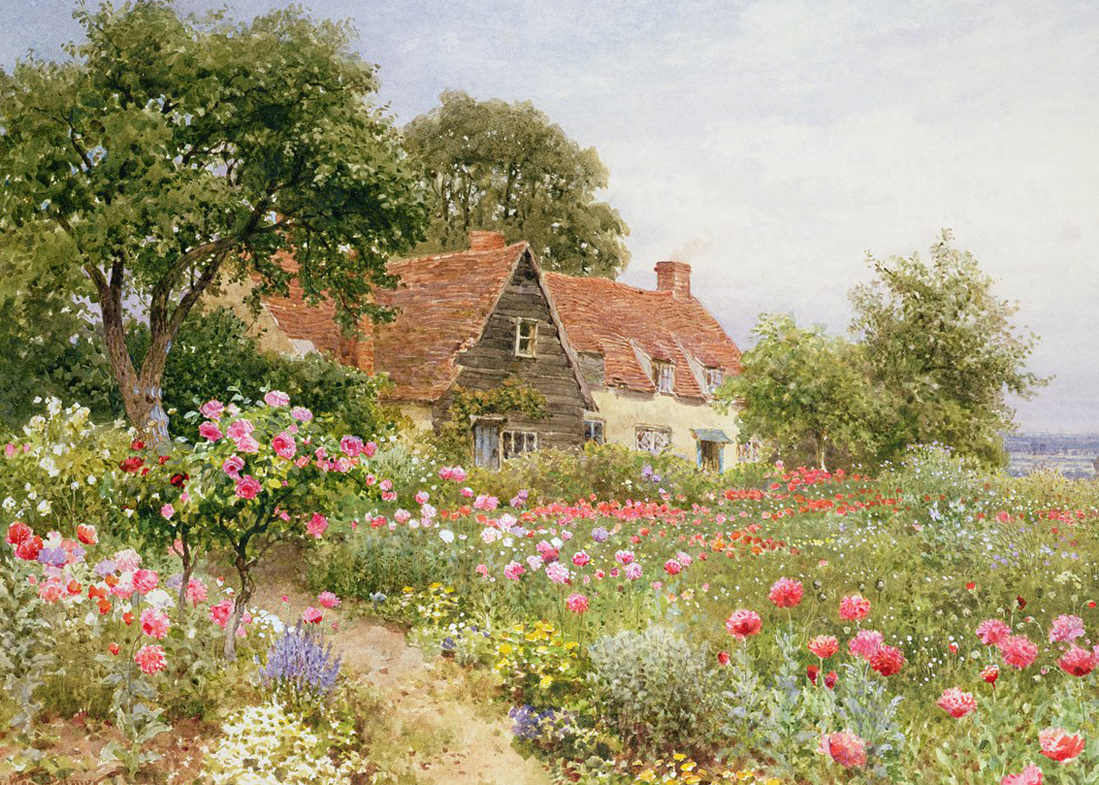
“And where beech trees had mixed a pale green light, With the ground-ivy’s blue, he saw a stage, Whited than curds, its eyes the tint of the sea, Because it stood upon his path and seemed, more hands in height than any stag in the world.”
W. B. Yeats, The Collected Poems of W. B. Yeats, 1934
Cover art by Henry Sutton
Ground Ivy or glechoma hederacea is also called atherlus, cat’s foot, gill go, gilly flowers, hay-maids, turn-hoof or alehoof. It’s called eidhneán talún in Gaeilge and staoin or athair-lus in Scots Gaelic. The name ‘alehoof’ stems from its use as a flavoring in ale and hops. This practice was recorded at minimum in Wales, Cornwall and various other parts of England.1 Ground ivy is one of those plants that when I see it, I have to pick and taste it. The sharp bitter taste sends me sailing immediately back into time. I feel like I’m catching a glimpse of the flavoring of very old and ancient ale as well as plant wisdom. The bitterness reminds me somehow of how tough life was and continues to be at times, to honor that and give myself grace.
Subscribe to get access – $5 a month

Isla Skye
Isla Skye is an American Celtic scholar, a mother of 3, elementary teacher for 21 years as well as an author and herbalist that splits her time between the States and Ireland. She has studied the druids and related practices for over 20 years. She is a published author of children’s books as well as other folkloric literature and is currently working through an M.A. in Celtic Studies. Her hobbies are family time, camping, hiking, reading, writing and research.
Leave a Reply