
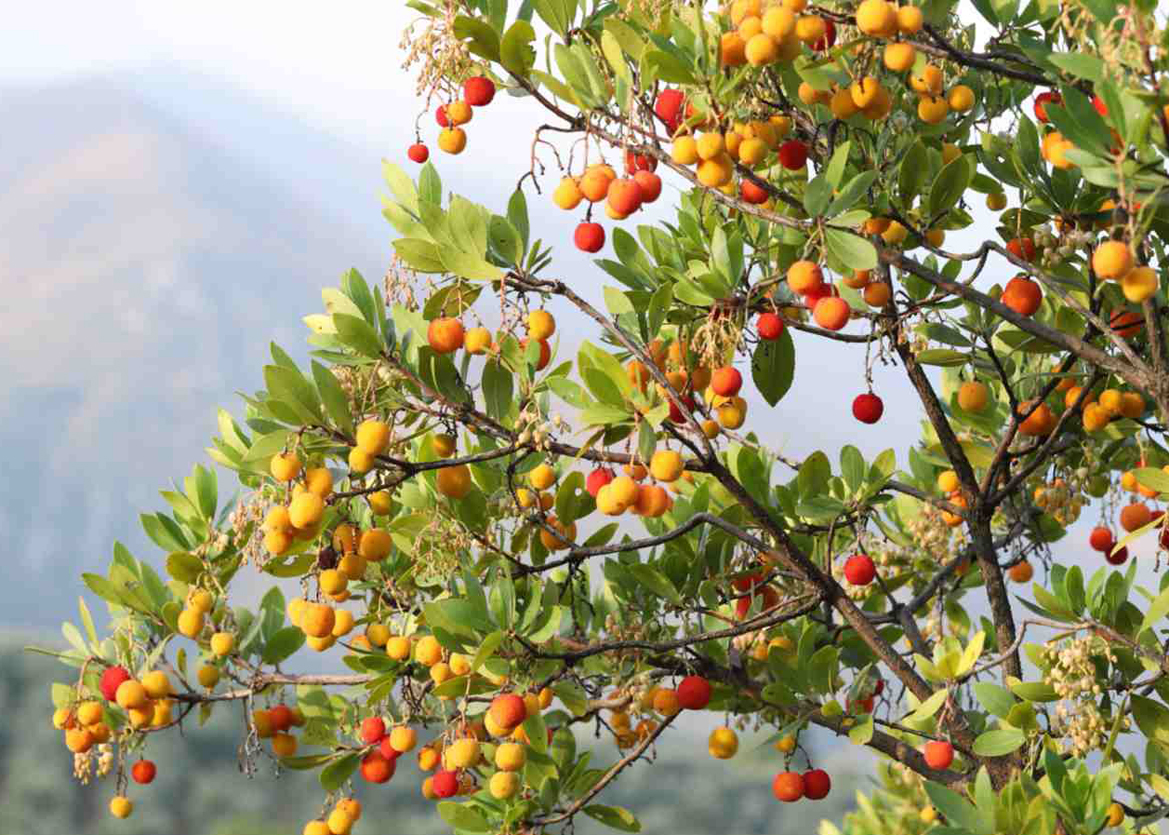
“When eaten in quantities this fruit is said to be narcotic, and the wine made from it in Spain as the same property. The tree is common in the Mediterranean region, and the fruit was known to the ancients, but according to Pliny (who gave the tree the name of Arbutus) was not held in much esteem, as the name implies (un ede = one), the fruits being considered so unpalatable that no one tasting them for the first time would be tempted to repeat the experiment.”
M. Grieve, A Modern Herbal, 1931
The Strawberry Tree or Arbutus unedo is also called cain, cane apple, arbutus, arbute or the ‘Irish or Killarney Strawberry Tree’. It’s called caithne in both Gaeilge and Scots Gaelic. The Latin name unedo means ‘one time shrub’ possibly lending to the idea that you tried the fruit once and never again due to its pungently sweet taste. The common name Strawberry tree is due to the shape and size of the fruit being similar to strawberries. The berries are well loved by local wildlife, particularly birds and come into ripeness during the timely autumn season when food sources are becoming more scarce. The tree also tends to do well in otherwise inhospitable areas and finds a perfect home amongst barren rocky crevices. The small tree with its bright green and red colors, strike beautifully against the brown, yellow or otherwise muted backdrop of neighboring foliage during the autumn and winter seasons.

At one time in Ireland, the Arbutus was a very common evergreen understory tree but was especially prevalent in the western portion of the island. The largest and most prolific of the trees were said to be in County Kerry, where the mild and humid atmosphere provided ideal conditions for growth. It was said that on Dinish and nearby islands were strawberry trees that reached greater heights than anywhere in the country.1 Many historians feel this plant made its way over to Ireland by way of some of the first inhabitants bringing it with them from the Iberian peninsula. Interestingly, there is an obscure reference to the Tuatha Dé Danann bringing the ‘arbutus apples’ with them from the Land of Promise, particularly to the Lakes of Killarney in County Kerry and these fruits were considered to have many secret virtues.2
Dioscorides mentions the tree’s fruit as being bad for the stomach and causing headaches which was later mentioned by John K’ Eogh as well. The fruit is still used in Portugal today in folk recipes for jams, desserts and alcoholic beverages such as medronho or Aguardente de Medronhos, a traditional strong brandy.
The name means ‘fire or burning water’ in Portugese due to the hot sensation as it travels down your throat. This prized beverage is not typically commercially produced but the tradition has been carried on by local farmers. The leaves have been used in folk medicine for their astringent, diuretic, anti-inflammatory and antiseptic properties. The arbutus tree was considered a shrub tree in Brehon law and to destroy one would require a fine of a ‘dairt’ heifer.3

The Strawberry Tree is in the Ericaceae family and native to the Mediterranean but became naturalized in Ireland, Britain, North America and Australia as well as various pockets throughout Europe. The strawberry tree has leaves that are oval, elongated and subtly serrated while the flowers are whitish pink and bell shaped that typically bloom from late fall through early winter. The fruit also ripens in late autumn through early winter and takes nearly a year to ripen, becoming mushy and going ‘bad’ rather quickly which is why it’s often used in jams, jellies or desserts. It may have been associated with Samhain or the Winter Solstice. It’s a perennial and evergreen in zones 4 through 10, grows up to 9 m or 30 ft and does well in part to full sun and rocky soil. The strawberry tree’s energy is cool and drying. The bark, leaves, flowers, roots and fruit are edible and have varying flavors from sweet to bitter. It’s most commonly used as an infusion, decoction, jam or dessert and in alcohol.
Benefits
antibacterial, anti-inflammatory, antioxidant, antiseptic, astringent, diuretic, neuroprotective, vulnerary
Recipe
Irish Strawberry Liqueur
Ingredients: 12 oz. or 1 ½ cup water, 12 oz. or 1 ½ cup sugar, 36 oz. or 4 ½ cups Irish strawberries, 24 oz. or 3 cups of vodka
Instructions: Rinse your berries well and pluck off all the stems and leaves. Make sure to leave out any bruised or mushy ones. Next, combine your water and sugar in a pot. Set your stove to medium heat and warm mixture and stir until the sugar melts. Let it cool and then combine your sugar water, strawberries and vodka into a large jar and cover it with a lid. Store in a dark and cool cupboard or closet. Strain and decant into a bottle after 3 to 4 months.
References
- O’ Mahony, Thaddeus and Richey, Alexander, Brehon Law Tracts Vol. IV, (Hodges, Foster & Co., Dublin, 1879), pg. 147.
- Nall, S.C., Ireland: It’s Scenery, Character and History Vol. 2. (Niccolls, Boston, 1911), pg. 81.
- Rhys, John, Lectures on the Origin and Growth of Religion as Illustrated by Celtic Heathendom, (Williams and Norgate, London & Edinburgh, 1888), pg. 356.

Isla Skye / The Druid's Cauldron Historical Society
Isla Skye is a writer, photographer, herbalist and teacher of 20 years who lives in Mayo, Ireland.
We are a registered non-profit, The Druid’s Cauldron Inc. 501(c)(3) The Druid’s Cauldron is an independent journal established in 2016, dedicated to the preservation and exploration of the druids, filid/poets, culture, native wisdom, and the living traditions of the isles. We exist to recover folklore, herbalism, spiritual philosophy, and ecological knowledge embedded in the whispers of our ancestors.
Through deep research into traditional folklore, herbalism and mythology as well as personal artistic endeavors, we seek to cultivate a deeper relationship with the land, the seasons, and to one another. We are committed to serious inquiry and evidence-based information, or it is alluded that it’s personal philosophy and labeled as such. The Druid’s Cauldron is a space for the curious, the contemplative, and those who feel called to remember older ways of being in right relationship with the land and each other.

Leave a Reply