
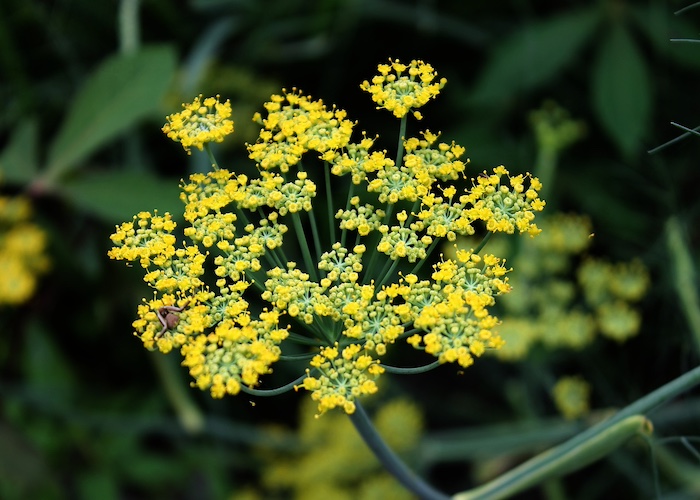
“Above the lower plants, it towers, The Fennel with its yellow flowers; And in an earlier age than ours, Was gifted with the wondrous powers, Lost vision to restore.”
Henry Wadsworth Longfellow, The Goblet of Life, 1842
Fennel or Foeniculum vulgare is also called samar, sweet fennel, wild fennel and sheeh. It’s called finéal in Gaeilge and fineal in Scots Gaelic. The name fennel is derived from the Old French word fenoil, from Latin, faeniculum which means ‘hay’ likely due to the plant smelling like hay. I really enjoy fennel and love all aspects of the plant from the smell to the look and the taste. It’s exceptionally hardy and is somewhat of a sure thing in any garden. Because of its prolific nature, it has become a nuisance in some areas where it is not a native plant such as in North America and Australia. Fennel feels highly nutritious to me when I ingest it similarly to nettle and I really feel that it must have been a staple food people could count on in ancient times.

Indeed, fennel was incredibly valuable and revered by the Greeks, Romans and Gauls alike. Initiates into the cult of Dionysus, the Greek god of wine were instructed to carry a thyrsoi, a fennel wand wrapped in ivy and topped with a pine cone. The initiatory ritual likely involved a lot of dancing, singing and alcohol along with ritualistic steps leading to initiation.1 Greek athletes often used fennel to control their weight and they wore them in wreaths around their necks after victories in the arena or other sports competitions. In Phoenician culture, fennel was ritually planted in honor of the god Adonis. There is also an interesting reference to the benandante, the ‘good witches’ of northern Italy that used bundles of fennel to battle and protect themselves against the opposing harmful witches local to them.2
Dioscorides said of fennel that it was used as an emmenagogue, digestive tonic, kidney tonic, diuretic and used to treat the bites of dogs or snakes as well as eye ailments. The leaves, seeds and roots together were juiced together to create an eye treatment. He said this was extracted in Iberia by laying the stalks down next to a fire so that the plant would get hot enough to secrete a melted fennel substance which was more potent than the juiced leaves themselves. He also mentioned that the Gauls called it sistrameor.
Pliny included fennel in over twenty recipes and claimed that snakes sharpen their sight by rubbing against the plant. Fennel was yet another magical herb that was employed to stave off witchcraft and other evil influences all across Europe. It had a wide cross cultural usage as a digestive tonic and carminative which helped relieve gas. Fennel water is still used to this day to relieve colic in babies successfully and the same was true at least 1,500 years ago throughout Europe. Breastfeeding mothers can also drink infusions of fennel tea to help improve their own and baby’s digestion. Another somewhat cross cultural tradition was to chew on fennel seeds to stave off hunger pains or discomfort during religious fasts.
In Ireland, it was used to treat hiccups3, tuberculosis4, swellings5, fevers6, eye ailments, boils and as a galactagogue and liver tonic. The leaves were said to be pounded with vinegar to create a poultice specifically for external boils, swellings and inflammations7 Tadgh O’Cuinn included fennel in his remedies and medicinal recipes over thirty times. Overall, it seems that it was often added to other mixtures to increase the efficiency of the main herbal ingredient and remedy. In Scotland, there are scant records for its use medicinally but it was most certainly used for cooking and especially salmon or other fish.8 In Cornwall it was also used to treat many of the same ailments as well as asthma.9

In Wales, and in the sacred herbal The Physicians of Myddvai, there are an astounding sixty three references to the usage of fennel in various medicinal remedies. It was said to be an herb of May and treat swellings, pain, dog and snake bites, eye ailments, deafness, bronchitis, pneumonia, derangement or hysteria, jaundice and used as a digestive tonic, galactagogue or diuretic to name just a few. In England, it was used for similar purposes being used to treat hiccups, coughs, poisonous bites or ingestion of poisonous mushrooms, eye ailments, liver ailments and was considered an emmenagogue, blood tonic and diuretic.10 The fennel was also purposefully burned and smoked around cattle to cure them of various diseases.11 Finally, it was used to flavor beer and quite famously, absinthe which was first crafted in Switzerland in the 1700’s.
Fennel is in the Apiaceae family and native to the Mediterranean but has become naturalized throughout Europe, North America and Australia. Fennel has fluffy serrated leaves and hollow stems with yellow colored flowers that typically bloom from mid to late summer and it may have been associated with the Summer Solstice and Lughnasadh. The seeds were also ripening near the end of summer into autumn. It’s a perennial in zones 5 through 10, grows up to 2.5 m or 8 ft and does well in part to full sun with well drained soil along roadsides or pastures. Fennel’s energy is warm and wet. The leaves, flowers and stems are all edible and have a uniquely pungent licorice like flavor. Because of fennel’s strong flavor, it makes a fantastic herb to include in recipes or with other herbs that are not as flavorful or palatable such as valerian. That is, of course, as long as you enjoy the flavor of fennel. It’s most commonly used as a whole food, infusion, tincture or in alcoholic beverages.
Benefits
anthelmintic, antiemetic, antibacterial, anti-inflammatory, antispasmodic, antitussive, blood tonic, carminative, decongestant, digestive tonic, diuretic, emmenagogue, expectorant, eye tonic, galactagogue, heart tonic, kidney tonic, weight alterative
Recipe
Fennel Salad
Ingredients: 4 oz. or ½ cup of chopped fennel, 2 oz. or ¼ cup of dill, 32 oz. or 4 cups of various salad greens, 1 tbsp. of garlic chives, 1 tbsp. of edible flowers of your choice (I like dandelion, self heal, pansies), balsamic or oil dressing of your choice
Instructions: Mix all ingredients except for flowers. Gently sprinkle and mix with the dressing and sprinkle the flowers on top at the end before enjoying.
References
- Lipscomb, Suzannah. A History of Magic, Witchcraft & the Occult. DK London, 2020. Pg. 44.
- Lipp, Frank. Herbalism. Little, Brown, 1996. Pg. 46 – 47.
- Irish Folk Duchas, The Schools’ Collection, Volume 0842, Page 246
- Irish Folk Duchas, The Schools’ Collection, Volume 0387, Page 241
- Anonymous. On Wounds. 1352.
- O’Cuinn, Tadhg. Materia Medica. 1415. Pg. 659.
- K’Eogh, John. An Irish Herbal. 1735. Pg. 64.
- McNeill, Marian. The Scots Kitchen. St. Albans: Mayflower, 1974. Pg. 140.
- Borlase, William. The Natural History of Cornwall. Oxford, Pg. 232.
- Culpeper, Nicolas. Culpeper’s Complete Herbal. Pg. 135.
- Van Arsdall, Anne, Medieval Herbal Remedies, The Old English Herbarium and Anglo-Saxon Medicine, New York, 2002 (5th century original text)

Isla Skye / The Druid's Cauldron Historical Society
Isla Skye is a writer, photographer, herbalist and teacher of 20 years who lives in Mayo, Ireland.
We are a registered non-profit, The Druid’s Cauldron Inc. 501(c)(3) The Druid’s Cauldron is an independent journal established in 2016, dedicated to the preservation and exploration of the druids, filid/poets, culture, native wisdom, and the living traditions of the isles. We exist to recover folklore, herbalism, spiritual philosophy, and ecological knowledge embedded in the whispers of our ancestors.
Through deep research into traditional folklore, herbalism and mythology as well as personal artistic endeavors, we seek to cultivate a deeper relationship with the land, the seasons, and to one another. We are committed to serious inquiry and evidence-based information, or it is alluded that it’s personal philosophy and labeled as such. The Druid’s Cauldron is a space for the curious, the contemplative, and those who feel called to remember older ways of being in right relationship with the land and each other.
Leave a Reply