
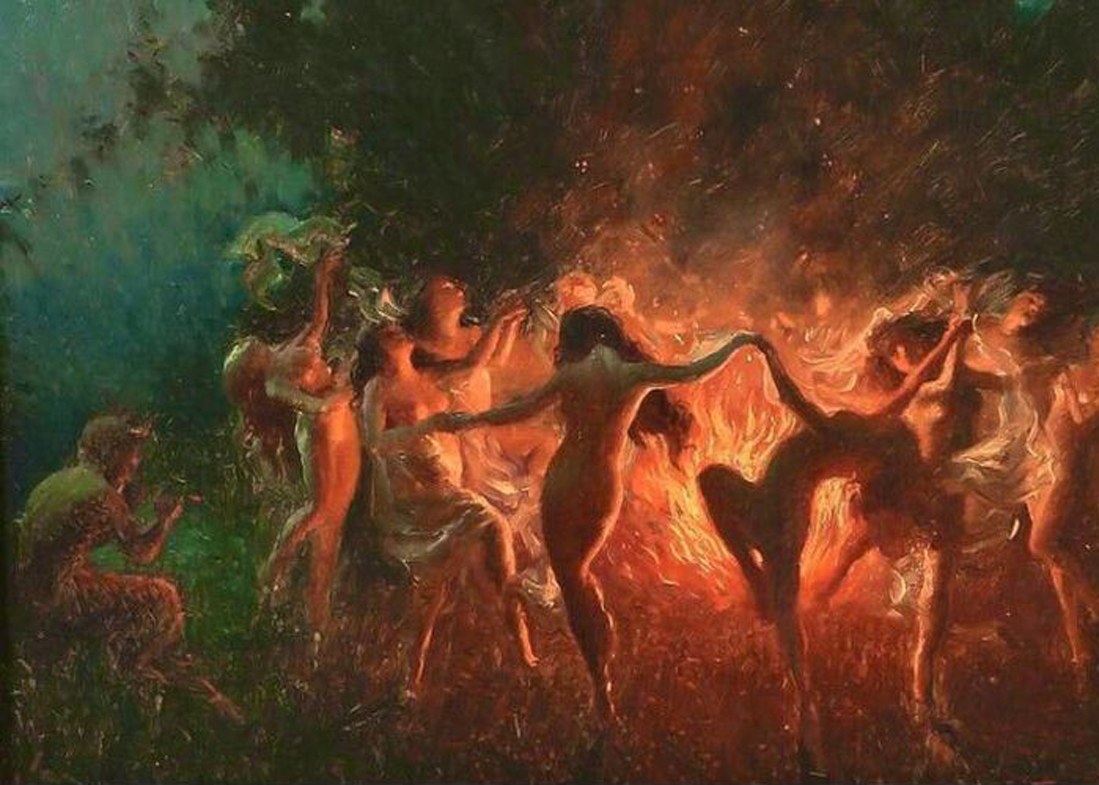
“They fed the fire from great bundles of sacred wood brought to the knoll on Beltane Eve. When the sacred fire became kindled, the people rushed him and brought their herds and drove them through and round the fire of purification.”
Alexander Carmichael, Carmina Gadelica, 1900
Cover art by Joseph Tomanek
April 30th – May 1st (astronomical date varies)
The word Bealtaine (Irish) and Bealtainn or Beltane (both Scottish) is pronounced bay-ul-tin-uh in Gaeilge and similarly in Scots Gaelic. The name means “bright fire”. It was sometimes referenced in Irish sources as ‘Cétshamhain,’ ‘first of summer’ of which there are Scots Gaelic and Welsh equivalents. Bealtaine or May Eve. marks the beginning of summer and the lighter half of the year. Cattle were driven out to pastures and rituals were performed to protect cattle, crops, people and to encourage continued health.

Bonfires were especially important at this time as a very literal representation of the energy this festival signified. The towns people would likely have ritually extinguished their fires at home and rekindled them later with an ember from the central need fire. Many people would try to leap or walk over the bonfire or bonfire embers after it died out on May Eve. night as it was deemed to have protective powers and be a sign of luck to make it across without getting burned. There are overall very similar traditions surrounding the month of May throughout Europe.
As people were working with or around their sacred fires, they may have chanted a phrase or song like the recorded “No fire, no sun, no moon, shall burn me,” from the Carmina Gadelica. According to the medieval Irish texts Sanas Cormaic and Tochmarc Emire, “…to protect cattle from disease, the druids would make two fires with great incantations and drive the cattle between them”. This practice has been documented all the way up into the early 1900s in Ireland. This was considered another very liminal and thin time where the Aos Sídhe and witches were more frequently roaming about. Dairy products were incredibly vulnerable to being tampered with. Many folk customs relate to protecting milk and cattle at this time. It was customary to not go out of the house on May 1st or give anything away, lest you risk negative influences from the fairies and witches roaming, very similarly to Samhain.

During Bealtaine… “It was customary for the Lord of the place, or his son, or some other person of distinction, to take the entrails of the sacrificed animal in his hands, and walking barefoot over the coals thrice, after the flames had ceased, to carry them straight to the Druid, who waited in a whole skin at the altar. If the nobleman escaped harmless, it was reckoned a good omen, welcomed with loud acclamations: but if he received any hurt, it was deemed unlucky both to the community and to himself. Thus I have seen the people running and leaping thro’ the St. John’s fires in Ireland, and not only proud of passing un-singed: but as if it were some kind of lustration, thinking themselves in a special manner blest by this ceremony, of whose original nevertheless they were wholly ignorant in their imperfect imitation of it.” – John Toland (1670-1722), A Critical History of the Celtic Religion and Learning
Doors, windows, byres and sometimes cattle themselves would be decorated with yellow or orange flowers. “May bushes” on May Eve. were made by covering a bush with flowers, ribbons and other household decor. In particular, the most common flowers used for this were marigold varieties, primroses and yellow iris. It was a time for mating of animals as observed in nature and for sexual activity. Marriage was considered unlucky at this time. It was instead a time of youth, sexual initiation and freedom rather than marriage which wouldn’t occur from a seasonal perspective until Lughnasadh. It was common tradition for young couples to go “a maying” and make love in the forests or fields.

In Ireland, the morning May Eve. dew was also thought to be protective, bestow beauty or protect you from sunburn the rest of the year. A Saxon tradition of dancing around the May pole, a phallic symbol of fertility may have been used in rituals in Britain near this festival, although there is no evidence this was an ancient Celtic, Irish or Scottish practice. The tradition of the may pole however did eventually reach Ireland and Scotland, although infrequent. The dance was carried on through the various generations of the islands and brought to America with colonists, still being used in many spring celebrations today. The dance around the maypole was a common elementary school tradition well into the 90’s in America and has been reinvigorated in recent years.
The tradition of driving cattle between two fires for luck was also very prominent in Scotland (as well as the Isle of Man) and Alexander Carmichael relayed much to us…
An old Scottish rhyme preserves this idea of using “sacred wood” to build the Beltane bonfires that were considered more sacred than usual.
“Choose the willow of the streams, Choose the hazel of the rocks, Choose the alder of the marshes, Choose the birch of the waterfalls, Choose the ash of the shade, Choose the yew of resilience, Choose the elm of the brae, Choose the oak of the sun.”
Another Scottish hebrides tradition was called “the day of migrating”, which occurred on May 1st all the way up through the early 19th century. People traveled together from all over the countryside from their winter homestead to their summer sheiling…

“The summer of their joy is come, the summer of the sheiling, the song, the pipe, and the dance, when the people ascend the hill to the custard bothies, overlooking the distant sea from among the fronded ferns and fragrant heather, where neighbor meets neighbor, and lover meets lover. All the families of the downland bring their different flocks together at a particular place and drive the whole away. This miscellaneous herd is called ‘trials’ procession and is composed of horses, cattle, sheep and goats. When the people meet they greet each other with great cordiality, as fi they had not seen one another for months or even years, instead of probably only a few days before. There are endless noises in the herd. The men give directions; the women knit their stockings and sing their songs. Ranged along on either side of the procession are bareheaded comely girls, and sturdy boys, and sagacious dogs, who every now and then, and every here and there hack a neck-and-neck race.”
Another Scottish Beltane Blessing…
“Ah Mary! Sonnie, it were worse for me to do that for thee, Than to pass between the two great fires of Beall. Bless, O Threefold true and bountiful, Myself, my spouse and my children, My tender children and their beloved mother at their head. On the fragrant plain, on the gay mountain shelling, On the fragrant plain, on the gay mountain shelling. Everything within my dwelling or in my possession, All kine and crops, all flocks and corn, from Hallow Eve to Bealtane Eve, With goodly progress and gentle blessing. From sea to sea, and every river mouth. From wave to wave, and base of waterfall. Be the Three persons taking possession of all to me belonging, Be the sure trinity protecting me in truth.”
Alexander Carmichael, (1860 – 1909) Carmina Gadelica

This festival may have been associated with the ancient Gaulish and continental God Belenus or Bel who’s name meant the ‘shining one’. He was often compared to the Roman Apollo. He was one of the most ancient and widely worshiped ‘Celtic’ deities. There are 31 known ancient inscriptions dedicated to Belenus and a 4th century Roman text described him as being worshipped by druids at a sacred well in modern day western France. Additionally, he was associated with the healing plant Belenuntia or beleno, a hallucinogenic henbane which was named after him and this all gives speculation of his representation of healing and health.1
“If report does not lie, you [Patera] were sprung from the stock of the Druids of Bayeux, and traced your hallowed line from the temple of Belenus; and hence the names borne by your family: you are called Patera; so the mystic votaries call the servants of Apollo. Your father and your brother were named after Phoebus, and your own son after Delphi [Delphidius]. In that age there was none who had such knowledge as you, such swift and rolling eloquence.”
Ausonius (Roman poet, 310 – 295),
Commemoratio Professorum Burdigalensium
There are a number of places in Ireland containing a corruption or cognate of the word Bealtaine or include his name (possibly), indicating these were places festival activities may have been held such as the Beltany Stone Circle in Ireland. In the tale , The Wooing of Emer by Cú Chulainn, “To Beldine, i.e. Beltine, viz., a favouring fire. For the druids used to make two fires with great incantations, and to drive the cattle between them against the plagues, every year. Or to Beldin, viz., Bel the name of an idol. At that time the young of every neat were placed in the possession of Bel. Beldine, then Beltine.” (2) ‘Beltine’ is mentioned in passing in The Táin as simply occurring as a celebration and marking the beginning of summer with feasting and various traditions. The Tuatha Dé Danann were said themselves to land in Ireland on Bealtaine and the Partholón (first settlers in Ireland) nearly all died from a plague during the week of Bealtaine celebrations as well.

There are countless references to Bealtaine practices and superstitions in the Irish Folk Duchas, especially pertaining to the keeping of milk and ensuring luck the whole year through. Many sacred pagan hills in Britain that are associated with Bel and face the rising sun at Bealtaine were dedicated to saints later by the Christian Church such as Mt. Michael’s Mount, Brent Tor, Burrow Mump and Glastonbury Tor. In Wales, he may have been a cognate related to the character Beli Mawr. Belenus is quite famously the patron deity of the Italian city of Aquileia. Many rulers may have had names related to him such as one of the last great rulers of Britain before coming under the Roman yoke, Cunobelinos, who’s name meant ‘hound of the god Belenos’.
“The ancient author Apollonius relates a Celtic story of a stream formed by the tears of Apollo Belenus when he was forced from heaven by his father; as Apollo was the Greek sun divinity, this textual evidence strengthens the argument that Belenus had solar connections… Such deities were often associated with healing springs on the theory that the sun, leaving our sight at night, traveled under the world, heating the waters of thermal springs as it went.”
Patricia Monaghan, Celtic Mythology and Folklore
Fertility and pastoralism being a central theme of Bealtaine, there are many stories in folklore that re-enact this symbolism of overcoming the hostile aspects of nature to attain the desired pairing and being able to fertilize the land/woman/Goddess. Many May day festivities are celebrated today by various secular and religious groups throughout the world. The essence of Bealtaine is to feel healed, vibrant and passionately connect with life in the most primal of ways. I don’t think it’s coincidence that after a long winter, the sun, the energy coming off the land, the new growth is incredibly healing to witness and partake in, particularly by planting seeds and fertilizing them. When we connect into the energy exchange occurring between the sun’s increasing power and the land’s fertility and vivacity, it is potent natural medicine.

“It appears to me that the principal Celtic deity was the sun, Belenus (speculative)… The Caledonians worshipped this deity under the name of Baal (speculative), or Beil, and to his honor they lighted fires on Midsummer-day, or the 1st of May. This festival, which is not even yet discontinued, was called Baal-tein, or beltain, signifying the fire of Baal, and was formerly commemorated so generally that it became a term in Scots’ law, which is yet in use. This practice of lighting fires on Midsummer, arose from the circumstance of the Druids having at that time caused all fires to be extinguished, to be rekindled from the sacred fire that was never allowed to expire. It is surprising that this sacred flame, like that in the temple of Vesta, should be preserved for ages after the extinction of the religion, by Christian priests. It was no earlier than 1220, that Loundres, Archbishiop of Dublin, extinguished the perpetual fire, which was kept in a small cell near the church of Kildare; but so firmly rooted was the veneration for this fire, that it was relighted in a few years, and actually kept burning until the suppression of monasteries. This fire was attended by virgins, often women of quality, called ‘Inghean an Dagda, ‘daughters of fire’ and Breochuidh, or the ‘fire-keepers’, from which they have been confounded with the nuns of St. Brigid.”
J. Logan, The Scotish Gael, 1850 (controversial source given the time period, but just posting for curiosity sake)
Many events have been born in the spirit of this ancient festival such as Edinburgh’s Beltane Fire Festival which started in 1988 and the Bealtaine Fire Festival at Uisneach …
References
- Koch, John. Celtic Culture: A Historical Encyclopedia. ABC CLIO, 2006. pg. 195.
- https://celt.ucc.ie/published/T301021/text056.html

Isla Skye / The Druid's Cauldron Historical Society
Isla Skye is a writer, photographer, herbalist and teacher of 20 years who lives in Mayo, Ireland.
We are a registered non-profit, The Druid’s Cauldron Inc. 501(c)(3) The Druid’s Cauldron is an independent journal established in 2016, dedicated to the preservation and exploration of the druids, filid/poets, culture, native wisdom, and the living traditions of the isles. We exist to recover folklore, herbalism, spiritual philosophy, and ecological knowledge embedded in the whispers of our ancestors.
Through deep research into traditional folklore, herbalism and mythology as well as personal artistic endeavors, we seek to cultivate a deeper relationship with the land, the seasons, and to one another. We are committed to serious inquiry and evidence-based information, or it is alluded that it’s personal philosophy and labeled as such. The Druid’s Cauldron is a space for the curious, the contemplative, and those who feel called to remember older ways of being in right relationship with the land and each other.
Leave a Reply