
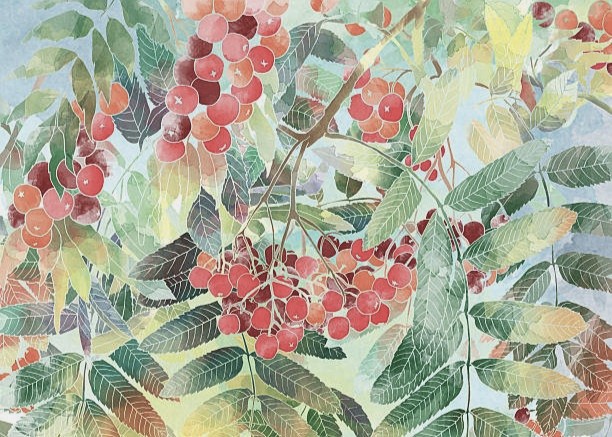
“(Luis) Delightful to the eye is rowan, i.e. rowan, owing to the beauty of its berries”
Anonymous, Bríatharogam, Book of Ballymote
Cover art is artist unknown, public domain.
Rowan, or Sorbus aucuparia, is also called Mountain Ash, Lady of the Mountain, Quicken Tree, Quickbeam or Witchwood. It’s called caorthann in Gaeilge and caorann in Scots Gaelic, and its Ogham letter, Luis, gives its name to the second consonant of the old tree-alphabet. The medieval Bríatharogam, the kenning-glosses on the Ogham letters preserved in the fourteenth-century Book of Ballymote, describes Luis simply and beautifully, “delightful to the eye is luis, i.e. rowan, owing to the beauty of its berries.”¹ Rowan is a small, hardy tree of the rose family, no relation at all to the true ash despite the common name, and it will happily take root higher up a mountainside than almost any other tree in these islands, gnarled and wind-bent where nothing else will grow. It rarely lives much past two centuries, modest beside the other trees, but what it lacks in longevity it makes up for in the sheer density of the stories and symbology wound around it. Rowan has never struck me as a tree of quiet dignity so much as a tree of vigilance, always seeming to stand sentinel at a gate, a threshold, a churn, a cradle, as though it had been posted there on purpose…
The tree’s protective reputation runs the length of these islands. Frazer recorded that rowan, along with woodbine, was hung over the doors of cowhouses at Beltane, when witches were believed to be abroad casting spells on cattle and stealing the milk, the custom reinforced by fires kindled by every farmer and cotter on the eve.² In the Highlands, John Gregorson Campbell set down the belief in exhaustive, almost bureaucratic detail: the peg of the cow-shackle, and the handle and cross of the churn-staff, were properly made of rowan, and in Islay a man was remembered keeping “a rowan-tree collar for securing his cow at night,” passing it three times through the chimney crook whenever the animal had been to the bull.³ Campbell also recorded a stranger tale from Mull, in which a farmer’s small daughter boasted she could sink every ship passing through the Sound by looking back at them between her legs, and did, save for the one vessel that carried rowan-tree timber aboard, “because there was rowan-tree wood on board, and she could not touch it.”³ Frazer, separately, described a lighter, more festive relic of the same instinct still surviving into his own day: a hoop wreathed with rowan and marsh marigold, hung with two gilded balls representing the sun and moon, carried through the townlands of Ireland on May Day.⁴

The tree’s uses at the churn were recorded with the same seriousness by the schoolchildren who gathered folklore for the Irish Folklore Commission in the 1930s. One contributor from Killeen, near Granard, described how on May morning a ring of red berries was placed on the handle of the churn dash “to prevent anyone from taking their butter.”⁵ Even the tree’s own fruit had passed into proverb by the time the same Schools’ Collection was compiled: a saying recorded at Taplach runs “an crann caorthann bíonn sé searbh ar a bharr” the sourest berries are on top of the rowan tree.⁶ In Scotland, Alexander Carmichael, gathering the material that became the Carmina Gadelica, described crofters engaged in exactly this kind of quiet household work of an evening: “a neighbour crofter is twining quicken roots into cords to tie cows,” alongside the twisting of heather ropes and the plaiting of bent-grass baskets that filled the same firelit hours.⁷
Rowan moves through the old Irish tales with the same watchfulness it kept at the byre door. In the Táin Bó Fraích, one of the remscéla, or fore-tales, attached to the great Cattle Raid, the hero Fráech swims a pool to fetch berries from a rowan growing on an island within it, so that Findabair, daughter of Ailill and Medb, might have them; a serpent seizes him in the water as he does, and he must be rescued at sword’s point.⁸ The tree gives its name outright to one of the great Fenian tales, Bruidhean Chaorthainn the Hostel, or Fairy Palace, of the Quicken Trees in which Fionn mac Cumhaill and a company of his best warriors are lured to a feast at a hostel built among rowans by Míodhach, son of the defeated King Colgán of Lochlann, and are pinned fast to their seats by enchantment until Diarmuid and his companions can fight free the three kings’ blood needed to break the spell.⁹ The tale was old enough, and well-known enough, that Geoffrey Keating, writing his history of Ireland around 1634, cited it as a byword for the kind of “unhistorical” Fenian romance already circulating in his own day.¹⁰ Its hold on the popular memory outlived the manuscripts themselves: the Schools’ Collection preserves both a townland actually named Droim Caorthainn, the Ridge of the Rowan, and a hill called Caorthann Mór among the recorded place-names of another district, small proof that the tree had marked out real ground as well as legendary ground.¹¹
The Irish Druids, MacCulloch wrote, “attributed special virtues to the hazel, rowan, and yew,” and fires of rowan were said to have been lit by the druids of opposing armies, with incantations spoken over them, in an effort to discomfit the enemy host before battle.¹² It is a small, striking image, two hosts, each with its own rowan fire and its own charm, each trying to out-word the other and it sits comfortably alongside every quieter, more domestic use the tree was put to afterward: a wood trusted first at the edge of a battlefield, and later at the edge of a butter-churn, doing more or less the same work in both places.

Botanically, rowan belongs to the Rosaceae, kin to the apple, hawthorn, blackthorn and true rose, and the resemblance is easy to see in the small white corymbs of blossom that cover it in May and the bright pomes, often loosely called berries, that follow in autumn. Those fruits are a determined food source for thrushes and other birds, which distribute the seed onward, and a heavy crop was long read locally as a sign of a hard winter to come. The berries are bitter and mildly astringent raw, but cooking or freezing them softens both the flavour and the fruit acids, and once treated they are rich in vitamin C. Rowan wood, being dense and resilient, was long favoured for tool handles, spindles and walking sticks, and the tree was carried aboard ships, much as pine was, for the same hoped-for protection against storms.
Benefits
anti-inflammatory, antiscorbutic, antioxidant, astringent, diuretic, expectorant, kidney tonic, laxative, vulnerary
Recipe
Rowan Berry Jelly
Ingredients: 2 lb. rowan berries, stripped from their stalks and rinsed; 1 lb. tart cooking apples, roughly chopped (skins, cores and all); water to cover; granulated sugar (approximately 1 lb. per pint of strained juice); juice of half a lemon

Instructions: Place the rowan berries and chopped apples in a large pot and add just enough water to cover the fruit. Bring to a boil, then reduce to a simmer and cook for about 45 minutes, mashing occasionally, until the fruit is soft and pulped. Pour the mixture into a jelly bag or a sieve lined with muslin set over a bowl, and let it strain undisturbed overnight. Do not press or squeeze the bag, or the jelly will turn cloudy. The next day, measure the strained juice and return it to a clean pot with the sugar and lemon juice in the proportion above. Bring to a rolling boil and cook, skimming any foam from the surface, until the mixture reaches setting point Test by chilling a small spoonful on a cold plate. It should wrinkle when pushed. Pour into sterilized jars while hot and seal. Traditionally served alongside with dinner, but very good with cheese or on warm bread as well as a snack.
Footnotes
- The Bríatharogam, glosses on the Ogham alphabet preserved in the Book of Ballymote (Royal Irish Academy MS 23 P 12, 14th c.), s.v. Luis; edited and translated in Calder, George (ed. and tr.), Auraicept na n-Éces: The Scholars’ Primer, John Grant, Edinburgh, 1917.
- Frazer, James George, The Golden Bough: A Study in Religion and Magic, abridged ed., Macmillan, London, 1922; Dover Publications reprint, Mineola, 2002, pg. 620, 702.
- Campbell, John Gregorson, Witchcraft and Second Sight in the Highlands and Islands of Scotland, MacLehose, Glasgow, 1902 (posthumous), pp. on cattle-charms and the Mull tale of the farmer’s daughter.
- Frazer, James George, The Golden Bough, abridged ed., Macmillan, London, 1922, chapter “Relics of Tree Worship in Modern Europe.”
- Irish Folk Dúchas, The Schools’ Collection, “The Taking of Butter,” Killeen, Granard, Co. Longford, https://www.duchas.ie/en/cbes/5009191/4996557/5105671.
- Irish Folk Dúchas, The Schools’ Collection, “Seanfhocail,” Taplach, https://www.duchas.ie/en/cbes/4758587/4756942/4936570.
- Carmichael, Alexander, Carmina Gadelica: Hymns and Incantations, Vol. 1, “Introduction,” T. & A. Constable, Edinburgh, 1900.
- “Táin Bó Fraích,” in Leahy, A. H. (tr.), Heroic Romances of Ireland, Vol. II, David Nutt, London, 1906; see also Byrne, Mary E. and Dillon, Myles (eds.), Táin Bó Fraích, Mediaeval and Modern Irish Series, Vol. V, Dublin Institute for Advanced Studies, Dublin, 1933.
- Joyce, P. W. (tr.), “The Fairy Palace of the Quicken Trees,” in Old Celtic Romances, C. Kegan Paul & Co., London, 1879, pp. 177–222; see also Mac Piarais, Pádraic (ed.), Bruidhean Chaorthainn: Scéal Fiannaidheachta, Connradh na Gaedhilge, Baile Átha Cliath, 1908.
- Keating, Geoffrey (Seathrún Céitinn), Foras Feasa ar Éirinn, ed. and tr. David Comyn and Patrick S. Dinneen, Irish Texts Society, London, Vol. II, 1908, pp. 326–327 (text composed c. 1634).
- Irish Folk Dúchas, The Schools’ Collection, “Droim Caorthainn,” https://www.duchas.ie/en/cbes/4605935; and “Áitainmneacha,” https://www.duchas.ie/en/cbes/4591080/4588597/4593238.
- MacCulloch, J. A., The Religion of the Ancient Celts, T. & T. Clark, Edinburgh, 1911, Chapter XIII, “Tree and Plant Worship.”

Isla Skye / The Druid's Cauldron Historical Society
Isla Skye is a writer, photographer, herbalist and teacher of 20 years who lives in Mayo, Ireland.
We are a registered non-profit, The Druid’s Cauldron Inc. 501(c)(3) The Druid’s Cauldron is an independent journal established in 2016, dedicated to the preservation and exploration of the druids, filid/poets, culture, native wisdom, and the living traditions of the isles. We exist to recover folklore, herbalism, spiritual philosophy, and ecological knowledge embedded in the whispers of our ancestors.
Through deep research into traditional folklore, herbalism and mythology as well as personal artistic endeavors, we seek to cultivate a deeper relationship with the land, the seasons, and to one another. We are committed to serious inquiry and evidence-based information, or it is alluded that it’s personal philosophy and labeled as such. The Druid’s Cauldron is a space for the curious, the contemplative, and those who feel called to remember older ways of being in right relationship with the land and each other.
Leave a Reply