
“At all events, research of this type needs to be carried out with more sophistication and less wishful thinking than have commonly been brought to bear upon it hitherto. Even so, the results will often be far from certain, and should not be allowed to detract from study of the actually attested construct in its own terms. Far from being mere clumsy and unimaginative redactors of oral traditions, early Christian Ireland’s monastic moulders and transmitters of senchus combined literary creativity with intellectual rigour to such an extent in their pursuit of a coherent ‘native Christian’ mytho-history of their island and race that they have had little difficulty in duping many a modern scholar inclined to patronise their efforts. Instead of cocking a snook, we should take our hats off to them.”
Kim McCone, Pagan past and Christian present in early Irish literature, 1990
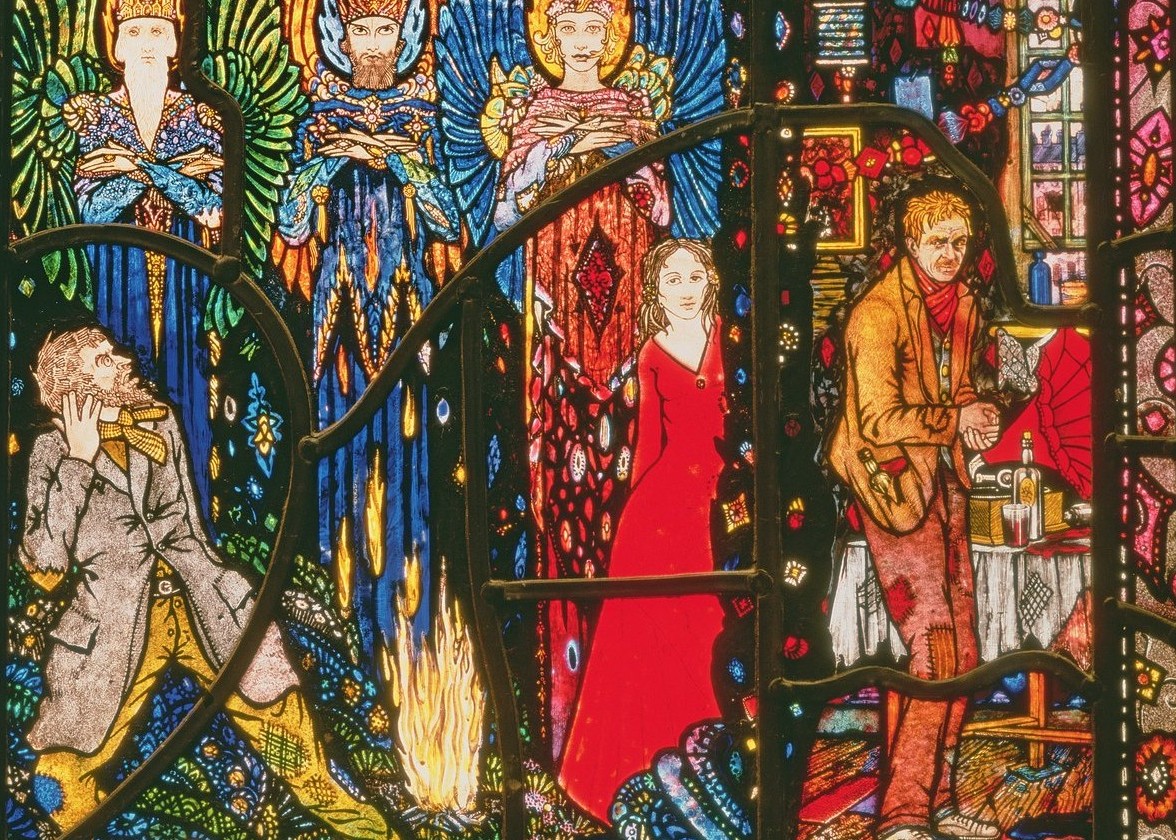
Cover art and all art by Harry Clarke

If you find the article too lengthy and rather just read the cliff notes, here are my main points I discuss breaking apart McCone’s and other scholar’s argument on the druids in Ireland being either literary fabrications or simply, too unknown through the Christianized role of the Filid to be taken seriously. It’s also a collective rebuttal to the overall anti-nativist approach that has often taken ahold of academia related to Irish manuscript studies.
- This is somewhat of a straw man argument from the start because most academic writers available to us, even old nationalists, usually established somewhere in the forward that the stories in the manuscript tradition are hypothetically possible, possibly probable but still not provable. It would be illogical to assume that just based on the fanciful and magical nature of so much of the content. There has always been a sense of “This is just what we have to go off of.” and we’re going to make the best of it and make careful analysis and not sweeping conclusions. McCone established somewhat of a harsher stance to give himself something to combat that not many serious academics to my knowledge actively ever took. We can all see that some of the texts, especially the Lebor Gabála Érenn, Taking of Ireland are heavily Christianized but also, these are only some of the texts, and not all of them. Just as many entries or stories don’t have any Christian mention at all or an entire story was recorded and the singular Christian element comes at the very end, simply stating, ‘Finit, amen.’
- Christianity itself was built off prior pre-Christian myth. Stories were often altered but content, characters and theme typically stayed very similar. Christians actively adopted what they liked and got rid of what they didn’t in their writing and practices. Example: Miracle unique births were very common in pre-Christian birth myths. Jesus’s birth is of course also a miracle birth as well as many saints (Brigid etc). This literary tool served as a type of foreshadowing that the child would go on to do wonderful things. Point being, when certain things show up in the Irish manuscript’s mythical stories that are also in the Bible, that shouldn’t academically (as McCone often does), automatically mean, “It’s just Christian.”
We can go example after example where a practice was happening in moderate part across Europe earlier than the Bible was written. This is also attested in church letters such as here… in Augustine’s Second Question to the Pope when he asks what he should do when he comes across different practices in different churches and Pope Gregory’s answer is to allow it so that it was easier to become accustomed to… “Choose, therefore, from every Church those things that are pious, religious, and right, and when you have, as it were, made them up into one bundle, let the minds of the English be accustomed thereto.” - This is a big one for me… There is no other pattern of Christians fabricating entire mythologies elsewhere. Christians never created original stories or myths about nearby cultures and for example, the Norse. They supplanted and edited, usually, purposefully, to encourage the ease of conversion. This is moderately proven in letters between the Pope and clergy throughout the isles discussing the methods of their own evangelism. They fully admit they couldn’t truly change Natives and came up with other options here …
Pope Gregory the Great (590-604) wrote this letter to the Abbot Mellitus, who was about to join St. Augustine of Canterbury on the mission to England in 597 AD. “Tell Augustine that he should be no means destroy the temples of the gods but rather the idols within those temples. Let him, after he has purified them with holy water, place altars and relics of the saints in them. For, if those temples are well built, they should be converted from the worship of demons to the service of the true God. Thus, seeing that their places of worship are not destroyed, the people will banish error from their hearts and come to places familiar and dear to them in acknowledgement and worship of the true God. Further, since it has been their custom to slaughter oxen in sacrifice, they should receive some solemnity in exchange. Let them therefore, on the day of the dedication of their churches, or on the feast of the martyrs whose relics are preserved in them, build themselves huts around their one-time temples and celebrate the occasion with religious feasting. They will sacrifice and eat the animals not any more as an offering to the devil, but for the glory of God to whom, as the giver of all things, they will give thanks for having been satiated. Thus, if they are not deprived of all exterior joys, they will more easily taste the interior ones. For surely it is impossible to efface all at once everything from their strong minds, just as, when one wishes to reach the top of a mountain, he must climb by stages and step by step, not by leaps and bounds. Mention this to our brother the bishop, that he may dispose of the matter as he sees fit according to the conditions of time and place.”
Also, here in Martin of Braga: De correctione rusticorum: The Epistle of Saint Martin Bishop to Polemius Bishop on the Correction of the Rustics... “But since it is fitting, from the beginning of the world, to proffer to them even a modest knowledge of reason, as by way of a taste, it has been necessary for me to touch the vast forest of past times and deeds with the abridged speech of a slight compendium, and to season food for rustics with rustic speech.”
In one incident in Bede’s Ecclesiastical History of England an Irish (Called Scots) Bishop is specifically mentioned and, not only are Irish churches criticized for being unique in their practices (They wanted to celebrate Easter based on the moon cycles.) but the Bishop Dagan purposefully does not sit with the visiting Romans because likely either A. he is following his own cultural customs and it is improper or B. he dislikes the Romans that strongly, he doesn’t wish to sit with them, and this is despite being involved within the same religious paradigm. He is actually quoted as not even wanting to be in the same house… In either scenario the result is the same, the Irish Bishop was more loyal to his own thought and way of doing things than Roman Catholic custom. - The Catholic Church needed specific and given permission by the kings and chieftains to build a church on their land. In other words, the Catholic Church absolutely had to play nice with Natives, in political as well as cultural terms mentioned above. Muirchú’s Vita Patricii confirms this in St. Patrick’s arrangement with King Lóegaire. It’s the same pattern In the Life of Brigit by Cogitosus where Brigit receives land at Kildare from the King of Leinster. In the Life of Ciarán, Ciarán receives the land at Clonmacnoise from the King of Connacht. In the Life of Colum Cille, the land on Iona is granted by the King of Dál Riata. These monasteries served as cultural hubs, schools and for agricultural purposes so they functioned differently in Ireland from the start where Native belief and art were incorporated and valued and not shunned. These were also still mostly Irish people at the end of the day.
- McCone saw the druids as literary fabrications to an extent. There is no logically good academia that can truly disprove or deny Ireland or Scotland had Druids or that it wasn’t the Filí that directly replaced them. There is far more evidence for this cultural role continuing merely under a different Native name. Countless mention in texts and oral tradition. Countless records, the Annals and beyond. Ogham stones with the name Druids on them. Multiple named Druid ancestors in the Book of Leinster spanning millennia. Archaeological proof of ritualized community events which would logically need a priestly class to oversee. Countless bog bodies, similar to identical jewelry and archaeological findings suggesting a strong cultural continuum. There is one ogham stone with a possible mention of druid (Mcmanus) and druids were mentioned in Brehon Law (Binchy) where their ‘sacred’ character is mentioned as not being able to be increased.
The fact that some academics that are highly well-known writers and scholars deny their existence or what can be known about them in Ireland is disappointing. It feels like an argument just to make an argument which isn’t pointless… but not fruitful either and arguably harmful to the point of encouraging cultural erasure. Why would the Christian monks in Ireland bother to create the role of Filid at all if they weren’t already embedded within Irish culture? The ecclesiastics were essentially the role the Christian church offered to replace them. There was no logical motivation to create an entire new priestly class specific to Ireland if it wasn’t already there. What logical argument can rest upon the idea that Christian monks created multiple other cultural roles and poets to compete with their own influence? - McCone’s main argument for his anti-Nativist approach that the texts started more Christian and got more ‘pagan’ over time doesn’t actually prove anything. That could be evidence for either spectrum because if we use the metaphor that pre-Christian belief is a stain, you’re going to scrub the hardest first and then ease up on the next one because the hard work was done. In other words, future versions of the same stories became more pagan over time and this somehow proved to him (and many scholars) it was never pagan to begin with when it could equally be said it was proof of what McCone was trying to disprove… there was something there to begin with that required scrubbing.
- Another of McCone’s main arguments is that characters in Irish mythology mimic characters in the bible and the connections (to me) are still somewhat distant. As one small example, Cú Chulainn’s story is compared to Samson from the Book of Judges. Both heroes have extraordinary strength, abilities connected to their hair, (Samson’s hair is not explicitly magical though) have a woman as their fatal weakness and both are fighting marauders. In Samson’s case, these are known as the Philistines of which McCone thought the Fomorians were a parallel enemy people. Firstly, extraordinary strength and a woman as a fatal weakness is part and parcel of old pre-Christian myth. Secondly, the Fomorians were written as monsters or not entirely human whereas the Philistines are human and are logically quite different. There is also a larger comparison made to the Tuatha Dé Danann in being considered the Israelites of the Irish version.
There is possibly some truth to this as the Israelites were called in direct Irish translations, Tuath Dé but that means ‘People of God’. They were most uniquely however monotheists whereas the Tuatha Dé Danann are not described as such and their presence matches with sacred monuments and specific places across the landscape. This is also arguably one of the most heavily Christianized part of the manuscripts and there are still enough notable differences. The Israelites have the Torah while the Tuatha Dé Danann brought four treasures with them. The idea of displacement is also such a common theme as to not be substantial imo. Most importantly, the Israelites are exiled while the Tuatha Dé Danann retreat into the living landscape. These stories and characters also compare well with the Norse (Aesir-Vanir), Greek (Olympians-Titans) and Indian (Deva-Asura) mythologies.
We know there is a very old cultural connection across Europe from either the Anatolian Neolithic farmers (Turkey and the Levant) or Yamnaya pastoralists (Eurasian Steppes) collectively, 2,500 – 6,000 + years ago who emigrated en masse reshaping Europe and the Mediterranean entirely. They went outward in all directions bringing horseback riding, metal smithing, the wagon, and unique ways of doing things to put it in the simplest terms. Similarities in culture brought about from migration at any point before Christian arrival are inherently going to be very hard to siphon out of any assumptions of similarities with Christianity. As mentioned above, Christian stories weren’t original and were probably drawing water from similar wells. Who else came from and migrated out of the Levant region? Israelites. I just don’t find these arguments have enough legs to stand on when we take a harder comparative glance at other pre-Christian literature and mythos. Which, he does this… but I just don’t know if it went far enough. - Truth is one of the most extensively used words in the manuscript tradition. It was said if Brehons gave a false judgement, their cheeks would break out in blotches. There are even ritualized tools designed for upholding integrity in the manuscript tradition, the Book of Ballymote, where a Brehon had a torc, the Imthecht na nDáer, Torc of Morann that tightened on the neck of those that were guilty and remained loose on the innocent. There are genuinely, numerous examples of truth telling or truth in general being an integral part of the story’s theme, where truth was critical for the success of the character in Irish belief, ‘Christian’ or not. Many of the manuscript texts also seem to be very strictly factual in nature where the writer input very little to no personal opinion despite reasons to have a strong one. So, we are to believe that an entire inherited family role of Filid, highly culturally bound to honor and truth (affirmed in Brehon Law) chose to conspire with the monks and create an entire fictional mythology chock full of fake pre-Chistian references, matching genealogies and further place-name connections? And… the wider Irish community at the time went along with it?
While many of the texts in the manuscripts are recorded by anonymous writers, quite a few are attested to hereditary Filid or Brehons including the entirety of the Great Book of Lecan which was written by the poet, Giolla Íosa Mór Mac Fir Bhisigh, bard Ádhamh Ó Cuirnín and brehon, Murchadh Ó Cuindlis. These were all hereditary roles… and it’s also interesting they were working in 3’s. Possibly, coincidence. To get a further sense of the familial continuation of this practice, Gilla Isa Mac Fir Bisigh died in 1301 as ollam and his descendent, Giolla Íosa Mór Mac Fir Bhisigh died in 1418 and was the main compiler of the Great Book of Lecan as well as the Yellow Book of Lecan. His descendent, poet and scribe Dubhaltach Mac Fhirbhisigh died in 1671, wrote the Leabhar na nGenealach, Book of Geneologies. The continuity in regard to tradition was often very clear even in times of great political turmoil in Ireland. - An additional facet of this whole time period is to consider what was happening in Europe at the time when both, the manuscripts were largely written and the round towers built (between 950 and 1130) to hypothetically protect valuables and their most precious knowledge and stories. Of course, there are the well-known Viking raids which started happening in the 700’s and didn’t end until after the Battle of Clontarf in 1014. However, Muslim empires were also sweeping in, stealing millions of Europeans for slaves and otherwise colonizing significant sections of Europe from the 7th through to the 19th centuries… they once colonized all of Spain, Portugal, parts of France and Italy and many other places. There is an Irish poem in the Annals of Tigernach and related texts referring to Carolus, Charles Martel and his victory over the Saracens (Muslims) at the Battle of Tours in 732… Irish annalists were actively tracking the Islamic expansion into Europe as a significant historical event. It’s well known that Europe wouldn’t be (or settler countries) what they are today without the Crusades (1095 – 1291) having occurred. There was ultimately only one Muslim attack on Irish soil, far later in 1631, the Sack of Baltimore. However, point being, joining the Catholic Church had major societal benefits during a collective time period of immense upheaval, famine (Numerous devastating ones, many spanning years on end) and war or at minimum, the possibility and threat of war.
So… a possible underlying political reasoning for Christian conversion of the upper echelon of society is completely different than conversion for the genuine belief in it. It was of course possibly a mix of both, true belief and political reasoning (as it still is today). What is interesting though in relation to this is that in church records, Ireland’s Catholic mass attendance rate never reached past 33% of the population until clear after 1850 according to Emmet Larkin’s research in the Dimensions of Irish Catholicism. Whether due to poverty, distance of travel or disinterest is harder to say. Ultimately, I make these points to circle back around and call into question the academic motive McCone presents for the Filid and monks to obscure the pre-Christian beliefs entirely. What evidence do we have socially, culturally, linguistically (in any capacity) that they were so Christianized so immediately they were ashamed of their culture to the point of fabricating stories rather than speaking the truth of what it was? What was the motivation to lie in the first place? I really can’t find much… Ireland has historically always been keen to do their own thing and made their flavour of Christianity uniquely ‘Celtic’ as has been known for as long as I can remember.
Nothing I’ve said here is iron clad but I do hope that it at least offers a moderate rebuttal on McCone’s assumptions.
Here is the full article where I talk about all of the above and more in greater detail as well as give a summary at the end of ways to disseminate pre-Christian from Christian material in a more careful way…
Something well known about the Celtic Studies academic world is that a lot of folklore or mythical tales are dismissed as not pre-Christian. There is a particular sentence that you will eventually hear spoken with the authority of settled fact: “We cannot actually know this is pre-Christian, and what we have is simply a Christian text.” It is said about the Táin. It is said about Brigid. It is said about the Wild Hunt and May Day and about half the seasonal customs collected by Victorian folklorists who were a little too eager to find Druids hiding in every hedge. Fair. It’s very fair. The people proliferating this are not wrong. They are pointing at something genuinely real and important. However, I think at times it can cause an overcorrection pushing a different kind of reality entirely and also encouraging some strange sort of cultural erasure.
I’ve wanted to write this article or something like it for a long time and I want to take both halves of this argument seriously because the question of what survives, what was invented, and how we could possibly tell the difference is one of the genuinely most important and challenging questions to ask in the study of traditional folklore and Celtic Studies. The skeptical position, in its strongest form goes something like this… Every text we have describing pre-Christian religion, mythology, or custom was written down by Christian scribes, monks or poets often centuries after the ‘conversion’ was complete. These were not neutral transcribers. They were trained intellectuals, writing in Latin (or Old or Middle Irish), steeped in biblical myth and classical learning, who were actively composing literature and certainly not merely recording it. They were actively supplanting and attempting to slowly impose a religious transition. These writers may have also been influenced by local mythologies during the classical era in Greece and Rome that weren’t entirely distant yet at this stage in Ireland’s history. For example, the tale of the long eared King, Labraid Loingsech in Irish literature has parallels with King Midas’s tale in Greece where they both had donkey ears.

This is the position most rigorously argued by the scholar Kim McCone where he made the well-known case against what is sometimes called “nativism”… the assumption that medieval Irish tales like the Táin offer something close to a direct window into pre-Christian belief and there are few borrowed elements. McCone is described as having documented the influence Catholic monks had on the oral stories they transcribed, demonstrating that the monks combined Catholicism, classical literature and traditional Gaelic mythology into genuinely new renditions, stories and laws rather than simply preserving older myths and beliefs underneath.
I don’t think he’s entirely wrong and he made some great points. The fact that a lot of old Irish and medieval literature was convoluted with Christian fallacy where they tried to create an entirely new but syncretized biblical myth for Ireland is very agreed upon. The problem arises in the fact that he painted with a wide brush and this simply doesn’t seem to be the case in all of the texts. Some of them do feel quite old with scant if any biblical references. Also, in at least some of the cases, the genealogical tracts overlap characters in mythical stories and sometimes further overlap sacred sites. There is a high amount of unique detail. Another problem with his work for me is when he alludes that druid mention in the myths is simply a fabrication, a parallel to philosophers and magicians in the Bible. Magus or Magi was the standard Latin equivalent of druí by the middle of the 7th century in written records. To me, that’s not evidence of character fabrication but merely evidence that these titles were the closest and most appropriate linguistic alternative in Latin. Ultimately, they use both terms throughout the manuscripts as well as wizard.
A similar argument was made for English and broader European folklore by the historian Ronald Hutton. Part of Hutton’s career-defining work dismantled the assumption inherited from Victorian and Edwardian folklorists, and from earlier figures like James Frazer and Margaret Murray that surviving seasonal customs, May Day rites, and witchcraft beliefs were direct relics of an unbroken pagan religion. This is collectively a very successful scholarly intervention. It was a movement desperately needed and corrected real, widespread errors and misrepresentations.
It’s absolutely true that folkloric romanticism was frequently driven by a hunger to find an unbroken ancient religion hiding beneath normal rural customs. The druids were commonly injected into beliefs and practices that were really never supported by evidence entirely. Margaret Murray’s theory of an organized, unbroken witch-cult surviving from antiquity into the early modern witch trials as another example, was thoroughly discredited by further historical research. People built entire belief systems, including modern Wicca, on foundations later shown to be shaky if not just entirely fabricated. These were not inherited, succinct, organized cultural belief systems but conglomerates of belief, amalgamated together by wishful thinking. That doesn’t mean in any capacity that there isn’t indeed a mountain of folklore and potentially pre-Christian practices, traditions and stories that survived. I suppose it’s just a matter-of-fact sort of feeling… why lean into fakery when the reality is more meaningful?
It’s true that a custom can look ancient, feel ancient, even be genuinely very old and not be a continuous survival of pre-Christian belief. Sometimes a tradition genuinely is an invention that springs into being that is dressed in old language. Everything we have across the world of any culture was arguably at some point brought into being by someone of that culture or borrowed from somewhere else. Sometimes stories may have been a genuine medieval Christian invention that simply resembled what they imagined pre-Christian belief to have looked like. Clergy discussed this at great length and were actively contending with and condemning various practices as well as vying for support from the Natives at the same time. They pushed, but not too hard as to scare them completely away.
This is proven in letters back and forth between various ecclesiastics discussing ‘Native/Rustic’ belief and ways to manipulate it away. The straight fact is that the Irish mythical stories left to us, whether written by an Irish monk or a poet, were still written within Christian frameworks and Christian schools of learning. Some of those schools were run by the poets, but they were still choosing to play within the Christian game. That’s not meaningless. Without this collective skepticism, folklore studies may still be considered the pseudo-history it largely was in the 1800’s. The discipline genuinely needed scholars willing to ask “How do we actually know that though?” and to refuse easy, and most importantly, romantic answers. That rigor is a genuine gift to anyone who wants to understand the past more accurately.

However… sometimes I think it can go too far.
Having granted all of that and I do grant it, fully and believe it’s important for this perspective to be constantly considered and informing Celtic studies collectively, there is a point at which this skepticism morphs into something less careful than it presents itself as being. I think at times, often enough, it is dismissive, at odds with itself and hypocritical. I also fear there is a greater goal at work of cultural and identity erasure. It took a lot of convincing to get me to that point but one can only read so many academic perspectives parroting McCone or others who agree with him until you have no other conclusion to make…
The false blanket presumption that everything Christian-altered is therefore Christian-originated does not take center stage in this argument enough. All evidence that I’ve come across but including for other local European native belief systems (most important for this argument), points to the fact that Christians only edited Native stories, but that they weren’t creating them out of nothing. They consistently sought to synthesize rather than replace. They frequently re-wrote gods and goddesses to be simply, ‘magical’ or have magical abilities. In a related example, many pre-Christian gods and goddesses were written to have elements of magic surrounding their births specifically. Was this a pre-Christian ideal of magical births or birth circumstances which denoted the reasoning for their divinity or was it a Christian literary tool itself? Let’s look at the evidence in older pre-Christian cultures…
Greece —> Paternity through disguise and seduction where a god slept with a mortal. Self-generation where a female magically got herself spontaneously pregnant, sometimes through masturbation.
China —> Emperors being conceived through lightning.
India —> Devotional purposeful reincarnation into a human as a spiritual lesson lending to spontaneous and magical circumstances surrounding a god or goddess’s birth.
Egypt —> Paternity through disguising and seduction where a god slept with a mortal. Ritual magic in general where for example Horus was conceived through a set of ritual steps.
So… no. Magical circumstances surrounding a birth of someone important is not singularly ‘Christian’ and they don’t own that literary and mythic story structure. I am immediately harkened to Irish myths such as when the Dagda made the sun stand still for nine months so that his son Angus could be conceived, gestated, and born in a single day. Or, the instances where gods disguised themselves in order to sleep with their woman of interest. As an example, Midir, a god of the Tuatha Dé Danann falls in love with Étaín, the most beautiful woman in Ireland of the time and his known love from a previous life hundreds of years earlier. In one version, Midir disguises himself as a mortal warrior to woo her and sleep with her. When they kiss later while he is in his true form, she remembers who he is and they fly away together as transformed swans.
In the story of Cú Chulainn, the god Lugh appears to his mother Deichtine and tells her that he placed his child in her womb, who is to be called Sétanta. She aborts the baby and gets pregnant by Súaltaim mac Róich but he is then considered both Lugh’s reincarnation and mac Súaltaim mac Róich’s child. In another version of the tale, Deichtine is Lugh’s magical wife from the start. In a third version, at a feast celebrating Deichtine’s betrothal to Súaltaim, a mayfly falls into her cup of wine. She drinks the fly with the wine, falls asleep and Lugh appears to her in her sleep claiming to be the mayfly. He tells her she must come away with him. He transforms her and her fifty maidens into birds and takes them to Newgrange. She lives there with Lugh, conceives a child and eventually finds her way back to Ulster where she gives birth to Sétanta. There are clearly some creative liberties taken depending on the writer but the characters remain intact and again, the magical birth story McCone uses to claim similarity to Biblical text is… very distant. Furthermore, the medieval compilers were aware of the contradictions and preserved all versions rather than choosing one. This is extraordinary editorial transparency and honesty. They are fully admitting to their creative liberties while again, keeping the characters the same.

Christ’s mother being a virgin was his ‘magical’ birth story therefore culturally endowing him with divinity and specialness where from this very old collective cross-cultural lens, it makes sense he went on to do wonderful things with his life. The hagiographies of saints themselves frequently included similar magical birth stories. However, this cultural pattern was laid hundreds of years at minimum before Christianity came into existence. Christ’s own story is in a very literal sense, pre-Christian. The bible is arguably a collection of none-original stories. What is possibly ‘original’ is the meaning Christians made with those stories and practices they gathered and the way they have shaped the theological lessons to be gleaned from them. They may have changed some characters and themes to be about ‘being saved’ or coming home to God but the story structure… the journey to that end goal was often un-original. They were purposefully shaping already available stories to suit their own needs. Jesus may have existed and inspired the Bible but a lot of studies around what was written in the Bible itself, presents the incorporation of unoriginal material. We could look at each individual story, story arc, story theme, moral rule or belief etc in the bible and do this time and again.
If the Bible itself was not entirely original, the argument that Christians went on to create entire original stories within specific cultural avenues such as in Ireland, becomes so incredibly less plausible. This fact in itself has me cyclically seriously wondering why so many scholars think this harsh anti-nativism perspective is strong enough to lean into with conviction. How can they say “Where is the evidence it’s pre-Christian?” when really the question should be “What is the evidence it’s not pre-Christian?” when Christianity doesn’t have any substantial original stories? Early Christians had a strong habit in general of amalgamating various beliefs and bringing certain idealisms they found beneficial or agreeable into the fold of their newfound faith.
In other words, regardless of whether it was ‘pagan’ or not, if they liked it and agreed with it, they kept it. Two quick examples are funeral practices or singing as a form of meditational power. Circumcision, animal sacrifice (yes, early Christians did this as well), and purity or dietary laws were common across the ancient Near East, not unique to Israelite religion and the Bible adapted and regulated existing regional practice rather than inventing from nothing. I’m not seeking to de-legitimize anyone’s beliefs, but rather, just analyzing and attempting to break apart McCone’s argument. Ultimately, I think Christian authors were simply using what was available to them story wise that would also be the most appropriate literary vehicle for the lessons they wished to impart. I’ve had my own experiences with Jesus and while I don’t identify as a Christian, I do still believe in Jesus as the light figure he is. Literature has always been human written, not infallible, and built around unexplainable or magical experiences with the divine. Again, my goal here is to debate human design in literature, not poke holes in anyone’s spirituality.
So, the presence of a Christian gloss tells us the text was shaped but it does not, by itself, tell us how much pre-existing material that shaping was applied to. The skeptics rarely have a good theory of where the material did come from, if not from older traditions. Often, they just cite similarities to Mediterranean belief systems already mentioned in the Bible but again, we already know there is a connection there culturally from the Anatolian farmers and Yamnaya pastoral culture 6,000+ years ago that reshaped Europe and the Mediterranean entirely. Similarities in culture brought about from migration at any point before Christian arrival are very hard to decipher from Christian influence. Cultural similarities from thousands of years ago also don’t negate the meaning of the practices that evolved in the isles when they did and how they did into an organized druid and subsequent, poetic and priestly class. The cosmological connections, the geographically rooted place-lore (So immense in meaning…), the place-lore connected to sacred sites, the genealogical tracts binding specific landscape features to specific named figures, genealogies that describe 10 – 50 generations of ancestors… if none of this descends from pre-Christian material, again, where did medieval Irish monks and the Filid get it?

Inventing an entire mythological system, complete with internally consistent (if messy) genealogies stretching across multiple generations and cycles of great literature, at times with meaningful linguistic cognates to continental deities attested in Gaulish and British inscriptions centuries earlier, is an extraordinary claim requiring extraordinary evidence. The Filid also recorded a full list of stories and ‘Requirements to be a poet’ they were required to remember in the Book of Leinster, most of those stories being the ones as mentioned above that feel older and relate the most to pre-Christian idealisms, figures and practices. Why would the Christian monks in Ireland bother to create the role of Filid at all if they weren’t already embedded within Irish culture? The ecclesiastics were essentially the role the Christian church offered to replace them. There was no logical motivation to create an entire new priestly class specific to Ireland if it wasn’t already there. What logical argument can rest upon the idea that Christian monks created multiple other cultural roles and poets to compete with their own influence? Additionally, as written in my article about this topic ‘Druid and Poet Survival Through a Celtic Christianity’ I discuss the many historical references to the poets and clerics being at odds and in conflict. There are references, even though scant, to clergy arguing that there were too many poets, and they were too expensive to continue to support. So we are led to believe they not only created a role to compete with but also to argue with?
Going back to McCone’s degradation of the druids as an Irish role, I’ve genuinely had a professor tell me they truly believed the Irish druids were fabricated by Christian design to be similar to the Persian Magi in the Bible (parroting McCone). Their role is in some circles entirely discounted and they’re seemingly just thought of as a literary tool in fabricated Christian literature, at least from the lens of the Irish manuscript tradition. They are thought to be an interesting conglomerate of being similar to the wise men as the Magi were but also the religious cultural enemy to be bested, similar to the example provided of them in Roman literature/propaganda. Despite all of the evidence that the Filid were based off of the druids, with a lot of quotes in Irish manuscripts referencing both figures, I’ve had professors also tell me the Filid were not related to the druids either. Then, my next professor said of course they were the descendants of druids, they had nearly the identical role. My hope was restored… but, to propose their similarities were just happenstance is just bad academia in my opinion. Of course, these are individual opinions, and the Celtic Studies world is highly conflicted on countless topics, but these are opinions that are intended to be informed by as much academic perspective and possibility as possible, not regurgitated skepticism to the point of cultural dismissal and erasure.
There is one possible connection to druids on one Irish ogham stone that reads an unclear number and then ‘DRVVIDES’ in Latin as further archaeological evidence of their existence. This is speculative but put forward by the Ogham expert and TCD professor Damian McManus, writer of A Guide to Ogam. The druids were also recognized in Brehon Law which further affirms the transition from druids to poets in Ireland (translated by D.A. Binchy) and it was said that… “§ 51. There are three persons in the territory who are maintained according to the [standard of ] maintenance of a neither their dignity nor their sacred character‘ nor their rights nor their …make any increase? in [the standard of] their sick-maintenance—a druid,’ a reaver,’ a satirist. For it is more fitting in the sight of God to repudiate them ‘’ than to protect them. They are maintained according to the [standard of] maintenance of the boaire, and each man of them has the property [qualification] of a boaire. For them in the nursing due toa boaire. Their reverence at an assembly. Of the druid. The satirist or the reaver. Whereby? They do evil by extempore chanting. Who causes the magic mist. The air echta. The lampooner. For it is righteous in the sight of God to revile, i.e. to insult them, as regards giving hem anything more than the nurse due to a boaire. In that case the druid and the satirist and the aire echta have the property qualification of the boaire when the attendance fee of a boaire is due to them; or even though they have not the property qualification of a boaire, the attendance fee of a boaire may be due to them for the following reasons: for avenging of outrages on the territory and race by the aire echta; and the for the magic mist which the druids send across the border into the midst of the enemy host so that they enter not the territory to do damage; for the knowledge of all the metres (classes of poems) which the lampooner possesses, so that he allows no poet to enter the territory save along lawful lines.”
Because Ireland doesn’t have a description of rituals being thwarted by Romans (as occurs on Anglesey) has little to do with the fact that druids didn’t exist in Ireland and everything to do with the fact that they simply weren’t colonized by Rome (outside of Roman Christianity). Politically motivated quotes are surely not without meaning but to use them as singular evidence that Ireland didn’t have druids is a fairly weak argument to state such an idea. Ireland also has more discovered evidence for ritualized death practices that would allude to a priestly class overseeing them at minimum via bog bodies. There are also countless similar artifacts in both design, function and material shared throughout the isles to suggest large amounts of cultural sharing. So, we are to believe then the isles shared countless things but not the most important of cultural roles that allowed for the ease at which those ideals were spread in the first place, the druids specifically?

In another important point, in McCone’s analysis of Echtrae Chonnlai, McCone’s own evidence doesn’t prove his point when earlier texts demonstrate heavier Christian manipulation and intervention than later ones. The manuscript tradition would arguably become more progressively Christian as it was built upon by future writers, but it didn’t. In other words, later copies would just be copies, with no special reason to be more or less Christian than the originals. However, later versions of similar material and stories are noticeably lighter in Christian content. Think of pre-Christian content like a stain. If you spill red wine on a white tablecloth, the first person who tries to clean it scrubs the hardest. The person who washes it the second time has less work to do because most of the stain is already lifted. McCone’s own evidence shows the scrubbing which possibly means there was a stain to begin with… which means something pre-Christian was there before the monks had a go at it. His most careful analysis points toward the thing his theory says wasn’t there. Arguably. Also, arguably as time passed, the Filid may have been making amendments that were simply left out before based on oral tradition or unique attributions from their scope of knowledge or local oral traditional version which was in their power to do so. This was exhibited earlier as mentioned in the comparisons of Lugh’s reincarnation story into Cú Chulainn, but there are other examples as well. This is also true today. Do we not have 100+ versions of Cinderella (one of the oldest tales in the world) where the theme, story arc or main characters remains the same but details were creatively altered?
Moving on from Christianity, general cultural folkloric skepticism about Victorian misrepresentation and fabrication often gets applied to evidence it wasn’t built to address. In other words, yes, some things were fabricated but not everything. Goodness… it’s nearly impossible to think that everything, every tradition was fabricated after Christianity. While there wasn’t necessarily a long continuous succinctly understandable pre-Christian religious framework, there is reason to believe certain cultural patterns were passed on such as the reverence of water, trees and the number three. Again… Christians adopted what they wanted and decided to take the sanctity of water and the number three (father, son, holy ghost) into their fold but left out the reverence of trees. Although, as is commonly known, in later years the Christmas tree was adopted originally based in Norse and medieval German culture to my knowledge. So, again, the practice (or stories as we’ve been discussing) may have stayed the same or very similar, but the meaning around it changed. They were still bringing in greenery (life and hope) into the home, just in a symbolically altered way. Collectively, countless practices are arguably the same. The purpose of the practice was merely reframed.
Looking at analyzing a practice-by-practice approach of the druids in Irish manuscript text, even if pseudo, would look something like this:
The Irish practices known as teinm laído and imbas forosnai were most closely paralleled by the Greek Dionysiac tradition and Siberian shamanic practices which both involved eating raw flesh as a route to altered consciousness and prophetic or divine experiences. However, the Irish practice is somewhat unique because you weren’t devouring an entire animal like the Greeks and mushrooms are used in shamanic practices instead of flesh to attain a similar prophetical state. Biblical tradition explicitly prohibits the consumption of blood and raw flesh in contexts that suggest the goal was prophecy. Comparative evidence suggests this was a very ancient practice common to multiple branches of the Indo-European tradition. Without a way to truly prove it, which scenario seems more academically likely? The practice was genuine and pre-Christian or the Christians made up something the druids practiced that seemed unsavory, so they had motivation to subdue them? I’m of the opinion I think either scenario is equally possible leaning again towards being real because of specifically, the uniqueness of the practice. If Christians were merely going off of classical examples, they might have described it more similarly to the Greeks. We are still not able to say it is true absolutely, but we can still lean towards it curiously.

Conversion was also never a single event with a hard lined ‘before-and-after.’ Instead, what we have collective evidence for is often a centuries-long, geographically uneven, generational process. Monks or poets writing in the seventh or eighth century were not writing about a civilization that was dead to them. Many were only one or two generations removed from grandparents who had lived under the older religious framework, in a country where, as folklorists studying its remoteness from Roman conquest have noted, conversion proceeded through negotiation rather than force for far longer than it did almost anywhere else in Western Europe. Another often overlooked crux is that a lot of the poets writing during the beginning of the manuscript tradition were hereditary poets. They were continuing their societal familial role that was likely in place before Christianity arrived. They were not reconstructing a lost world from nothing. They were, in most cases, working with material that was still recently told, still locally remembered and still embedded in the landscape they lived in. They were also honor bound to being truthful.
Their cultural role remained intact to record history, genealogies, place lore, satire and praise poetry so that their king and territory could be remembered. Part of this important work was undoubtedly being true to the facts when it was said in their own texts that Brehons who told a false judgement would get red blotches on their cheeks. There are stories of famous Brehon judges such as in the Audacht Moraind, The Testament of Morann that concerns the entirety of its lines with the importance of truth. The judge Morann mac Moín was also said to have a torc that tightened on someone guilty or stayed loose on the innocent. If I continued with examples of exhibiting the importance of truth in the manuscripts, I’d be writing a book more than I already am here…
In all the Irish literature I have read, I have all the reason to believe that the Filid and monks and the entirety of much of the Catholic Christian Church as it was established in Ireland was largely proliferated because it was a way for Ireland to further legitimize itself. We know legitimization was already a very important cultural idea when legitimizing Kings through praise poetry, historical and genealogical work was one of the principal roles of the Filid. Both the Filid and monks would frequently travel to Europe to study, share and learn new information. I believe that they wanted to stay in the ‘know’ for the betterment of their people and to do that, you had to sometimes play within the constraints of the wider societal norms. When you really study the texts available to us, I get the strong impression they were mostly allowed to maintain their prior belief except for needing to worship God as the one true God and for Christian figures to have their own place in the political structuring of Ireland alongside the Filid.
Point being, the jump required in belief was minimal enough where the benefit was certainly worth it to transition and one of greater financial gain, resources and connection for the upper echelon of society. Christianity, across Europe on the whole mostly spread by political means first and trickled down to the working class only very slowly. Religion in all of its varied iterations has always been political despite the modern intention to have ‘separation of church and state.’ The Irish churches also developed locally, kingdom by kingdom, only with approval of the local subject king, as collective cultural hubs rather than strictly Christian institutions.

Christian hierarchy was not organized in Ireland in the same way that Roman Christianity was organized in other places. Kings established monasteries that critically functioned simultaneously as centers of learning (for their poets too), agricultural estates, and economic hubs. Writing and literature was an established norm, significant stone architecture was implemented and most importantly, there was a relevant political advantage to joining the Christian fold. A Christian king could communicate with other Christian kings across enormous distances through a shared institutional framework, shared ‘secret’ language (Latin), shared intermediaries (bishops, abbots etc.), shared legal concepts, shared calendar and shared ritual. This was possibly a genuinely new, groundbreaking and exciting prospect. It created a kind of proto-international system that previous tribal networks simply could not replicate on their own.
Christianity spread rapidly from here by providing legitimacy for kings (again, already very culturally important) and leaders and by creating a network that all of Europe could lean into and defend itself behind. This became immensely important throughout the Crusades, and the truth is that Europe or any future settler country would not exist the way they do today without Christianity. This was also a time in history when Muslims were actively raiding coastlines and enslaving Europeans. When all was said and done, over 2.5 – 5 million Europeans were enslaved between the 7th through 19th centuries. In other words, the unity of Europe through Christianity was also being inevitably instigated by the Muslim slave trade and Muslim colonization. Spain and Portugal as well as parts of Greece, Romania and France and many others were all once areas that were colonized by Muslims. These were temporary occupations ranging from a few years to hundreds but significant enough to warrant action on Europe’s collective behalf. Transitioning to a ‘Christian’ nation may have potentially been seen as politically necessary but that certainly doesn’t mean Native culture was erased in the process. On the contrary, it continued purposefully and continues to flourish.
Another aspect of the spread of Christianity in Ireland being unique in general is the fact that in 1155 or 1156, Pope Adrian IV, the only English pope in history, born Nicholas Breakspear issued a papal bull known as Laudabiliter, granting Henry II of England permission to invade Ireland for the stated purpose of reforming the Irish church and bringing it into conformity with Roman practice. The bull begins with praise (laudabiliter means “laudably”) for Henry’s declared intention to extend the Christian faith, and grants him lordship over Ireland on the following theological basis… that all islands, by virtue of the Donation of Constantine, the (later proven fraudulent) document by which the Emperor Constantine supposedly granted the papacy dominion over all islands, belonged ultimately to Rome, and that the pope could therefore dispose of them as he saw fit. That is… dispose of the people they felt were not in line with Roman Catholicism specifically. As we know, it wouldn’t be long that in years later they were invaded again by the British monarchy for being ‘too Catholic.’
Ultimately, these were possibly excuses, a somewhat false flag to invade Ireland (when it was really about power in general) but there is also proof there were genuine concerns that Ireland was working too independently. Their flavour of Christianity was too unique and needed to be ‘brought to heel.’ The Irish church kept detailed records and one of the reasons what I’m describing is supported is the fact that church attendance to mass remained extremely low for hundreds of years. In the The Historical Dimensions of Irish Catholicism, Emmet Larkin mentions that according to church records, “Weekly mass attendance went from 33% before the famine (in 1850) to 90% within 50 years. If attendance can somewhat determine true loyalty to a belief structure, what does that say when nearly 7/10 people didn’t go to church for hundreds of years in Ireland?
Concerning the increase after the famine, this was a critical time of need and the church was firstly, likely one of the only places providing support to locals in need which added to their legitimacy and popularity. Also, the events surrounding the famine may have cast doubt on rural superstition when the perception may have often enough been that the land was failing them and therefore, they were doing something wrong that needed amending. This was true for Irish kings so much so that their lives may have depended on their success and bounty of the land around them or they risked being murdered or expelled in some highly negative fashion. Long story short, I’m just making the point that I think Ireland was it’s own master and commander theologically from the start. It took hundreds of years to ‘buy’ into Christianity fully. That ‘stain’ I compared pre-Christian belief to earlier was never fully gone which points to an original, very well managed and continuous folk tradition from the moment Christianity stepped foot on the soil. Ultimately, there were many famines, many emergencies, many wars that lended to a cultural benefit of joining the fold of the Catholic church. There was still not in my opinion, enough cultural motivation to fabricate entire stories and genealogies.

Cycling back to the original point, and maintaining that I’m taking a stance somewhere in the middle, where do we go with all of this academically? Firstly, we have to surrender in a way where we admit we’re not looking for certainty, but rather, statistical probability built on a case-by-case basis. Some ideas are going to be harder to prove they’re pre-Christian simply because they appear a lot in the Bible. That doesn’t mean it’s not pre-Christian (the birth story example), it’s just going to be harder to prove from an academic standpoint. From there we can answer a few questions for each facet of ‘Celtic’ or Gaelic culture on a case-by-case basis.
- Does a name, motif, artifact or association appear independently in pre-Christian archaeology, predating any possible Christian literary invention?
If so, any Christian invention pertaining to that topic becomes a much harder case to make. An example is the reverence of the number three when it appears symbolically in the triskele inside structures like Newgrange. The archaeological structures concerning sacred kingship in Ireland such as the worn foot imprints or genuine ritualized building structures themselves such as the Rathcroghan complex itself and the artifacts found there or other places like it. The linguistic progression and similarity between certain figures found in inscriptions like Lugus → Lugh → Lleu reflects consistent phonetic shifts in the Goidelic and Brittonic branches of Celtic. The horse sovereignty tradition attested in the archaeological record… etc. etc. There are ‘threefold deaths’ mentioned frequently in the manuscript stories and then there is further archaeological evidence of this in bog bodies. You can see where this is going. Once something is established in the archaeological record, you can then build on top of that using literature where references support that belief and mirror it. - Does the material serve an obvious Christian theological purpose, or does it sit awkwardly alongside Christian content, as though it were inherited rather than designed?
Material that fits too neatly into Christian molds is more suspicious than material the Christian redactor seems to be working hard to accommodate or explain away. A lot of the manuscript stories feel a bit awkward in this way where the entire story feels pre-Christian but you’ll get an occasional, ‘Praise God’ or at times, they’ll be absolutely no mention of Christianity and at the very end, they’ll say ‘Finit, amen’ and that is the entirety of any Christian reference. These stories specifically were possibly written by the Filid rather than Christian monks, although most of the writers remain anonymous. Although, there are a few texts proven to be written by a specific named Filí because their birth and death appear in the Annals and the text is the appropriate age to have been written by them. - Is there comparative evidence from genuinely independent ‘Celtic’ traditions showing structural parallels (such as the cauldron being significant in symbology and usage in the isles and Gaul) that would be a remarkable coincidence if the Irish manuscript versions were invented? Again, the cauldron appears in both the old Irish literature and in the archaeological record.
- Is there comparative evidence from genuinely independent pre-Christian European cultures in general? For example, tree and water worship or the sacred symbolism of certain animals that is highly cross-cultural and shared. If an animal has similar symbology in both pre-Christian Norse, Greek, Roman and Irish literature… that is meaningful. As an example, the Irish warriors fought for the prized portion of pork in Irish literature as did the Gauls in Roman literature and pork bones appear in the archaeological record quite frequently. Over a hundred pigs have been found amongst Navan Fort alone, a sacred site with a clear ritualistic function and feasts being cited as occurring there in Irish literature during the story of Crunnchu and Macha.
- Does the custom, belief or story show the kind of regional individuality, dialectal, or ritual specifics that tends to mark organically inherited folk practice, rather than the more uniform, deliberately composed literary or institutional inventions? In other words, something that is very specific to place, or families… characters (Sheela-na-gig/Boa figures) or ghostly apparitions (like banshees) are much harder to generalize as Christian in nature.
To summarize, in order to prove something is pre-Christian, you’re going to want to compare practice by practice (or story by story structure) with first, local distribution, then broader ‘Celtic’ nations and from there, other pre-Christian European traditions and story structures. The more consistent cross-cultural evidence, the likelier it’s an older belief. Of course there’s many entirely independent practices and those are equally as possible to be pre-Christian versus not. The ends of the spectrum are essentially where the magic happens, either completely unique and local as well as ‘pre-Christian’ related or very common in pre-Christian terms across Europe. Finally, you’ll compare the practice or story with those mentioned in the Bible. If it doesn’t appear in the Bible at all, the odds are greater at whatever you’re researching that it’s part of an older belief.
Nativists to my knowledge, from the older texts that I’ve read, have always embraced the idea of the manuscript tradition to be an amalgamation of belief and edited somewhat to fit the times they were recorded in. It has nearly always been established (at least from the Irish lens) that they were making the best they could with it and framed it as hypothetically representing a pre-Christian Ireland. McCone made Nativists out to be philosophical enemies that weren’t actually enemies or in complete disagreement with him from the start. So, not only did he build a strawman argument and repeat points that Nativists also originally made but contradicted himself in some of his own evidence.
Again, there is no logical way one can soundly, academically, cast-off genealogical texts recording back 20 – 50 generations in the Book of Leinster as an example. What was the Christian point to that? Logically, there is an immensity of collective folklore, stories, genealogies, place – names and belief in the manuscript tradition and beyond that simply can not be relegated away as “That’s just Christian invention.” This is ultimately about which direction to lean… hypothetical —> culturally untrue/Christian fabrication or hypothetical —> culturally true/Christian amended. There is so much more evidence for the culturally true side of this argument while still admitting a belief is only probable rather than entirely provable. I think this was all worth addressing because what is at stake is needless cultural erasure.
Somewhat related, possibly as a result of academic naysayers, why has there been a consistent heralding of Greek and Roman culture that is very similar and when Ireland shares a similar tale, “They just copied it.”? How many Greek, Roman or Norse stories have been made into movies or shows? How many Irish or wider, Celtic ones? Even when the Gaulish stories aren’t known, where has there been an accurate and good portrayal of Gauls in media? The Irish couldn’t even get proper historical representation in The Vikings series despite largely being filmed in Ireland. It makes you think…
At this point, I wouldn’t want to see Hollyweird touch a single sacred thing anyway.

Isla Skye / The Druid's Cauldron Historical Society
We are a registered non-profit, The Druid’s Cauldron Inc. 501(c)(3) The Druid’s Cauldron is an independent journal established in 2016, dedicated to the preservation and exploration of the druids, filid/poets, culture, native wisdom, and the living traditions of the isles. We exist to recover folklore, herbalism, spiritual philosophy, and ecological knowledge embedded in the whispers of our ancestors.
Through deep research into traditional folklore, herbalism and mythology as well as personal artistic endeavors, we seek to cultivate a deeper relationship with the land, the seasons, and to one another. We are committed to serious inquiry and evidence-based information, or it is alluded that it’s personal philosophy and labeled as such. The Druid’s Cauldron is a space for the curious, the contemplative, and those who feel called to remember older ways of being in right relationship with the land and each other.
Leave a Reply