
“Intuition is a spiritual faculty and does not explain, but simply points the way.”
Florence Scovel Shinn
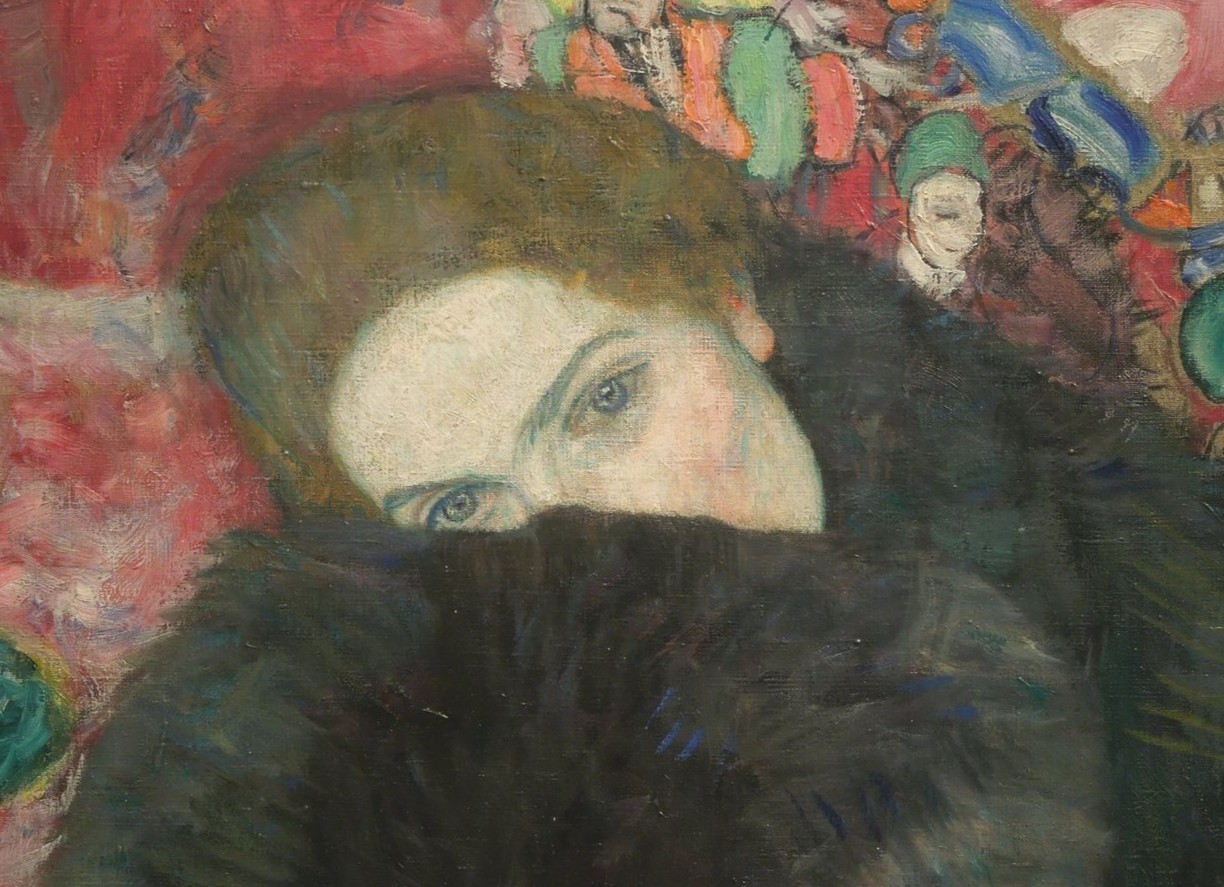
Cover art and all art by Gustav Klimt

There is a moment most people have experienced… the inexplicable conviction that a decision is right or wrong before any conscious reasoning has taken place. We hesitate, not because anything is consciously wrong, but because something just feels off. This is the unique quality we call intuition and many scientists have sought to explain it from a logical lens…
My own guesswork is threefold. Firstly, that intuition is formed by all that our unconscious mind is seeing, feeling and experiencing. It’s the information that goes on in the background of our peripheral lived experience, that is not consciously accessed but regardless, is present and guides us from the shadows and edges of our own thought. It could also be energetic… that situational awareness is innately there as a survival mechanism. Or, from a quantum perspective, we could be feeling into energy fields that we simply can’t see but that are present. Objects and people carry a presence and energetic blueprint regardless of if we’re seeing them directly. For me, it’s that feeling when someone is watching us, and we happen to look and see that there really is. When interacting with the Otherworld, or in sacred spaces, these feelings of energetic awareness can be even more heightened.
To understand intuition, it helps to know that our mind is essentially running two very different operating systems at the same time. The first system, System 1, is ancient, lightning-fast, and operates almost entirely beneath our conscious awareness. It is the system that catches a ball before we have consciously registered it is moving, that reads the mood in a room the moment we walk in, that makes us slam the brakes before our thinking mind has processed the danger ahead. System 1 does not deliberate. It just knows. Intuition is what happens when System 1 taps on our shoulder. The second is the one we know well, the slow, careful, analytical voice that deliberates, weighs options, makes pro-con lists, and takes its time.1

Here is where things get genuinely fascinating. Intuition is not purely a mental event. It lives in our body. The neuroscientist Antonio Damasio made one of the most startling discoveries in modern brain science when he studied patients who had suffered damage to a specific region of the brain involved in processing emotional signals.2 These patients were, by any standard measure, perfectly intelligent. They could reason, analyze, and debate with complete clarity. There was just one problem, they could not make decisions. Faced with even simple choices, they would deliberate for hours, endlessly shuffling through options without ever landing anywhere. What they had lost was the ability to feel the weight of a choice. They had no gut feelings. And without gut feelings, it turned out, the whole machinery of decision-making came to a halt.
Damasio called the signals these patients were missing ‘somatic markers,’ bodily sensations that attach themselves to memories and past experiences, flagging them as good or bad, safe or dangerous, promising or poisonous. Every time we have ever felt our stomach tighten before a difficult conversation or noticed a warm expansiveness in our chest when we are about to make a decision that is right for us, that is our somatic markers doing their job. Our body has been quietly taking notes our entire life, and when a relevant situation arises, it sends up a flare. The gut feeling, in other words, is not a metaphor. It is a real physiological event. Our body genuinely knows things our conscious mind has not yet caught up with.
The explanation for its existence goes back a very long time. For the vast majority of human history, there was no time to convene to decide, and absolutely no opportunity to sleep on what to do next. Our ancestors were living in environments that demanded instant decisions and the ones who could read a situation faster and act correctly were the ones who survived long enough to become our ancestors. Evolution is as it seemingly always has been, a brutally efficient teacher. The psychologist Gerd Gigerenzer has spent his career arguing that the mental shortcuts underlying intuition, what he calls heuristics, are not lazy thinking or cognitive errors. They are purpose-built tools, refined over millennia of trial and very-high-stakes error.3 In complex situations with incomplete information and no time to waste, these shortcuts frequently outperform elaborate, painstaking analysis. Sometimes the wisest thing our brain can do is stop overthinking and trust the ancient machinery.

As mentioned, there is also quantum reasoning to analyze. Now, here is where we venture into truly fascinating territory… with the caveat that scientists argue fiercely about all of this, and nobody truly knows. Some physicists and neuroscientists have proposed that human consciousness, and by extension, intuition, may involve quantum mechanical processes happening at the microscopic level inside our brain cells. The physicist Roger Penrose and anesthesiologist Stuart Hameroff put forward the idea that tiny protein structures inside neurons, called microtubules, might be capable of sustaining quantum effects, the bizarre, rule-bending behavior of matter at the subatomic scale, where particles can exist in multiple states at once until they are observed.4
It is speculative, and many scientists remain deeply skeptical, but the implication is fascinating… that the flash of knowing, the sudden collapse of many possibilities into one clear and certain sense of what is true, might be mirroring something that happens at the very foundation of physical reality. That intuition, at its most profound, might be the universe thinking through us. It’s worthwhile that we can hold that thought, even if it’s held lightly. Another quantum explanation is that if we placed an invisible energy grid over all that is, even ourselves as we’re walking down the road, we can feel reality shift and like a spider feels when a fly landed on its web, we can also sense into vibrations that impact our world regardless of whether that energetic shift is emotional or physical.
The decision to trust our intuition depends. The crucial question is not whether intuition is real (the neuroscience is pretty clear that it is), but whether ours is well-calibrated in the area where we are using it. A firefighter’s intuition about burning buildings is trustworthy because it has been sharpened by years of high-stakes, real-world feedback. Our intuition about any number of things we have zero experience in is naturally less reliable. Malcolm Gladwell, in his exploration of rapid cognition, documented study after study showing that people making quick, intuitive assessments in their domains of genuine experience were startlingly accurate, often matching or beating careful deliberation.5

The place intuition can lead us astray is when it is actually bias dressed up in the clothing of insight… snap judgements based purely on past experiences. The gut is an honest organ, but it also reports what it has been fed. If it has been fed a distorted picture of the world or people (because of trauma), it will more often report a distorted picture back. This is why the practice of listening to our intuition needs to be paired with the humility to occasionally ask, where is this feeling actually coming from? Is it wisdom, or is it merely habit? Or is it the left-over remnants from personal trauma? Unfortunately, some people in our lives leave such lasting negative impressions on our nervous system, that we have to work extra hard to navigate our decision-making process forever after.
This is incredibly relevant when it comes to interpersonal relationships where we were manipulated emotionally in the deepest ways possible by people that swore honesty and integrity repeatedly. These experiences along with losing a loved one, assault, rape and just run of the mill psychological abuse genuinely re-wire our brain. However, it can be re-wired again. Our systems are pliable, albeit with effort. We can’t simply sit still, do nothing and expect to feel differently about our trauma. At minimum the energy needs to be put somewhere else, released into nature when we cry, put into a painting or musical piece or embedded within our journals and late-night writing. Wherever we decided to transmute it, it’s been transmuted and that’s what matters…
As someone who has experienced all of these human travesties, I also cannot overstate how important somatic therapy is. The same way our intuition is felt in the body, so is our grief and luckily, also our joy. We need to move, dance, sing and feel our way to emotional freedom and a clearer intuitional foundation. At some point on our healing journey, the trauma bias is inevitably left behind but the learning remains. This journey is overall incredibly sacred and deeply powerful. We cyclically meet ourselves on the other side of genuine healing, irrevocably wise and stronger. The philosopher Eugene Gendlin spent years studying what made some people grow and change while others stayed stuck.
His finding was simple and profound, the people who made genuine progress were the ones who paused, turned inward, and checked in with what he called the ‘felt sense’… the pre-verbal, whole-body sense of a situation that lives below the level of words and concepts. Not an emotion exactly. More like a knowing that has not yet learned to speak. Learning to hear that knowing, to sit with it, not rush past it, not immediately override it with a very reasonable argument, may be one of the most important skills a human being can develop. His work was later formed into The International Focusing Institute to help people cultivate these critical skills.
Our intuition is not infallible, but it is not nothing, either. It is millions of years of evolution, a lifetime of experience, and an entire body’s worth of intelligence, all conspiring to get our attention. How I find this all pertains to the druids is the way they cultivated their intuition relating directly to prophecy and how well they could do their job as seers, as guides and as counselors for their patrons. Any actual capabilities are built on a foundation of intuition first, of most importantly, trusting and knowing ourselves deeply. Over our lives, we begin to truly internalize the accuracy of our intuition. This coupled with genuine healing and being completely grounded in a greater understanding of human nature, is the crux of how to strengthen our actual seership skills. We begin to not only know it as in, to feel it, but also, to see it.
References
- Daniel Kahneman, Thinking, Fast and Slow (New York: Farrar, Straus and Giroux, 2011), p. 20.
- Antonio Damasio, Descartes’ Error: Emotion, Reason and the Human Brain (New York: Putnam, 1994), p. 173.
- Gerd Gigerenzer, Gut Feelings: The Intelligence of the Unconscious (New York: Viking, 2007), p. 16.
- Stuart Hameroff and Roger Penrose, ‘Orchestrated Reduction of Quantum Coherence in Brain Microtubules: A Model for Consciousness’, Mathematics and Computers in Simulation, 40.3–4 (1996), p. 456.
- Malcolm Gladwell, Blink: The Power of Thinking Without Thinking (New York: Little, Brown, 2005), p. 14.

Isla Skye / The Druid's Cauldron Historical Society
We are a registered non-profit, The Druid’s Cauldron Inc. 501(c)(3) The Druid’s Cauldron is an independent journal established in 2016, dedicated to the preservation and exploration of the druids, filid/poets, culture, native wisdom, and the living traditions of the isles. We exist to recover folklore, herbalism, spiritual philosophy, and ecological knowledge embedded in the roots of the early Irish Gaelic and broader Celtic world.
Through deep research into traditional folklore, herbalism and mythology as well as personal artistic endeavors, we seek to cultivate a deeper relationship with the land, the seasons, and to one another. We are committed to serious inquiry and evidence-based information, or it is alluded that it’s personal philosophy and labeled as such. The Druid’s Cauldron is a space for the curious, the contemplative, and those who feel called to remember older ways of being in right relationship with the land and each other.
Leave a Reply