
“The quieter you become, the more you are able to hear.”
Rumi
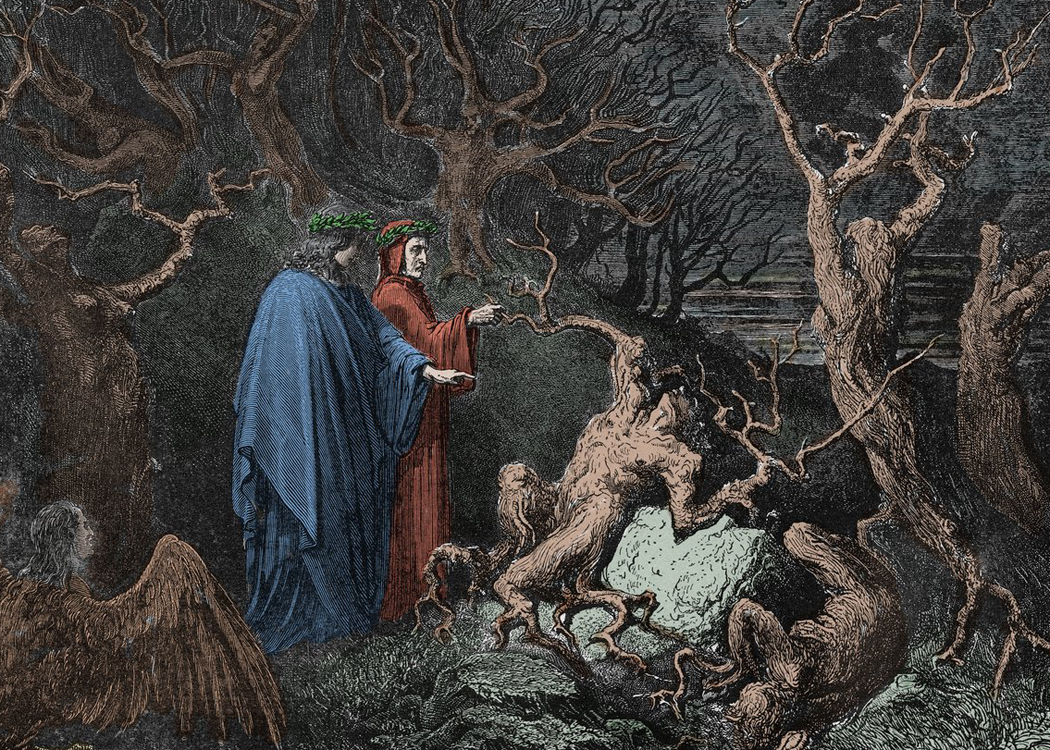
All art by Gustave Dore
Depending on the purpose of one’s meditation, one can go to the gods, reside in peaceful
harmony, or obliterate the ego to reach the so-called “Ground Luminosity.” This is the light that exists at the core of Creation. It is encountered at the moment of death and imbas (please note that the Gaelic word for death ‘bas’ is found within imbas). How we act and what we bring to such an encounter will determine our own experiences within the Otherworld, and will also shape our existence within each life that we live or throughout many lifetimes. Do not fear that you will be trapped within these experiences (especially if you are within a consecrated space and are strongly grounded as well as connected via bonds of love and honor to family). If one has an anamchara (a soul-friend), then that person will be the guiding light for the outward / inward journey, as well as the return journey. There is always a return path for those who clearly see their own truth or the truth of a soul-friend.

Those who are in confusion (and without spiritual connection or guardianship), are recommended to not seek this pathway or the calling of the gods during such a meditation. Without a center, a ground or a connection, ventures into the Greater Awareness are not recommended. The meditation itself takes one only to the doorway. It is the will and the spirit of the seeker that takes one beyond. It is the will of the Gods of Destiny that allows one to enter. It is the love of family, friends, tribe and anamchara, that allows one to return.
The daily meditation does not automatically take you anywhere other than into your own inner peace. This is a healthy and beneficial place for all of us to be every day. One must strive mightily to go elsewhere (or even NO-Where, i.e. the Not-Place). The use of mantric techniques must be coupled with the meditation to effect a journey. One must call out to the gods or willfully plunge within the nothingness of the Void. Among the Poets or Filidh, such a meditation was called the “Bed of the Poets.” It was accomplished within a safe, well-guarded and well-shielded room and bed, a place where imbas could be safely and reliably sought.
The edge of consciousness and being (that represents the “in-between-ness” of the worlds) is a fine line like a razor, and is easily missed by both the seeker and the spirit of a dying person. If this “two-places-in-one,” divided-attention doorway is missed, then the meditation is a normal one and the cycle of life-death-transition-rebirth begins anew in most of us. To be aware of it, is to have the choice of attempting the walk along its pathway, but stepping upon the edge of such a way is a choice that requires much knowledge of the self and of truth and is not recommended to those who have not studied and prepared themselves in their many lifetimes.
On the other hand, every person can and will eventually achieve their re-union with themselves and their ancestral spirits, which is a totality of communion and an uplifting ecstasy. It is a matter of lives and death and learning and loving. It is also a matter of doing and creating. That is why it is important for each of us to do the work of the body, mind and spirit, in truthfulness each and every day. That is also why one should endeavor to be even more honorable in the world of dreams, than when we are within the world of pain and of illusion. Within the world of the self’s truth, one wields the power to create and to destroy. It is the line between these extremes that we call life. When we are within this world we may not be fully aware, yet we are guided by our geasa and our dán.

One of the purposes of meditation for the Draíothe and the Filidh was to achieve imbas, a form of enlightenment and elevated awareness. In their long training, this practice was reserved for the two highest classes, the Anruith and the Ollamh. A master of such things could also have what was called a ‘divided attention.’ This is similar to sleep walking or talking, but with the added ability of conscious awareness in each state (dreaming consciousness and waking consciousness). Techniques in lucid dreaming are other ways that subconscious focus ispracticed. The key to success in each of these efforts is found in mastering the ability to concentrate. Let’s look at the classical methods for developing this skill.
Among those who would be Druids and Seers, there are three different methods for becoming focused. All of these methods rightfully assume that the people attempting to obtain focus have as a minimum the ability to concentrate. I call these three attention-gathering techniques:
- An Mionaire – lit. ‘fine (small) attention’ (i.e. I am Very Small): concentrating on a
very small non-living or inanimate object so that one may become absorbed. - An Neidín – ‘the little nest’, (i.e. A Place of Safety): concentrating on the breath or a
breathing object so that the mind and body may rest naturally. - An Iarrairdeall – lit. ‘solicitous attention’ (i.e. I am Very Large); Concentrating on
an abstraction to blank the mind and go beyond ego.

Searles O'Dubhain
Searles O’Dubhain is an American Celtic scholar, writer and story teller who has been practicing Druidry for over 30 years. Searles created ‘The Summerlands’, one of the very first beloved online Celtic pagan communities in the early 90’s. He additionally published ‘Ogham Divination’, that lays a detailed and creative pathway of recreating and discovering the ancient ways of the Druids. This and much more available on his website.
Leave a Reply