
“My chair is in Caer Sidi
where no one is afflicted with age or illness.
Manawydden and Pryderi have known it well.
It is surrounded by three circles of fire.”
Taliesin in the defense of the Chair as translated by Caitlin Matthews
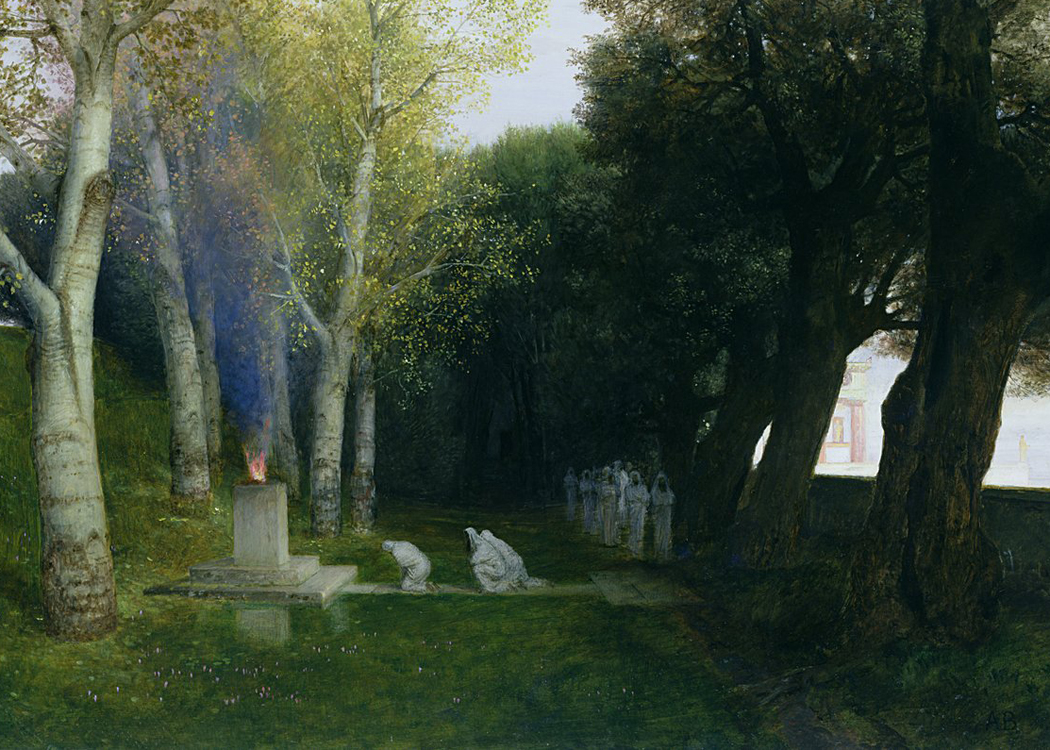
All art by Arnold Böcklin
We can create our own sacred spaces in a variety of ways. We can use chanting and musical intonation as we previously discussed, or we can construct spells and carve them upon Ogham wands or fedha. We can use symbols for each of the Four Hallows and place them in the appropriate Quarter. We could also use forms of personal meditations such as the Tree Meditation given within the Keltria Book of Ritual, or we could focus on the dúile themselves, that are found at the centers of each of the Three Cauldrons. I call this technique the Cauldron Meditation. It shares many common elements with chanting and drumming methods of achieving altered states, as well as with the Tree Meditation. Before we discuss these meditations and methods, let me say a few words about setting the stage, gathering the attention and focusing the will.

To adequately meditate, gather attention or focus the will, one must first address the needs of the body against the many distractions of the world. To achieve a gathering of attention requires each of us to achieve a physically relaxed posture. Among the Celts and Druids, there are three postures that have been reported as being used for meditation and attention. I call these three postures:
A Suide Súadh (The Sage’s Seat): sitting cross-legged with the back straight, (as the Stag God is shown on the Gundestrup Cauldron).
A Suide Righ (The King’s Seat): sitting in a chair with the legs together and the back
straight (like a chief or king sitting upon their thrones).
Leapaidh Lánlaidhí (The Bed of the Poets): lying completely prone (in a secluded guarded
place), with the hands upon the eyes (or with the body covered by a blanket, a skin or a
cloth).
The object of these postures is to allow the body to take care of itself while the mind seeks its own natural state through control of the attention. IMO imbas can be achieved primarily through meditation. To properly meditate for imbas, requires that the body and mind first be quieted so that the spirit is not chained by their needs. The first essential step in such a meditation is to find a place to meditate that is comfortable. The next step is to relax the body by assuming a posture that is stable and self-supporting. This can be in any of several positions: the famous Lotus position or prone (lying down) works well. After the muscles joints and bones are completely relaxed, then the breath, heart and mind must be placed into rhythms that are automatic and quieted. I slow my breathing and journey on my heartbeat until they are one and then I think about absolutely nothing until I am in an altered state. This experience is called the “natural state” and can be very peaceful or it can be ecstatic beyond description.

The key to reaching imbas through meditation is connecting with all of yourself and the gods. That is why the conscious mind must be quieted from all of its programming, preconceptions and inherent limitations. A first step towards this ability is to use what is known as a single focus. This was traditionally done on an object or on a concept (visualization). Among the Filidh, this object was a small stone that was placed on the chest while lying on a secluded bed in a guarded area or room. I personally try to visualize things outside of normal reality in order to shock my senses into being more aware. An example of this technique would be to visualize seeing both ahead and behind at the same time or to see the insides and the outsides of an object all at once. One might try to hear a color or to taste a melody in an effort to awaken the senses into a higher, more symbiotic state.
Other ways to reach the state of imbas are to simply will yourself into that connection. The first attempts at doing this might require that a person call out to their gods and deities. I do not suggest doing this audibly, but rather that these names should be chanted within the quieted mind. Call your deities using the power of your mind and spirit. Repeat the name and the need over and over within yourself. Try to reinforce the power of your inner calling of the name until your mental/spiritual volume increases. Be alert for changes in the way that reality presents itself around you and be ready to follow the light, the music or the flow of perception that will appear when the deity approaches. Take the step or leap across the void into their presence when the pathway opens.

Searles O'Dubhain
Searles O’Dubhain is an American Celtic scholar, writer and story teller who has been practicing Druidry for over 30 years. Searles created ‘The Summerlands’, one of the very first beloved online Celtic pagan communities in the early 90’s. He additionally published ‘Ogham Divination’, that lays a detailed and creative pathway of recreating and discovering the ancient ways of the Druids. This and much more available on his website.
Leave a Reply