
“Down with the rosemary, and so, Down with the bays and mistletoe, Down with the holly, ivy, all, Wherewith ye dressed the Christmas hall, That so the superstitious find, No one least branch there left behind, For look, how many leaves there be, Neglected there (maids, trust to me), So many goblins you shall see.”
Kitty Alfred, County Limerick, Ireland, A poem of a local superstition to ensure all the winter wreaths were taken down by Candlemas (February 2nd)
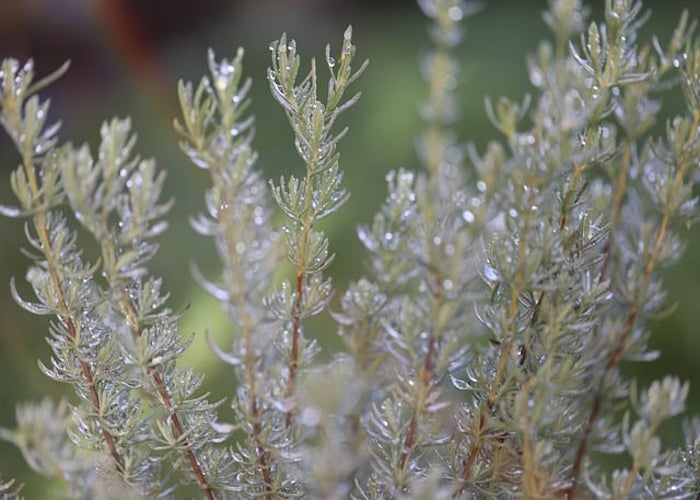
Rosemary or Rosemarinus officinalis is also called Dew of the Sea (as it’s often found on sea cliffs), Rose of Mary or the herb of remembrance. It’s called ros mhuire or marós in Gaeilge and liath-ròs or ròs-màiri in Scots Gaelic. Its name originated through stories with the virgin Mary and in some versions, what would become known as the Rose ‘mary’ bush sheltered her when she was in peril. Being able to experience rosemary thriving in my garden nearly all year long is a true gift. I know that at a moment’s notice, if I need it, it’s there and completely fulfills its folk symbolism of fidelity. Rosemary has so many endless qualities, I find this lovely plant to truly be a wonderment. I personally find the easiest way to include rosemary in my diet is to infuse it in the olive oil or vinegars that I use on an almost daily basis.

Rosemary was well traded and became a common cottage herb throughout Europe at least by the 800’s but likely well before this point as it was in use throughout ancient Egypt, Greece and Rome for millennia.1 Dioscorides mentioned rosemary as being used to treat jaundice and fatigue. In Ireland, it was used to treat disorders of the head and nerves, cleaning teeth, coughs, asthma, running nose and eyes and other lung ailments.2 A local cure for asthma, colds and cough called for boiling an infusion of rosemary (sometimes with thyme) with sugar while another cure required boiling it in milk to treat wounds.3,4
Soaking your pillows and sheets in rosemary or lavender was thought to help with anxiety and sleeplessness.5 Finally, a gargle was recommended to treat sore throats that included rosemary, sage, garlic and honey all boiled together.6 Rosemary was one of the medicinal herbs planted and maintained by St. Columba’s Abbey monks on the Isle of Iona in Scotland.7 In Wales, it was an old belief that if rosemary grew well in the cottage garden, the lady ‘rules the roast’ or the house. Locally, rosemary was recommended to treat soreness, canker sores and gangrene of the mouth, stomach ailments such as nausea, headaches, paralysis, fever, cold symptoms and impotence.8 It was also custom for each mourner at a funeral to carry a sprig of rosemary and throw it onto the deceased gravesite which was undoubtedly a remnant of the old pagan practice to throw various flowers or tree sprigs onto graves as well.9

Interestingly, this practice was also carried out long before this time period by the ancient Egyptians, possibly due to the fragrant smell and nature of rosemary being an evergreen, representing vitality and longevity. Rosemary was somewhat of a unanimous symbol throughout Europe of fidelity between lovers, possibly on account of its ability to improve memory or the fact that it was a flowering evergreen. For this reasoning, it was a very common flower and herb included in wedding bouquets.
Rosemary is in the Lamiaceae family and native to the Mediterranean. Rosemary has small individual smooth pointed leaves along a woody stem and small purple flowers that typically bloom throughout the summer peaking in July and it may have been associated with Bealtaine or the Summer Solstice. It’s a perennial in zones 7 through 10, grows up to 91 cm or 3 ft tall and does well in full sunlight and well drained soil. Rosemary’s energy is warm and dry. The leaves and flowers are edible and have a distinct subtly pungent yet sweet flavor. It’s most commonly used in infusions, oils, steam baths and flavorings.
Benefits
analgesic, anthelmintic, antibacterial, anticancer and antitumor, anti-inflammatory, antioxidant, antispasmodic, antiviral, anxiety alterative, hair tonic, liver tonic, neuro-protective, neurostimulant, skin tonic
Recipe
Rosemary (Thyme and Dill) Vinaigrette
Ingredients: 4 oz or ½ cup balsamic vinegar, 4 oz. or ½ cup olive oil, 2 oz or ¼ cup raw honey, 2 garlic cloves, 2 tbsp fresh rosemary leaves, 1 tbsp thyme, 1 tbsp dill, 1 tbsp dijon mustard, 2 oz or ¼ cup chopped onion,
Instructions: Process all ingredients in a food processor except for olive oil. Once ingredients are well mixed, slowly add and stir in olive oil. Add extra olive oil or vinegar until you have your desired consistency.
References
- Ó Cuinn, Tadhg, Irish Materia Medica, Ireland, 15th century, pg. 855.
- K’ Eogh, John, Botanologia Universalis Hibernica, or An Irish Herbal, Cork, 1735, edited by Michael Scott, 1986, pg. 130.
- Irish Folk Duchas, The Schools’ Collection, Volume 0160, Page 051
- Irish Folk Duchas, The Schools’ Collection, Volume 0503, Page 452
- Irish Folk Duchas, The Schools’ Collection, Volume 0403, Page 299
- Irish Folk Duchas, The Schools’ Collection, Volume 0842, Page 247
- Beith, Mary, Healing Threads: Traditional Medicines of the Highlands and Islands, Birlinn Ltd., 2004, pg. 42.
- Myddvai, Meddygon, Pughe, John and Williams, John, The Physicians of Myddvai, Wales, 1861.
- Sikes, Wirt, British Goblins – Welsh Folk-lore, Fairy Mythology, Legends and Traditions, London, 1880, pg. 315 and 336.

Isla Skye / The Druid's Cauldron Historical Society
We are a registered non-profit, The Druid’s Cauldron Inc. 501(c)(3) The Druid’s Cauldron is an independent journal established in 2016, dedicated to the preservation and exploration of the druids, filid/poets, culture, native wisdom, and the living traditions of the isles. We exist to recover folklore, herbalism, spiritual philosophy, and ecological knowledge embedded in the whispers of our ancestors.
Through deep research into traditional folklore, herbalism and mythology as well as personal artistic endeavors, we seek to cultivate a deeper relationship with the land, the seasons, and to one another. We are committed to serious inquiry and evidence-based information, or it is alluded that it’s personal philosophy and labeled as such. The Druid’s Cauldron is a space for the curious, the contemplative, and those who feel called to remember older ways of being in right relationship with the land and each other.
Leave a Reply