
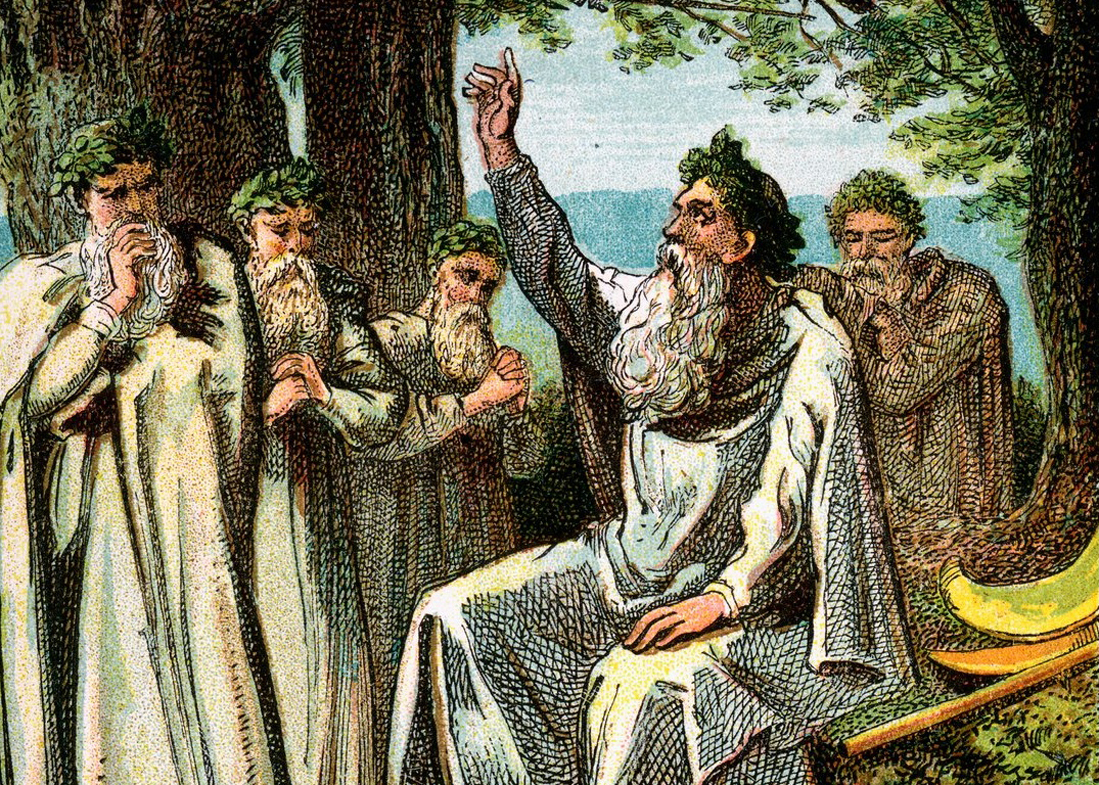
“Fear cannot be where knowledge is. There is no danger where there is light.”
James Stephens
Art is by unknown artists and public domain
“Air” means East in Old Irish and “airtherach” means the front of the head or the “perceiving intelligence.” The Celts determined directions by facing East in the morning. South was to the Right and North was to the left. West was then behind. Sacred space was entered from the West to the East, so that one was facing the direction wherein new beginnings occurred.
Positive Magicks were worked “ sunwise,” called “deasal” (to the righthand side). Banishing Magicks were worked to the lefthandside or “tuathal.” This motion was “against the Sun.” All of this is relative motion. To bring power from the Sky one would “honor” the Sun and travel its path. To invoke Power from below, one would travel the way of the Land which is where I think the word “tuathal” gets used. The right side was considered “good, strong, positive, projective and Light.”
The left side was considered “not good, weak, banishing, receptive and Dark.” The Wheel Ogham of Roigne Roscanach, a symbol from The Book of Ballymote, clearly demonstrates this idea of righthanded and lefthandedness in the way that it contains clockwise groupings of Ogham on its southern half and counter-clockwise groupings on its northern half. We will discuss this Ogham symbolic mandala, as well as its companions, The Stream Strand of Ferchertne and Fionn’s Wheel, in greater detail in later chapters.

Just about every Magical system I’ve ever seen is based on the seven directions. Almost all of them have a medicine/spirit/seasonal wheel. The Celts were especially enamored of wheels and circles. The area in which they lived was filled with stone circles and astronomically aligned stone/ritual sites. One of the primary Celtic Gods was a God of the Wheel (Taranis). Mogh Roith (the name means the Devotee of the Wheel) was possibly a God of the Wheel and not just a Druid. The Sun itself was said to be “roth fail” or a “wheel of circling light.” There are many other references to wheels, the Sun and the zodiac within Celtic writings.
The Three Worlds are Above, Here and Below; Sky, Land and sea; Future, Present and Past. This arrangement agrees with many indigenous as well as shamanic cosmologies.
Magicks were best conducted at places that were “in-between.” This means that they were best done on the edge of a lake, river or stream; at the top of a hill or a mountain or within a cave; at the dawning or the dusk or within a mist or a fog; upon a threshold, beside a well or in front of a fire. Places where roads crossed were considered to be good for Magick (since they were neither one road or the other). Bruidhean were located at such places to provide hospitality for all. This “not quite in this world” characteristic is one reason why a pooka or a faerie will vanish if you look straight at them (one should always gaze upon such beings from the corner of the eye). It is also a major reason why folks lose their focus during meditations and out of the body experiences.
The Summerlands were always in the Great Sea to the West.
The Tuatha Dé Danann were said to have come from the Sky/ the North/ the islands at the top of the world.
People were considered to be spirits inhabiting bodies and not Bodies that also happened to have spirits within them.
No spell had any Power without having risk to the person casting the spell. It is for this reason that oaths were taken to the three Worlds of Sky, Sea and Land. No curse could be given if the sender of the curse was not willing to take an equally horrible curse in return (however, if their own cause was just…if they were “true,” then they had nothing to fear). This is why many incantations were done across the edge of a spear or a knife. Magick cut both ways. Only the Truth would protect you. Let’s see how the “Truth Against the World” is itself divided.

Searles O'Dubhain
Searles O’Dubhain is an American Celtic scholar, writer and story teller who has been practicing Druidry for over 30 years. Searles created ‘The Summerlands’, one of the very first beloved online Celtic pagan communities in the early 90’s. He additionally published ‘Ogham Divination’, that lays a detailed and creative pathway of recreating and discovering the ancient ways of the Druids. This and much more available on his website.
Leave a Reply