
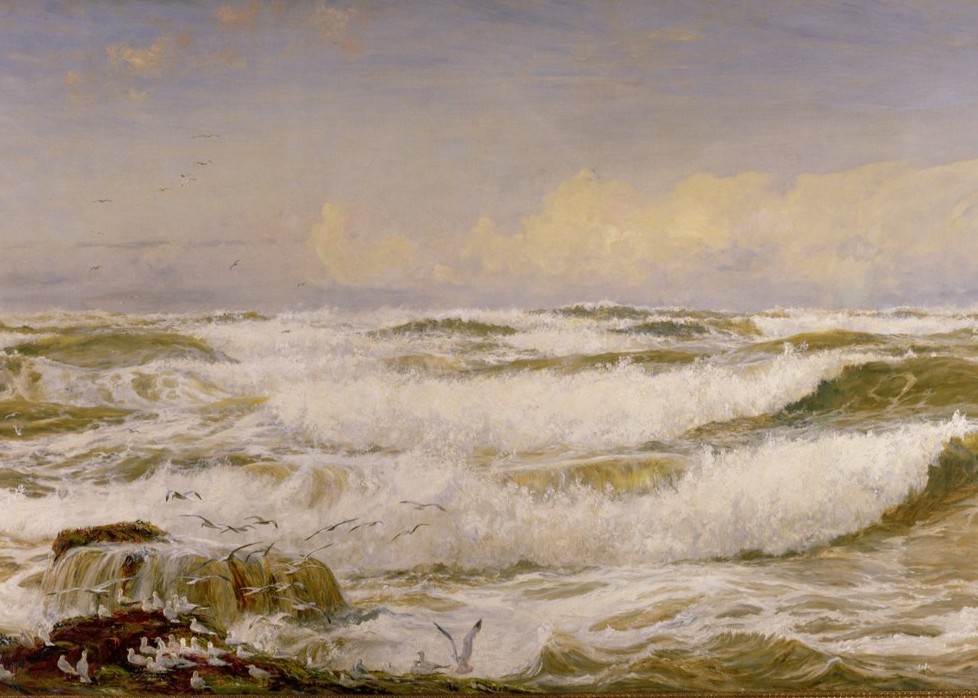
Excerpt taken from The Celtic Legend of the Beyond (re-printed 1986), by Anatole Le Braz. Anatole le Braz (1859 – 1926) was known as the “Bard of Brittany” and an incredibly important cultural figure that preserved many old Breton songs, stories and folklore.
Cover art and all art by William Lionel Wyllie
Whoever trusts the sea trusts death. Whoever dies at sea, therefore, always dies by their own fault. When the waves of the sea crash with a dull sound on the beaches, it foretells a shipwreck or some other misfortune. In the Hebrides, there are beliefs regarding the times when it is impossible to drown and the people who cannot drown. For example, no one has ever drowned while the sun was visible in the sky. Around 1856, thirty-two people chartered a barge to travel by sea to the pardon of Benn-Odet, at the mouth of the Quimper river. The weather was nice. The crossing of the bay went smoothly. But at the entrance of Vire-Court, opposite Lanroz, the boat capsized, probably due to a misstep.
This shipwreck caused quite a stir at the time. Several years later, the memory of it was still fresh in everyone’s minds, and the boats that went down the river carefully avoided the area where the accident had happened. They often struggled to steer away from it. A kind of sinister attraction drew them there.
With each disappearance of this kind, the sailors of Quimper would murmur among themselves, in low voices, at the port:
— Ah! You see! … you see! … The old ones have been replaced… It’s the new ones we need to watch out for now.
When people point out to the women of the island of Sein how small their cemetery is, they respond with the following saying:
Etre an Enez hac ar Beg
Eman terred ar gwazed.
[Between the Island and the Pointe (du Raz) is the cemetery of men.]

The drowned whose bodies have not been found and buried in sacred ground wander eternally along the coasts. It is not uncommon to hear them cry in the night, grimly:
— lou! lou!
They then say, in the country of Cornwall:
— E-man lannic-ann-ôd o iouall! (Here’s lannic-ann-ôd, — Peiit-Jean from the shore, — screaming!).
All these screaming drowned people are indiscriminately called lannic-ann-ôd.
Lannic-ann-ôd isn’t evil, as long as you don’t mess around sending back its eerie wailing. But woe to the fool who dares play that game! If you answer the first time, lannic-ann-ôd leaps half the distance toward you; if you answer a second time, it covers half of that half; if you answer a third time, it breaks your neck.
A Clever Boy
A farmhand was coming back from taking the animals to the fields one summer evening, at the time when they start spending the nights outside. As he walked along a stony path, he heard the hooves of lannic-ann-ôd clattering on the pebbles. The farmhand was a lively fellow. He knew all the stories told during winter evenings about lannic-ann-ôd, and he had promised himself to check them out at the first chance he got.
— Well, he said to himself, I’m going to find out for sure.
A clever boy though, he waited until he was close enough to the farm before responding to the loud “howls” that the wanderer of the beaches was letting out behind him.
Only then did he let out a sonorous “howl” in return.
Lannic-ann-ôd was probably shocked by such boldness, because he suddenly fell silent. The servant noticed, however, that he had gotten much closer. His silhouette was now visible over there, at the far end of the path, all black in the moonlight.
Here were the cries starting up again more intensely.
This time, the servant only responded when he reached the middle of the farmyard.
lannic-ann-ôd was at that moment near the gate.
He was screaming with growing fury:
— wolf! wolf! wolf!
There was some provocation in his cry.
The servant started running fast, fast, as if he had wings on his heels.
When he reached the manor’s threshold, he shouted the third “wolf” at the same time as he closed the heavy oak door. (The oak saved him.)
A tremendous blow struck the door from outside; one could have sworn it was splintering. And the voice of the screamer rose menacingly:
— Just this once: but if you come back, I’ll make a man out of you!

The servant took that as a warning (1).
(1) In Ouessant traditions, lannig an aod cries in a mournful tone at doorways: un lam lan d’in dre indan ann nor, “give me a little fire under the door.” Woe to anyone who hands him a ember under their door, for his arm, then his whole body, goes through with the ember, and he is never seen again (Luzel, Voyage à Ouessant; L’Echo de Morlaix, May 2, 1874; Revue de France, vol. IX, p. 773).
The Luck of Jean Duigou
Jean Duigou, a fisherman from Lancléevennec, was fishing one night in the harbor of Brest, a few cable lengths from shore, all alone in his boat. Suddenly, from one of the woods that cover this coast, a prolonged howl rose. Jean Duigou, thinking it was some joker trying to scare him, responded with a similar howl.
A second time, the same cry of distress rang out. And Jean Duigou responded again.
“That nasty monkey is starting to annoy me!” he told himself. “And if he does it again, I’ll hit back with a ‘coc’h!’ that will be heard all the way to the bottom of the harbor.”
He hadn’t finished talking to himself when the voice of the invisible character screamed for the third time:
— lou… ou… ou!
Then, Jean Duigou, with all the strength of his lungs:
— Coc’h, my soul… yes… yes… (M… for you!) he bellowed.
But the last sound choked in his throat.
Someone was standing in the boat, behind him,
and was gripping his neck with fingers as hard
as iron pincers. A sweat of pain and
anguish flooded the fisherman’s face.
— Whoever you are, in the name of God, let me go! he begged.
Then the other said:
— Yes, I’ll let you go, but not because you called on God’s name… If your boat hadn’t been oak, you’d be done for.
Saying this, he loosened his fingers and disappeared.
Jean Duigou had been lucky. And he could clearly see that what old people say is true: namely, that oak wood is a precious talisman against evil Spirits.
The Five Dead Men of the Bay
They were two sailors from Quimper.
They had taken on the task of transporting barrels of cider in their small boat to Benn-Odet.
Perhaps they lingered at the innkeeper’s where they had to deliver the cargo. In any case, they missed the tide. When they reached the place called ‘the Bay,’ there wasn’t enough water anymore, and they had to pitifully run aground in the mud… Six hours to wait for the next tide, and it was in the middle of the night!…
They made the best of bad luck. Both of them rolled up in the folds of the sail they had brought. They were already dozing off when a very strong voice called each of them by their respective first names. — Ahoy! Yann!… Ahoy! Caourantinn.
— Ahoy! replied Caourantinn and Yann. That’s how sailors usually hail each other.
— Come get us! the voice called out again.
The night was so dark that you couldn’t see two feet in front of you. The voice, though very loud, seemed to come from far away. Also, it truly had something strange about it. Yann and Caourantinn nudged each other.
— I think, said Yann, that it’s my nasty boss’s voice, Yannic-ann-ôd.
— I think so too, murmured Couarantinn. Let’s stay quiet. This is not the time to stick our necks out.
And they huddled even tighter in the sail.
But their curiosity was greater than their fear. Yann was the first to lift himself up to look over the edge.
— Look! he said to his companion.
The bottom of the bay, to their left, had suddenly lit up with a light that seemed to come from the water. And in this light, a completely white boat was outlined, and in the boat five men were standing, their arms stretched forward. These five men were all dressed alike in white oilskins speckled with black tears.
“It’s not Yannic-ann-ôd,” said Yann; “these are souls in distress. Talk to them, Caou-“
Rantinn, you who made your Easter this year. Caourantinn made a megaphone with his hands and shouted:
— We can’t come get you; we’re stranded here. Come to us yourselves or tell us what you need. What we can do, we will do.
The two sailors then saw the five ghosts sit on their benches. One took the helm, the others started rowing. But, as they all rowed on the same side, the boat, instead of moving forward, just spun in place.
— Are they stupid! grumbled Yann; what a bunch of landlubbers!… I really feel like going over to show them the maneuver. Maybe that’s what they need. What do you think, Caourantinn? Should you stay to watch the boat?
— No way! If you’re going, I’ll go with you.
— After all, there’s no risk. We can leave the boat where it is. There’s still a good hour before the first tide. Come on, buddy, God willing!
They barely had water up to their knees.
They made their way across the muddy bottom in the direction of the white boat.
The closer they got, the more the supernatural sailors rowed, and the more the white boat kept turning, turning, turning.
When the two companions were right next to it, it suddenly sank, and with it disappeared…
The light that lit up the corner of the Bay. For a moment, the night and the sea merged. Then, where the four rowers had been, four candles lit up. In their dim glow, Yann and Caourantinn noticed that the fifth ghost, the one who had been holding the rudder a moment ago, still raised its head and shoulders above the water.
They stopped, gripped with fear. Honestly, they would have preferred to be somewhere else. But since they had gone so far, they didn’t dare turn back. Besides, the man’s face was so sad, so sad, that it would have taken a very unkind person not to feel pity for him.
‘Are you from God or from the devil?’ asked Yann.
As if he had guessed their thoughts and the feelings stirring within them, the man said to them:
— Don’t be afraid. There are five of us here who are suffering terribly, and my four companions are suffering even more than I am. The sadness you see on my face is nothing compared to theirs. We’ve been waiting in this place for over a hundred years for the arrival of a man of good will.

— If it’s only a matter of goodwill, we are at your disposal, replied Yann and Caourantinn.
— Please go and find the rector of Plomelin, and ask him to have, for us, five funeral masses said at the main altar of the church for five days in a row. Then make sure that during these five days, at these five masses, thirty-three people attend regularly, old or young, men, women, or children.
— God forgive the departed! murmured the two sailors, making the sign of the cross. We will do our best to satisfy you.
The next day, Yann and Caourantinn went to see the rector of Plomelin. They paid him in advance for twenty-five masses. They attended all of them themselves; to make sure there were the thirty-three attendees required, they brought their wives, children, relatives, and friends from Quimper each day. Never had so many people been seen at the low masses of Plomelin at the same time.
On the sixth day, Yann said to Caourantinn:
— If you want, we can go to the Bay tonight to see if what we’ve done is done well…
— Alright, replied Caourantinn to Yann.
And when night came, they went down the river in their boat. They anchored at the spot where they had run aground six days earlier. And they waited. Soon, the light they had already seen began to rise above the waves. Then, the white boat took shape, and in the boat the five ghosts reappeared. They were still wearing their white raincoats, but the black tears were gone. Their arms, instead of being stretched forward, were crossed over their chests. Their faces were radiant.
And suddenly, a delightful music played, so touching that Caourantinn and Yann would have gladly cried with happiness.
The five ghosts all bowed at the same time, and the two sailors heard them say in a soft voice:
— Trugarè! Trugarè! Trugarè! (Thank you! thank you! thank you!).

The Druid's Cauldron Historical Society
We are a registered non-profit, The Druid’s Cauldron Inc. 501(c)(3) The Druid’s Cauldron is an independent journal established in 2016, dedicated to the preservation and exploration of the druids, filid/poets, culture, native wisdom, and the living traditions of the isles. We exist to recover folklore, herbalism, spiritual philosophy, and ecological knowledge embedded in the whispers of our ancestors.
Through deep research into traditional folklore, herbalism and mythology as well as personal artistic endeavors, we seek to cultivate a deeper relationship with the land, the seasons, and to one another. We are committed to serious inquiry and evidence-based information, or it is alluded that it’s personal philosophy and labeled as such. The Druid’s Cauldron is a space for the curious, the contemplative, and those who feel called to remember older ways of being in right relationship with the land and each other.
Leave a Reply