
“Most of the knowledge that gets through this process is reduced to basic content, artifacts, resources, and data, divided into foreign categories to be stored and plundered as needed. Our knowledge is only valued if it is fossilized, while our evolving customs and thought patterns are viewed with distaste and skepticism.”
Tyson Yunkaporta, Sand Talk
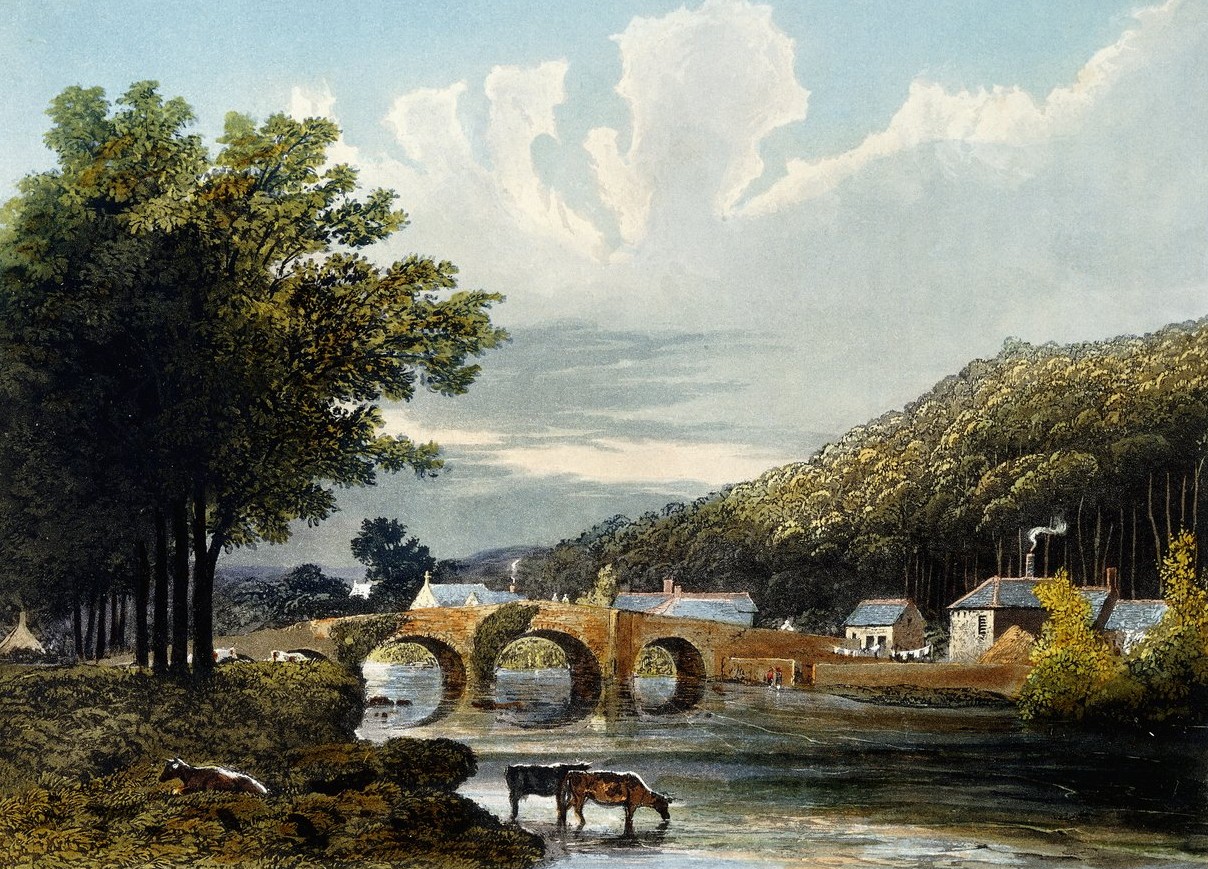
Cover art is ‘New bridge in Wicklow’ by an unknown artist, public domain
I remember going on a school trip to a stately home and gardens when I was a child, and, although I couldn’t have said why, I felt both appalled by and disconnected from the manicured gardens and regimented rows of flowers and trees all around me. Although I am not am empath of any kind, I felt something was very wrong with how the trees and plants had been clipped and tied, staked and removed from their authentic habitat in order to create displays of formal design. Much like the title of the Doris Lessing novel, The Grass is Singing, I felt I could almost hear the flowers and plants cry out.
Recently, having read Sand Talk by Tyson Yunkaporta, I was struck by those same feelings with respect to Irish mythology and native relationship with our land and the life within it, both visible and invisible that we share our habitat with. Considering that a bad metaphor is a curse within Tyson’s Aboriginal Australian tradition I’ll try to parse out what I want to say here carefully.
Like the once wild flowers and plants in those formal gardens during my school trip, our own Irish archetypal stories, our indigenous context of mind-medicine and wisdom, have also been imprisoned within a cage of words and terms which only serve to restrict and remove them from the living pathways they are part of. Even the language and cultural frameworks we now use to interact with our stories have themselves been changed over time and, as such, spin the older stories on trajectories and orbits that limit their power. If a nail is struck with a hammer or struck with a feather, is it not a property of the nail which creates the different outcomes.

The stored memory of our mythology and fairy-lore from our history needs to be understood as also having been changed by the very act of preservation. The tales and their lessons are like ships docked safe and tied to harbour walls. But, of course, this is not what ships are for. Ships are for sailing and moving through seas and worlds. Likewise, our stories themselves breathe and live through inner essence as opposed to structured rules and ‘correct’ and official linguistic cages.
Cultural norms, decided upon by a separated academia, filled in the gaps of understanding, (or lack of initiatory preparation and experience). These accepted interpretations became the mortar in the walls which came to surround Irish native wisdom, stranding it outside of the lived experience which was what gave it purpose in the first place. The stories became museum pieces, examined as dead things which must represent one solitary snapshot in time which all future tradition must mimic and refer to, even though stories were never intended to be such things. The movement and cooperation between story and teller, between living and changing tradition became distorted and a place to reach backwards to, instead of moving in tandem with the society and people who sang the stories to life in the first place.
Often, I am told that it is only because of our stories being written down that they managed to survive. Around the world, though, this is not borne out by evidence.
Many native and indigenous peoples have carried their stories and histories through oral tradition and without the need to freeze-dry their heritage in regimented structures which stop it from moving and living with the people. This can be a hard concept to sell to anyone living today of course where we reflexively ask Google or look up information outside of our own individual and familial memory. Some argue that the oral memory is not as ‘real’, that only symbolic language is testimony to be trusted.

But maybe it is how we have come to rely upon the written word which itself creates such distrust of other ways of thinking and interacting with our past. Writing in The Dawn of Everything: A New History of Humanity, David Graeber and David Wengrow explain how many anthropologists wrote about indigenous societies from the perspective that everything of importance had already happened to them. They explain how Mercea Eliade believed that ‘traditional’ societies lived in cyclical time, innocent of history. Eliade said that historical events themselves merged into archetypes. And yet, there is something here which also restricts and imprisons. It is as if to compensate for the complexity and absence of authentic connection that we instead employ reductionism in order to be able to at least grasp something and document it.
Locked-In-Syndrome is a condition where a person is aware of their surroundings and their predicament but cannot communicate or move because of paralysis. Irish mythology, constrained and defined in its own way, has also been ‘locked in’ and the inherent wisdom often set apart from ongoing growth and reinterpretation for contemporary times. It is sometimes a facsimile of its authentic self in this context, but one without true and living connection. Ultimately, it is our ability to talk back to our stories which allows us access to our ongoing collective wisdom, and which also allows our wisdom to answer in return.

David Halpin
David Halpin is a writer from Tallaght, now living on the Carlow/ Wicklow border. He has been writing about Irish Forteana and spirituality for over thirty years and has had his articles published in magazines and books throughout the world. David’s photographs of Ireland’s sacred sites have been published in journals and articles worldwide and in 2020 were included in An Taisce’s annual report on the Irish landscape. David is also a reviewer of esoteric writing and as well as publishing for The Occult Book Review, he also contributes regularly to newspapers, magazines and online publications. His articles have appeared in The Wild Hunt, New Dawn Magazine, Coire Ansic, and he is a regular contributor to Ancient Origins. David also runs the blog, Circle Stories, where he focuses his writing upon the topics of consciousness and folklore.
Leave a Reply