
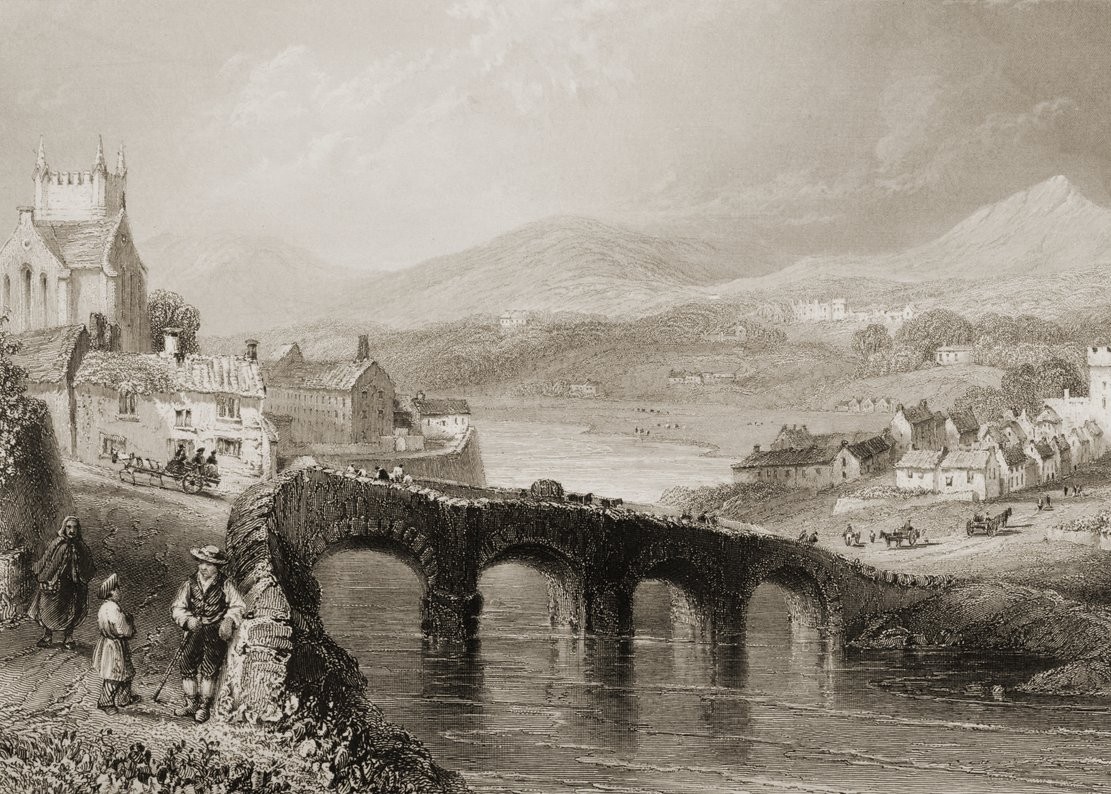
Cover art is by William Henry Bartlett
Book of Leinster Book I
Notes
Author: Cellach Ua Rúanada, poet, 11th century
- This poem is a technical catalogue of Old Irish poetic metres, each stanza praising a specific verse form by name. It functions as a kind of poetic manifesto or primer, celebrating the craft of poetry itself.
- The metres named are all well-attested forms in the Old and Middle Irish metrical tradition:
- Sétrad (long and short) — a syllabic metre of moderate complexity
- Rannaigecht (great and small) — one of the most common metres in Old Irish verse
- Dechnad (great) — a more elaborate, prestigious metre
- Lethdechnad — a half-form of dechnad
- Bairdne — a metre associated with the bard class
- Debide — a very common metre with end-rhyme between lines; debide scailte is a looser variant
- Snam sebaig (“the hawk’s swimming”) — a more ornate, figuratively named metre
- Cassbairnne — a compact metre, the name suggesting tightness or twisting
- Anamain — a highly prestigious and difficult metre, reserved for the highest grade of poet, the ollamh
- The síde reference in stanza 6 (aiste is ferr i nHere — “the form best in Ireland”) elevates the dechnad to almost supernatural status, associating it with the otherworldly fairy mounds.
- The closing S. is likely the conventional scribal or authorial mark ending the poem, as seen elsewhere in this manuscript.
Translation
Cellach Ua Rúanada sang it
- I shall declare to you the good forms of poetry — it will be a gleaning of grace; of grace between low and high, {5230} {MS folio 38a20} so that they may be in the ears of all.
- The long sétrad — better is its contemplation — the form on the ridge of swift poetry; the point of verse, the vigorous rule — the poetic companies take it as their step.
- {5235} The short sétrad — a noble, bright, pleasant, colourful craft; there is no one with a soul who will not praise before them their grace.
- The rannaigecht — great and spirited — {5240} from the cool, inspired spring; look at how fair its aspect is — it is lovely to make the poems.
- {MS folio 38a25} The little, vigorous rannaigecht — without trafficking, without shame — {5245} it stands here up to the summit in the ranks of lofty poetry.
- The great dechnad — how sweet its songs — above the bright island of the sun; {MS folio 38a30} refined beyond — it is a poem of the síde — {5250} the form that is best in Ireland.
- The lethdechnad — a garden of fragrant branches — it is not false in its keeping; there my speech would not be extinguished — a wondrous form.
p. 174
- {5255} {MS folio 38a} It is a gracious form — to the point — it is poetry, quick and well-ordered; I declare it to be sweet bairdne — beautiful debide of fine rhyme.
- {MS folio 38a35} Debide scailte — of the tales — {5260} this is it that is not unrecognised; this is the smooth, vigorous form in which ancient lore is customarily practised.
- A proud form I have — it is not the order of a nature that is much pressed; {5265} good is the beauty of every clear verse — the royal sun in its swiftness — of the honey-worded middle.
- The snam sebaig — so it is declared — {MS folio 38a40} it shall reach men who are seeking; let reward be given by me — no lie — {5270} for the gathering of the fragrant nuts.
- The cassbairnne — compact and vigorous — how it sweetens; it is not right to bend it crooked {5275} past the gold head — it is finer.
- The anamain — famous and noble in its declaration — not every person performs it, only an ollamh.
- {MS folio 38a45} These are the high forms of poetry {5280} that serve the songs; let them not be neglected. To God let us give thanks for our language — whatsoever person, noble, who shall declare it. S.

The Druid's Cauldron
We are a registered non-profit, The Druid’s Cauldron Inc. 501(c)(3) The Druid’s Cauldron is an independent journal established in 2016, dedicated to the preservation and exploration of the druids, culture, native wisdom, and the living traditions of the isles. We exist to recover folklore, herbalism, spiritual philosophy, and ecological knowledge embedded in the roots of the early Irish Gaelic and broader Celtic world.
Through deep research into traditional folklore, herbalism and mythology as well as personal artistic endeavors, we seek to cultivate a deeper relationship with the land, the seasons, and to one another. We are committed to serious inquiry and evidence-based information, or it is alluded that it’s personal philosophy and labeled as such. The Druid’s Cauldron is a space for the curious, the contemplative, and those who feel called to remember older ways of being in right relationship with the land and each other.
Leave a Reply