
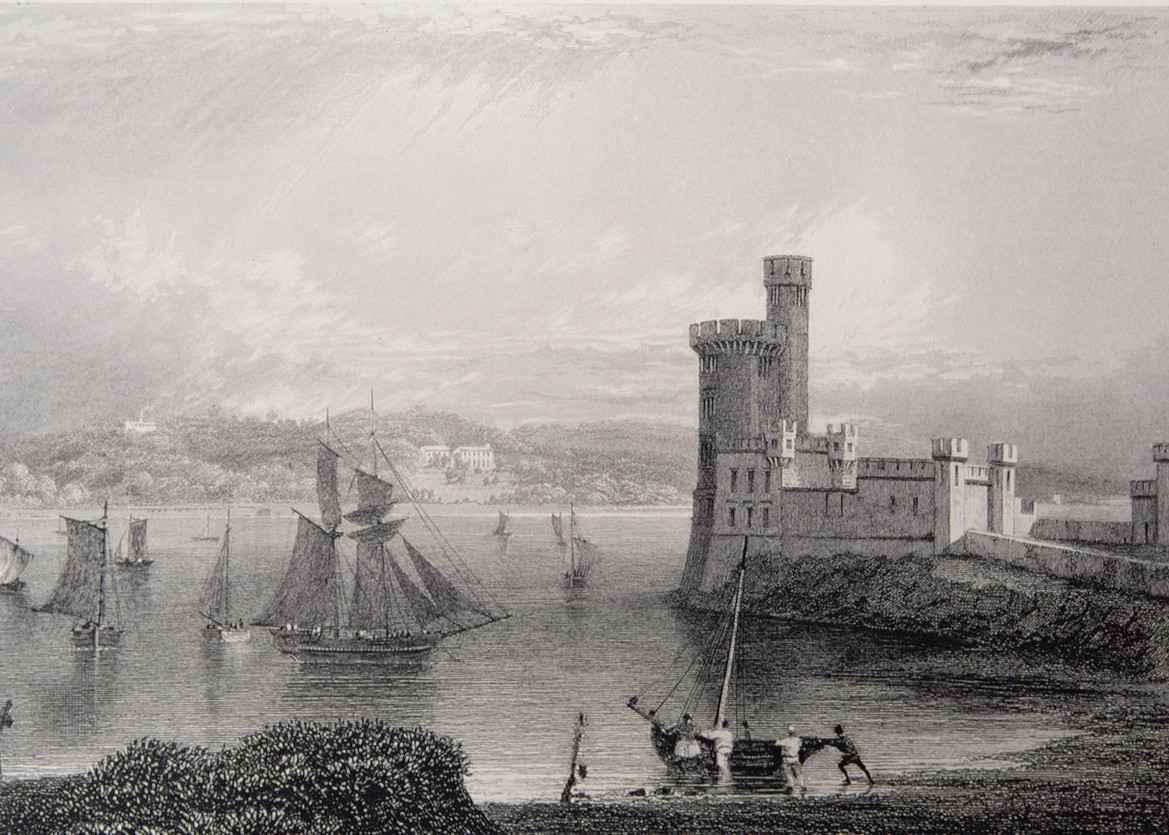
Cover art is ‘Black Rock Castle’ by William Henry Bartlett
Translated by Nessa Ní Shéaghdha and Máire Ní Mhuirgheasa, Trí Bruidhne, Dublin: Oifig an tSoláthair, 1941
Members of the Fianna are out hunting when they happen upon or are enticed into a strange dwelling. In some they are approached by Eochaidh Beag Dearg (also referred to as Eochaidh Béal Dearg or more generic descriptions) who offers the Fianna hospitality. Donegal versions closely mirror the Early Modern romance in that he offers otherworldly apples to entice them. In a version from Lochaber, the master of the house is away when they arrive, and his wife warns them not to stay.
After these members of the Fianna go missing, some versions have Fionn use his thumb of wisdom to see that they are in danger, and he sets off to join them, bringing along his young son and Bran. In versions from Argyllshire, when Fionn goes to look for them, he tells his men that “no man born in Ireland” (meaning any man at all) may follow him; Fergus follows him, however, as he was born in Jura, not Ireland.
More and more otherworldly guests arrive at the dwelling, some of whom challenge the Fianna. In most versions, Conán, who is on door duty, clashes with a large fairy woman – she beats him in the first bout and he then beats her, as he was never any good until he had first been cast down – and she promises that if he spares her life, she will aid the Fianna in some way.
A fairy warrior then arrives with a black hound. (Material from Laoidh a’ Choin Duibh – The Lay of the Black Dog – is generally incorporated here.) The black hound kills Conán’s hound and all the rest of the Fianna’s hounds, and Bran is also succumbing until Conán uncovers his venomous claw. Bran kills the black hound and Conán kills its owner.
In some versions, another fairy warrior then arrives with a boar that Eochaidh Beag Dearg has sent for their supper. It runs off, and Conán threatens to kill the warrior who brought it. The warrior then presents the roasted boar to Conán on a spit, and Conán gives the first quarter of meat to Fionn, the second to the Fianna, the third to Bran, and keeps the final quarter for himself.
A different fairy warrior may also appear carrying a trough of water for the Fianna to wash their hands after dinner. Conán is the first to go to wash, but is warned by Fionn not to act too quickly. Conán places his small toe into the trough and it is burnt to the bone. He then throws the soldier into the trough, turning him to ashes. Conán throws the water at the fairies and those it touches turn to ashes.
The tale ends with a battle in which Fionn summons the absent Fianna — often with the dord Féinne, a horn which the Fianna can hear when he blows it, however far away they are – and they defeat the otherworldly forces. In the County Clare version, the fairy woman whose life Conán spared earlier is responsible for alerting the rest of the Fianna.
Versions of this story are found in Donegal, Galway, Clare, and Kerry in Ireland, Mull, Tiree, North Uist, South Uist Barra, Glenorchy and Lochaber in Scotland, and in Nova Scotia, Canada. Although there are variations, most versions include the incidents with the hag, the dog fight, and the boar.

The Druid's Cauldron
We are a registered non-profit, The Druid’s Cauldron Inc. 501(c)(3) The Druid’s Cauldron is an independent journal established in 2016, dedicated to the preservation and exploration of the druids, culture, native wisdom, and the living traditions of the isles. We exist to recover folklore, herbalism, spiritual philosophy, and ecological knowledge embedded in the roots of the early Irish Gaelic and broader Celtic world.
Through deep research into traditional folklore, herbalism and mythology as well as personal artistic endeavors, we seek to cultivate a deeper relationship with the land, the seasons, and to one another. We are committed to serious inquiry and evidence-based information, or it is alluded that it’s personal philosophy and labeled as such. The Druid’s Cauldron is a space for the curious, the contemplative, and those who feel called to remember older ways of being in right relationship with the land and each other.
Leave a Reply