
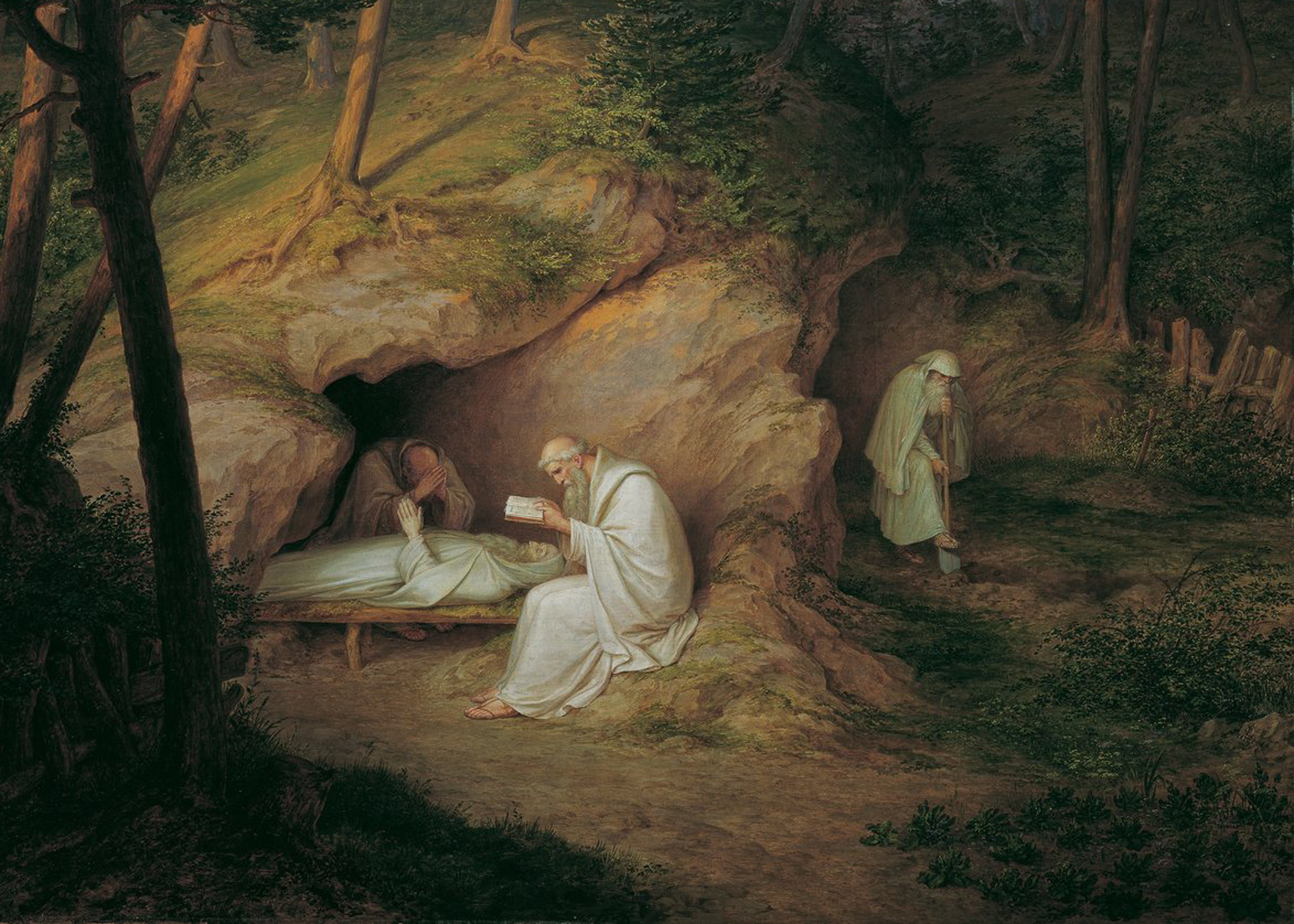
Cover art is ‘The Dead Hermit’ by Ludwig Ferdinand Schnorr von Carolsfeld
Notes
This celebrated poem is a dialogue between Guaire Aidne, the historical king of Connacht (d. 663), renowned in Irish tradition for his extraordinary generosity, and his half-brother Marbán, a hermit living in a woodland cell. The poem belongs to the genre of nature poetry and hermit literature that flourished in Early and Middle Irish and represents one of its finest achievements. The contrast between the two brothers — king and anchorite, court and wilderness, wealth and voluntary poverty — provides the structural and thematic engine of the dialogue, but the poem’s remarkable quality lies in the fact that Marbán’s case is made not through ascetic argument or theological reasoning but through an extraordinarily vivid and loving enumeration of the natural world surrounding his hermitage. The hermit’s bothán or cell, set in a wood whose precise location is suggested by references to Druim Rolach, Roigne, Mucruime, and Móenmag in Connacht, becomes the occasion for a catalogue of trees, fruits, birds, animals, sounds, and waters that constitutes one of the most sustained passages of nature description in all medieval Irish literature. The poem has been dated variously to the eighth or ninth century. It survives in several manuscripts and was edited and translated by Kuno Meyer, whose work remains a standard point of reference. The closing stanza, in which Guaire offers his splendid kingdom in exchange for the privilege of living in Marbán’s company, represents a conventional resolution — the worldly power acknowledging the superiority of the contemplative life — but one that the poem has earned through the sustained beauty of Marbán’s account of his woodland world.
Translation
Guaire speaks:
- O Marbán, O hermit, why do you not sleep on a feather bed? More often you would rest in a field, your head upon a hard oak root.
Marbán speaks:
- I do not sleep on a feather bed though I am kept in good health: there are many outside who rise up around me in contemplation.
- Nothing dies beside me in company, parting from weightless things — save for one solitary sitter alone, no one dies of it, O Guaire.
- Ornait and full Lugna, Laidgén and Ailirán — each pair is given to verse: Marbán and Cluithneachán.
- My testament has been heard by her — the proper clay of the world: my cup from the hermit, my crab-tree to ailing Laidgén.
- My knife and my pruning-hook, my habitation in Túaim Aidchi, my staff, my crab-tree, my cup, my little leather bag, my cauldron.
Guaire speaks:
- O Marbán, O hermit, why did you make your testament? God gives his grace to the man of craft — but to betray it to the Son of David.
Marbán speaks:
- I have a cold hut in a wood — none knows it but my Lord: an ash tree on this side, a hazel on the other, a great tree of a rath closes it round.
- Two heather doorposts for support and a lintel of honeysuckle. The wood pours around its girdle its mast upon fat swine.
- The size of my hut — small yet not small, a familiar homely place. From its peak a she-bird sings a sweet melody into the darkened land.
- The stags of Druim Rolach leap from its very clear stream. From it red Roigne is visible, splendid Mucruime, Móenmag.
- A hidden little fawn, devoted, at rest, of jewelled pace. Will you come with me to look upon it? (My life would be known without you.)
- A yew-tree’s mane with books of the young church — wonderful news! Beautiful the clearing: great green oak above the sign.
- An apple tree, great apple tree of bounty, bustling, vigorous; a fine right-hand fistful of small hazel, little nuts, green and branching.
- A spring pure and clear, cascades of water — noble your drink — crowds burst forth: berries of yew, true berries of yew.
- Around it pigs hide — hornless, tame — yearlings, bonhams, wild swine, a tall boar, hinds, badger-land, badgers.
- Peaceful, fairy-like, a great heavy country host, a gathering at my house; into its neighbourhood come wild garlic — lovely that!
- Beautiful feasts come — my dear one — swift offering: pure water, peaked branches — ever-fresh — salmon, trout.
- Peaked branches of rowan, dark sloes of brown blackthorn; foods of whortleberries, stripped berries of the bare slopes.
- A clutch of eggs, honey, mast, sweet apples — God has provided them — sweet apples, bog-berries, heathberries.
- Ale with herbs, a pool with berries, fine-flavoured snow, hawthorn bearing berries and sloes, acorns and nuts.
- A cup of mead, trim hazel-nuts, with ready service; brown acorns, a bramble thicket of drooping mane, good gooseberries.
- In summer, pleasant snow-colour, fine-flavoured taste: marjoram, little piglets, the blue watercress, the blue green purity.
- The music of the bright-breasted bird pouring down over me dear; the drone of bees, lovely and familiar, above my house;
- Wild geese, barnacle geese, before winter, playing of rough music; a gentle little woodpecker, a dark brown druid-bird from the branch of the hazel;
- A fair white bird, cranes, seagulls — the harbour sings; no music of grief is the dun hen-harrier from the red heather.
- The lowing of a heifer in summer — brightest of weather — not bitter or toilsome above the tender, pleasant, smooth plain.
- The sound of wind against a branching wood, grey-green cloud; the cascade of a river; the cry of a swan — beautiful music.
- The fine pines are tuning me — not for their price: to Christ always, it is no worse for me than it is for you.
- Though good to you is all you sweeten — more than any treasure — I am grateful for what is given to me by my fair Christ.
- Without an hour of quarrel, without the din of strife around me, grateful to the Prince who gives every good to me in my hut.
Guaire speaks:
- I will give my splendid kingdom with my share of the inheritance of Colmán, its ownership until the hour of my death, to be in your company, O Marbán.

Collaborative online journal on folk belief.
Leave a Reply