
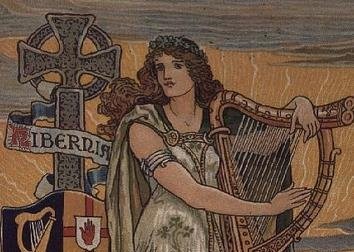
Cover art by Walter Crane
Notes
- This remarkable text is one of the most archaic and formally distinctive Old Irish lorica (“breastplate”) prayers — a genre of protective incantation invoking divine and supernatural powers to ward off death, illness, legal failure, and physical harm. It belongs to the same tradition as St Patrick’s Breastplate (Lorica Patricii) and the Lorica of Laidcenn, but is considerably more archaic and more deeply rooted in pre-Christian Irish cosmology.
- The text is sometimes associated with Mo Lling (St Moling of St Mullins on the Barrow, died 697 AD) and appears in manuscripts connected to his tradition — including its appearance within the Bórama tradition we have just been translating, where Mo Lling speaks similar protective formulae on his journey through Leinster. The present text may be a separate, older lorica drawn into that tradition.
- The Seven Daughters of the Sea (secht n-ingena trethan) — the opening invocation is startling and pre-Christian in register. The daughters who spin threads and control the threads of fate are a survival of an Indo-European fate-goddess tradition — comparable to the Norse Norns, the Greek Moirai, and the Roman Parcae. They are here invoked as protective powers rather than feared as death-bringers — a characteristic move of Irish Christian syncretism, where older supernatural powers are enlisted into a Christian protective framework.
- Lasréin — the saint invoked in the first section as the provider of a lúrig (“lorica/breastplate”) — is possibly St Laserian of Leighlin (died 639 AD), one of the major Leinster saints. The lúrig (“breastplate of Lasréin”) is both the physical garment and the spiritual protection of the saint.
- Argetnia (“Silver-Knowledge” or “Silver-Wisdom”) — the mysterious figure invoked in the second section — is not easily identified. The name suggests an otherworldly or divine being of silver nature — possibly a goddess of poetic or prophetic knowledge, or a personification of the silver-bright wisdom (fíndrui — “white bronze” or “silver”) mentioned immediately after. This is among the most archaic invocations in the text.
- Findrune (findruine) — “white bronze” or “electrum” — the gleaming silver-gold alloy associated with Otherworld treasures and divine prestige in early Irish tradition. The prayer asks that a “time of white bronze quality” be measured out for the speaker.
- Senach the seven-timed (Senach sechtaimserach) — another figure of uncertain identity — possibly a divine or semi-divine ancestor, or a personification of time itself. The women of the fairy-mounds (mná síde) who nursed him at the breast of youth (bruinnib ḃdais) connect him to the otherworld nursing tradition — the same tradition that lies behind figures like Lug being fostered in the otherworld.
- The seven candles (secht caindel) — a recurring symbol in early Irish spiritual texts for the gifts of the Holy Spirit, or the seven gifts of wisdom — not to be extinguished.
- The closing Latin — Damini est salus. Christis est salus. Super populum tuum, Domine, benedictio tua — “The Lord’s is salvation. Christ’s is salvation. Upon your people, O Lord, your blessing” — is a liturgical formula drawn from the Psalms and early Christian prayer, marking the text’s integration into Christian devotional practice despite its archaic Irish framework.
- The text is metrically complex and highly alliterative, composed in the archaic Irish rosc or retoiric style — compressed, formulaic, with strong sound-patterns. Many of the phrases have the character of legal formulas as much as prayers — demanding specific outcomes (ro orthar, ro saerthar, ro mórthar — “let my form be established, let my right be freed, let my strength be magnified”) rather than simply petitioning.
Translation
I invoke the seven daughters of the sea — who shape the threads of the long-lived sons.
Three deaths be taken from me — three lifetimes given to me — seven waves of good fortune be dealt to me!
Let me not be harmed in my circuit — in the breastplate of Lasréin — without its wearing! Let my fame not be concealed in darkness! Let age come to me — let death not come to me — until I am old!
I invoke my Argetnia — who does not die — who will not die — a time of white-bronze quality is measured out for me!
Let my form be established — let my right be freed — let my strength be magnified — let my grave not be ready — let death not come to me on a journey — let my going be blessed!
Let no headless serpent seize me — nor dark-grey earth-worm — nor headless beetle! Let no evil magic destroy me — nor company of women — nor company of hosts! Let a cast of time come to me from the King of all things!
I invoke Senach the seven-timed — whom the women of the fairy-mounds nursed at the breast of youth.
Let not my seven candles be quenched! I am a fortress of invincibility — I am an immovable cliff — I am precious — I am a seven-days’ ancient. Let me be a hundredfold — a hundred years old — each hundred of them in its time.
Let my blessings come to me — let the grace of the Holy Spirit be upon me.
Damini est salus. Christis est salus. Super populum tuum, Domine, benedictio tua.
The Lord’s is salvation. Christ’s is salvation. Upon your people, O Lord, your blessing.

Collaborative online journal on folk belief.
Leave a Reply