
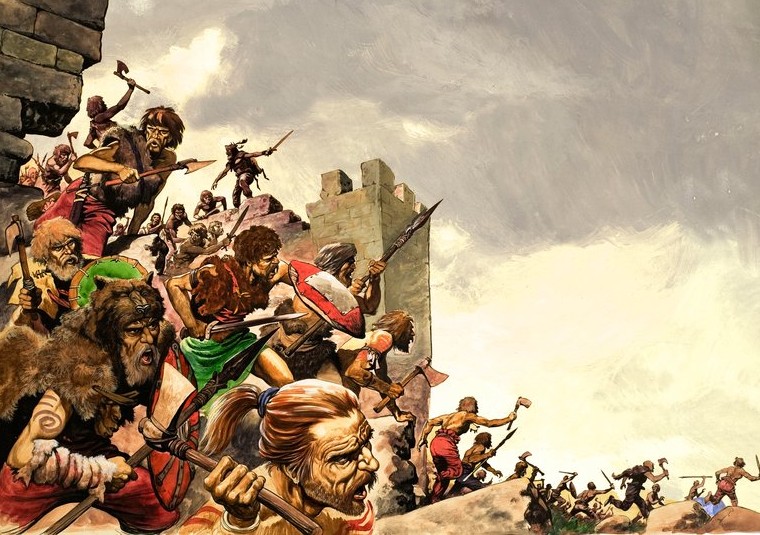
Cover art by Peter Jackson
Book of Leinster
Notes: This is one of the most extraordinary poems in the entire Irish corpus, a sweeping catalogue of the deaths of heroes spanning the full arc of Irish legendary and historical tradition, from the mythological age of the Ulster Cycle all the way down to the Battle of Clontarf in 1014 and beyond. It reads almost like a roll-call of the dead across all of Irish history.
The poem moves through deaths from the Ulster Cycle, Cú Chulainn, Conall Cernach, Fergus mac Róich, Cet mac Magach, Cú Roí, Furbaide, the sons of Uisliu then through the Kings Cycle with Art mac Cuinn, Cormac mac Airt, Muirchertach mac Erca then into genuine historical figures of the Viking Age including Niall Glundub (killed at Dublin 919), Congalach of Cnogba, and finally Brian Boru at Clontarf.
The closing stanzas are deeply personal and theological the poet steps forward in his own voice, reflecting that while all these heroes fell, the Son of God has protected him, separating him from the fate of the warrior-bands. It is a quietly moving ending to a magnificent poem.
Cináed Ua Artacáin himself died in 975 AD, so the references to Clontarf (1014) suggest the poem was either extended by a later hand or that the attribution is partly conventional. He was one of the most celebrated poets of the early medieval period and this poem stands as one of his greatest achievements.
Cináed Ua Artacáin:
The Warriors Who Were at Emain
The warrior-bands that were at Emain, at Ráith Cruachain, at Temair, at Luachair where heroes used to race, at Alind, at Iarmaig — they do not remain, their cattle are gone, though their deaths were many; their stories survive after them unless a fool conceals them.
Fergus mac Leite was a hero — he went against the beast in a rash, startled encounter; they fell together at the red ford of Rudraige.
[…]
Lugaid Lámderg laid them low upon Illand son of Fergus. On Sliabh Uillend, around which is a glen, Furbaide Fer Bend was slain — Lugaid Ríab nDerg struck him there in revenge for Cruacha of Clothra.
Amairgen — fierce was his wrestling, between great and small; in the morning at Imliuch Áe — together there is his grave at Áe.
The grave of Cú Roí is on Sliabh Mis; the grave of Lugdach under the flagstones of a fort; at Dún Binne — strength of his path — Fíamain son of Foroí was slain.
Cú Chulainn fell with venom upon the surface of Corthe Crumtherí; on Tráig Baile in clear conflict fell the Only Son of Aífe.
Erc son of Cairpre was taken in combat opposite Tara to the south; there is the grave of Lugdach, whoever comes, under the cairn in Mag Argetrois.
The grave of Fer Diad at the ford — beside Cú Chulainn all can see it. Cethern son of Fintan to the east fell at Smirommair.
Ercae Iuchna — fierce and lasting — at his destruction Luan fell, going out from his house. The grave of Loegaire Búadach was found.
Celtchair died — sad the tale — to the east of Dún Lethglaise; the death of Blaí Briuga through a woman’s fault in the south of the Assembly of Macha.
The killing of Cuscraid by Mac Cécht — from the spit of Celtchair — fierce the deed; Mac Cécht fell thereafter at the hands of Conall son of Amairgen.
The killing of the sons of Uisliu — it was treachery — at evening on the bank of Emain; it was not long after that betrayal until Fiacha was taken at Temair.
In their revenge — it was not slow — Gergend son of Illadon was taken; at the hands of the son of Ross — his grave was found — and Eogan son of Durthecht.
At the feast of Belcon the first wounding of Cet son of Magach was attempted. Belchú of Bréifne with his children — wounded by the arts of Conall.
Conall Cernach — fierce the deed — it is there he was slain in Mag Slécht; at Ráith Cruachain — a deed of the point — at his hand fell Ailill.
Fergus was slain early one morning by the spear of Lugdach at Findloch — that is the tale from which comes the single bird, fierce of Ailill.
Mes Gegra — routed at every rout — fell at the hands of crooked Conall, and his brain went forth over Munremur son of Gergind.
At the Battle of Étar — men were bound there — around Mes Dé son of Amairgen; leaping out from his fort fell Forgall Manach.
At the hands of Ferchess — though it was a sin — fell Lugaid Mac Con; and from that was taken in the contest Ferchess son of Commán the poet.
Art was taken above rusty Muccrama — until he was buried in Luachair Deirg; the grave of Cormac is in truth at the ford at Ros na Ríg.
The grave of noble Muirchertach is on the side of Clettech to the north-east; the grave of Tadg is in the glen that fair Findabair beheld.
The grave of Cellach is in the Bruig — in a death of cold — it does not decay; in Mag Muccrama there is the gravestone of Cían son of Ailill.
Mongán was the diadem of every company — he fell at the hands of the warrior-band of Cenn Tíre; at the hands of the warrior-band of Luagne — the death of Find — at Áth Brea on the Boyne.
Niall son of Eochaid fell above the English Channel — no hidden deed. Nath Í the bold was taken after victory from the mountains of the Alps to the north-east.
In Grellaig Dollaid there fell Finnachta son of Dunchada; in Mag Line — it was through treachery — fell Diarmait son of Cerball.
Fogartach son of Niall was slain at Druim Ríg, south of strong Tailtiu;
[…]
Fergal the fair of countenance fell in the Battle of the Bog of Almain. In the Battle of Uchbath was slain Bran — through the destruction of Áed son of Colgu.
The grave of Mál is in Druim Gam — he left behind a rush toward death — and the grave of the son of Con Crechta with Ferdomun of the single night.
The grave of the son of Carbad at Rea — it is long and great since Srub Rea — the grave of the son of Carbad at Druim Gat at the hands of the son of Inar son of Abrat.
The death of Brandub with sweetness at Cluain Senboth Síni; the son of Rudrach of the horses met death before the great, beautiful assembly of Masten.
Though the Battle of Ailbe is of great fame — the slaughter fell upon the Munstermen — whereby Cormac, height of the verse, was wounded before Tadg and before Cerball.
At Cenn Fuait — no deed of grip — Augaire son of Ailill; and the man who was loud of cry — Máel Mórda son of Muricán;
Niall Glundub son of noble Áed; Conchobar from Tulach Taidc; and Máel Dub, king of noble Airgialla; and Áed son of Eochucán — their slaughter was found without concealment before the fine, vigorous host of Dublin.
The son of Máel Mithig fell — Congalach of Cnogba the violent — at the hands of the free, fierce host of the foreigners at Inis Tigi Giugrand.
Dommall son of Lorcán — he was lame — since Murchad gave him his great defeat — a deed from which he met haste and hurry not going home alone at the second drinking.
At the Battle of Craíb — remember it — Eochaid son of Ardgar the noble, and Áed son of swift Dommall — it was a hard pull on the noble Uí Néill.
Many he brought to destruction — the death of Brian son of Cennétig — before the loud, valorous branch, before Máel Mórda son of Murchad, before the host of the victorious, prosperous foreigners, in the fruitful battle of Clontarf.
The battle at Sliabh Crott — remember it — it brought silence upon the host of noble Munster. Leinster, flooding in its fruit, from which Limerick got its quick heating.
The Battle of Monad Mór — great the rock — brought grief into Munster; the hosts of Leinster drowned Ua Bláit — horror of his good men around Diarmait.
Hard it is for them if they are in torment, without worship of the King who turns the sun; the fair Son of Mary has defeated them and separated them from their warrior-bands.
The Son of God has protected me until now despite the multitude of the enemies; it is he who has protected me since then so that I fall not with the warrior-bands.

The Druid's Cauldron
We are a registered non-profit, The Druid’s Cauldron Inc. 501(c)(3) The Druid’s Cauldron is an independent journal established in 2016, dedicated to the preservation and exploration of the druids, culture, native wisdom, and the living traditions of the isles. We exist to recover folklore, herbalism, spiritual philosophy, and ecological knowledge embedded in the roots of the early Irish Gaelic and broader Celtic world.
Through deep research into traditional folklore, herbalism and mythology as well as personal artistic endeavors, we seek to cultivate a deeper relationship with the land, the seasons, and to one another. We are committed to serious inquiry and evidence-based information, or it is alluded that it’s personal philosophy and labeled as such. The Druid’s Cauldron is a space for the curious, the contemplative, and those who feel called to remember older ways of being in right relationship with the land and each other.
Leave a Reply