
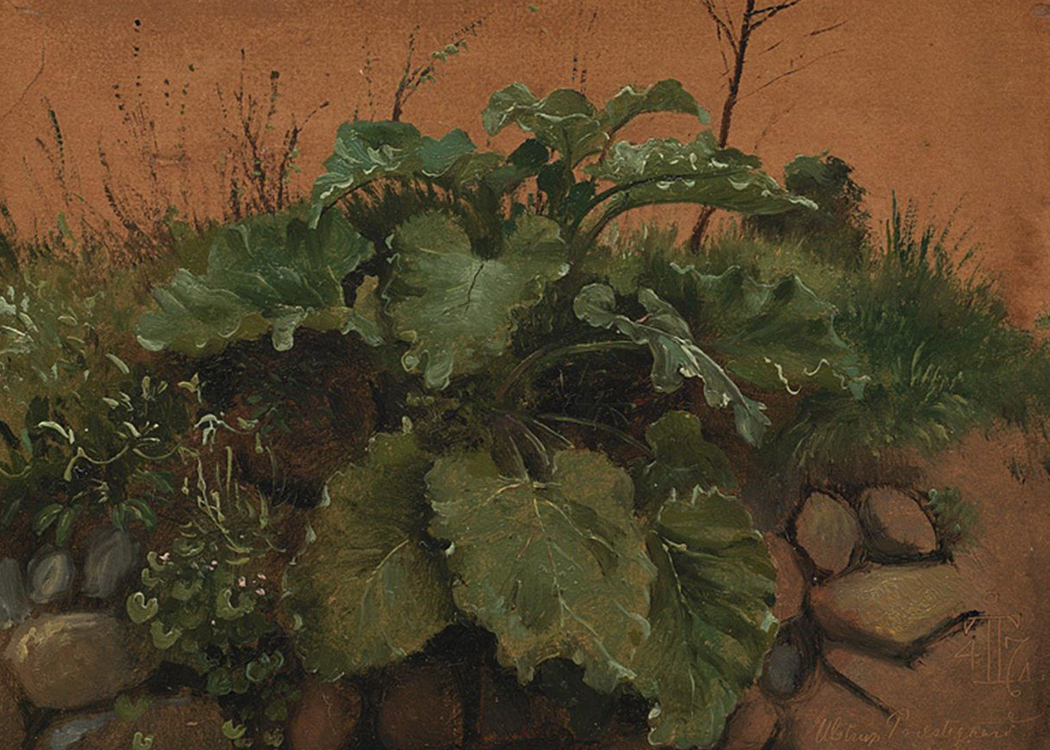
“(As a remedy for psoriasis, pityriasis or leprosy) Take the leaves of burdock, pound them well with a little wine and strain. Take three spoonfuls, night, morning and noon, and let a decoction of burdock be your only drink. The part should be fomented with the decoction also, a shot as you can bear it, and anoint it afterwards with an unguent composed of wine, olive oil and honey.”
Welsh Physicians of Myddvai, 1861
Cover art by Johan Thomas Lundbye
Burdock or Articium lappa or Articum minor are also called greater and lesser burdock, common burdock, wild rhubarb, thorny burr, butter-dock, beggar’s buttons, and love leaves. The bur of the burdock is called cnádán in Gaeilge and searcan, seircean or ‘meac-an-dough’ in Scots Gaelic. It’s also often called suirichean suirich, the ‘foolish wooer’ in both Irish and Scottish and refers to the burs and the manner in which they cling easily.1 As Ossian said, “Mar cheosan air sgiathan fior-eun, like bur clinging to the eagle’s wing.” The botanical name Articium derives from the Greek, arktos, or bear and lappa which means ‘to seize’. The common name Burdock is French meaning ‘a tangle of wool’.
Subscribe to get access – $5 a month

Isla Skye
Isla Skye is an American Celtic scholar, a mother of 3, elementary teacher for 21 years as well as an author and herbalist that splits her time between the States and Ireland. She has studied the druids and related practices for over 20 years. She is a published author of children’s books as well as other folkloric literature and is currently working through an M.A. in Celtic Studies. Her hobbies are family time, camping, hiking, reading, writing and research.


Leave a Reply