
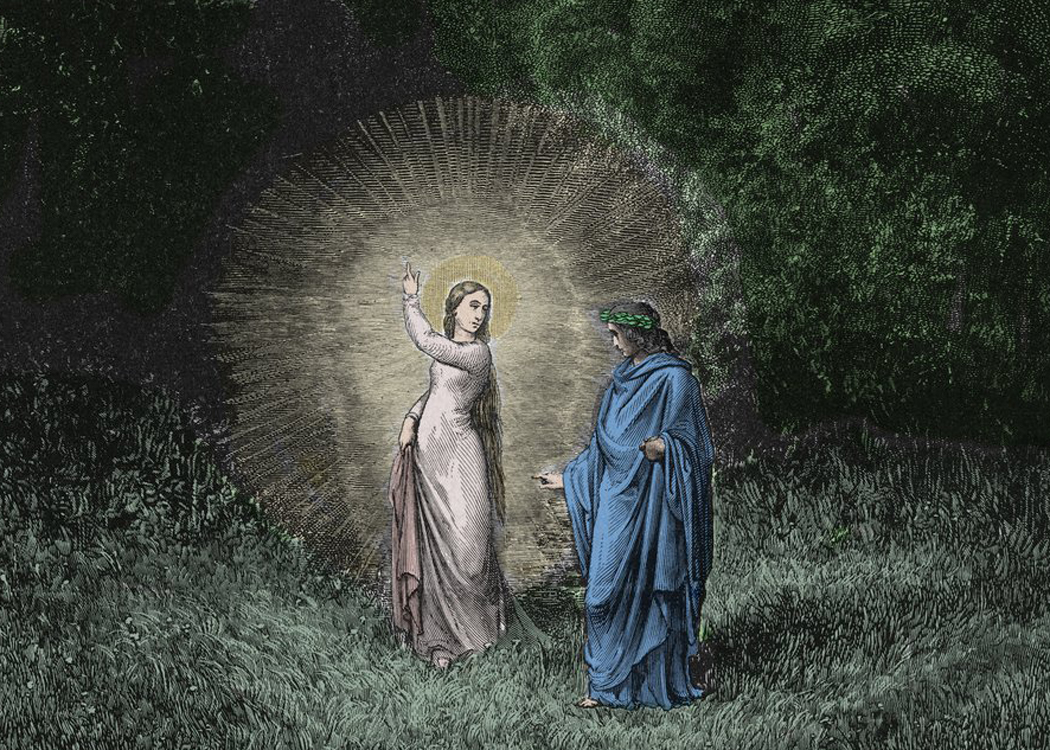
“Do you not behold the regions to which you have come?
The whole universe is comprised of nine circles. or rather spheres.
The outermost of these is the celestial sphere, embracing all the rest,
itself the “Star Goddess” (supreme god), containing all of the other spheres.
In it are fixed the eternally revolving movements of the stars. “
“The Dream of Scipio” from De Republica
by Marcus Tullius Cicero (106-42 BCE)
(names in “quotes” added by myself)
All art by Gustave Dore
The “Dream of Scipio” embraces many of the planetary correspondences included in the
Pythagorean concept of the Harmony of the spheres. In many ways, the Universe, that I have experienced both exoterically and esoterically, is very much like the short description of the “Dream of Scipio” listed above. In my own spiritual journeys, I have gone beyond the bounds of ordinary reality to walk the pathways of the Beyond. Such a place is the realm of the star Goddess. We’ve already encountered Cicero and his work when we discussed ancient memory techniques that may have been similar to those used by the Druids. I have chosen Cicero’s work as an illustration of the cosmology of the spheres for many reasons. First, because he was familiar with the philosophies of the Druids from his association with the Druid Diviciacus (who addressed the Roman Senate in 60 BCE), and secondly, because he followed the philosophies of Plato and the Stoics (Plato being a Pythagorean revisionist).

Thirdly, Cicero was an initiate of the Elyusian Mysteries, believed in reincarnation and life after death, as well as also having served as the chief Auger of Rome. Finally, Cicero was also a student of Posidonius, who was said to have possibly been the greatest expert on the Celts and the Druids of all time. Cicero publicly recognized the Druid Diviciacus as a philosopher, which clearly suggests that the Druidic beliefs and philosophies were considered to be on a par with those of the Pythagoreans (even though they were not the same). Both sets of philosophies believed in the reincarnation of the soul, in the existence of eternal regions beyond this world, in the literal execution of shamanic flight, and in the healing powers of music.
They each used the learning techniques of oral recital and memorization rather than writing. In fact, Cicero was a major proponent of ‘Memory Theaters’ while the Pythagoreans were practitioners of musical and numerical techniques. They both maintained that the self and the Cosmos were interconnected. Using the similarities to Druidic belief and practices that existed within the work of the Pythagoreans, and the memory practices and writings of Cicero, we will attempt to rediscover some of the relationships between the Ogham and the Cosmos.
Let’s start by considering two tables of correspondences: The Irish Harp-Ogham Relationships, and the Natural Concordance of Notes with the Planets, which was based upon the beliefs of the 12th century Neo-Pythagoreans:

I added ÓBoyle’s Ogham correspondences to a table of notes found within a Medieval
Concordance that was ascribed to the philosopher Boethius. I also restated the meanings of the Medieval qualities that were listed in that work. This re-assignment of names made the selection of the corresponding Irish Pagan deity names for the notes a much simpler task.

It has always been my contention that the realms of Land, Sea and Sky are physical parts of this world through which deity and spirit manifest to us. We are connected nine ways through the dúile and we live within the three realms that they constitute. The threes of the world and the self are reflected in the Cauldrons and the deities themselves. Vedic astrology even goes so far as to assign demons, ancestors and deities to each of the realms as well as dividing the houses of the Moon along these same lines. I’ve seen mention by Peter Berresford Ellis of such a division being a part of Celtic Astrological lore.

I quote from his The Ancient World of the Celts “It is from the sixth century AD that we begin to find a wealth of written evidence from the insular Celts concerning cosmology. From it we find that Irish cosmology falls into four historic phases. The pre-Christian phase, of which we only have fragmentary knowledge, indicates that the Celts shared the Indo-European knowledge of numerology, astronomy and astrology which emerges in the Vedas.” “Aibhistin, an Irish astronomer writing in AD 655, shows a masterful display of computational skills and in his text we find evidence of an ancient lunar-based astrological system which appears to have similarities to the twenty-seven lunar mansions of the Vedic system, called the Nakshatras. Aibhistin is the earliest medieval writer to discuss the relationship of the tides to the phases of the moon.
He is also the first Christian writer to proclaim that the Three Wise Men in the Gospel of St. Matthew were astrologers.” Many times, the Celts did not speak the names of their gods aloud in public, nor did they assign these names to the planets in a mundane way. It is thought that they did so in an esoteric and secret manner however. I’ve looked at Vedic deity/planet assignments and this is what I’ve been able to glean from that study:
This discussion of deity gender and how they relate to the planets is a favorite of mine. I am constantly looking for clues as to how they might be associated. One area in which I have looked for guidance is the Vedas and Vedic tradition. In Vedic Astrology, all of the planets are seen as male (The Lords that Wander) and all of the stars and constellations are seen as female. The Sun and Moon are considered to be planets. The rulers of the planets and their over-rulers are as follows:

If we were to seek to place Celtic deity names to these Vedic descriptions, then we would get IMO:

It is to be understood that deities do not map exactly from culture to culture. I’m certain we could have a long discussion as to meanings and roles of each of the deities that I’ve listed above. One point I would like to make is that the Vedic civilization considered the planets and Stars as incarnations or manifestations of the deities and not the entirety of the deity. I believe that the Celts also viewed them in this manner (we probably do much the same in modern religions). This concept goes along with my own view that the deities manifest in many items of our local life and area (rivers, streams, trees, wells, fires, stones, hills, mountains, storms, etc.), even as people at times.

Searles O'Dubhain
Searles O’Dubhain is an American Celtic scholar, writer and story teller who has been practicing Druidry for over 30 years. Searles created ‘The Summerlands’, one of the very first beloved online Celtic pagan communities in the early 90’s. He additionally published ‘Ogham Divination’, that lays a detailed and creative pathway of recreating and discovering the ancient ways of the Druids. This and much more available on his website.
Leave a Reply