
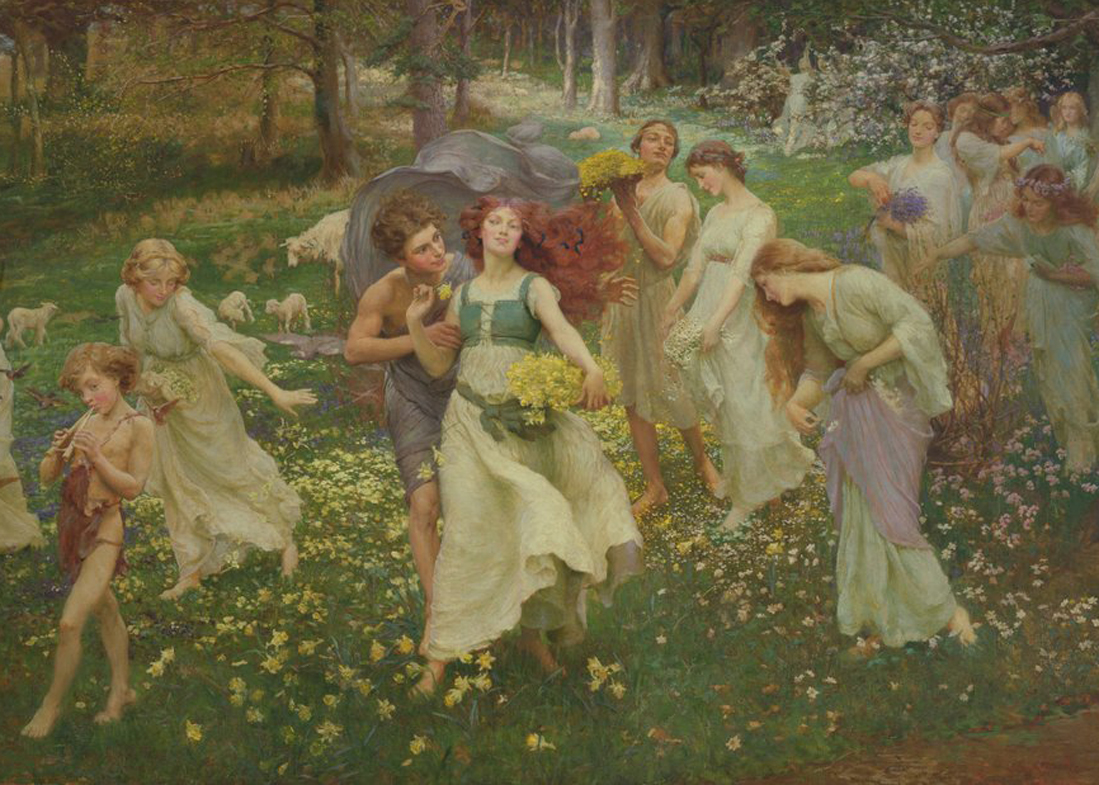
“Spring has returned. The Earth is like a child that knows poems.”
Rainer Maria Rilke
Cover art by Charles Daniel Ward
March 19 – March 21
The Spring Equinox is called Cónocht an Earraigh in Gaeilge and Alban Eilir in Welsh which means ‘light of the earth’.
The spring equinox is a fertile time when the sun is steadily growing warmer and the signs of spring are becoming very visible. For a pastoral people and agriculturally driven lifestyle, this must have been a very exciting time. Animals begin to become more active and it’s mating season for many creatures, big and small. Many animals that were already pregnant are now giving birth, hence why baby animals and especially baby lambs and sheep are common motifs. The hare, although normally only active at night, is now so frantic in an effort to mate that they are seen particularly often at this time and strongly associated with the fertility aspects of this year. Both the egg and the seed, are very ancient and literal symbols of fertility and naturally associated with spring and the equinox.

There were naturally quite a few folk traditions and practices that took place around this time in general. Nettles were heavily eaten and thought to prevent illness the rest of the year through.1 More specifically, in some instances, it was exactly three meals of nettle which is quite auspicious in the continued reference of the number three.2 Marriages were more common this time of year to the point of there being a common phrase, “Spring time, ring time”3 Weddings in the summer were actually considered unlucky which is interesting considering the majority of marriages now take place in the summer.4 If the first lambs you see in the spring are facing you, it’s a sign of good luck.5 There are countless other wonderful references to folk belief and superstitions surrounding springtime which varied of course depending on the locale.
As a gardener, I really loved this method of potato planting in the spring…
“Planted here every Spring. The land is first ploughed and then made into ridges (trenches for water to flow and not drown the plants). Afterwards, manure such as wrack from the sea-shore and bag-manure is spread on those ridges. Then the seed-potatoes are cut into slits, and spread about twelve inches apart on each ridge. They are then covered with clay, and left there for a few months until the stalks appear over the clay. They are then moulded in the month of May, and are sprayed with sulhare of copper in June or July. They are dug as required in July and August, but in September and October, all are dug up out of the ground, and are put into pits and left there until Spring. In Spring they are taken out of the holes, and are put into barns until used.”6

It’s not surprising that there were many ancient cross cultural festivals happening around this time of year celebrating the fertility of nature that becomes visible all around us. The Germanic celebration of Eostre or Ostara became overlapped with the Christian Easter, which is also a celebration of rebirth.
Any number of European goddesses representing fertility could have been celebrated at this time, including the revered Germanic Ostara or even Freyja and Irish Brigid. Many ancient stone circles and monuments align with the spring equinox including the Gossan Stones, Loughcrew, Knowth, Drombeg and the Grianan of Aileach. In Britain, Castlerigg stone circle may align with the equinox. There’s also possible alignments at the Callanish stones in Scotland and it’s speculated that the Men-an-tol stone hole formation in Cornwall is aligned or had something to do with the equinoxes. Although, there are certainly others that are simply less well known.
References
- The Schools’ Collection, Volume 0109, Page 286
- The Schools’ Collection, Volume 0975, Page 247
- The Schools’ Collection, Volume 0178, Page 088
- The Schools’ Collection, Volume 0651, Page 77
- The Schools’ Collection, Volume 0160, Page 304
- The Schools’ Collection, Volume 0137E, Page 02_015

Isla Skye / The Druid's Cauldron Historical Society
We are a registered non-profit, The Druid’s Cauldron Inc. 501(c)(3) The Druid’s Cauldron is an independent journal established in 2016, dedicated to the preservation and exploration of the druids, filid/poets, culture, native wisdom, and the living traditions of the isles. We exist to recover folklore, herbalism, spiritual philosophy, and ecological knowledge embedded in the whispers of our ancestors.
Through deep research into traditional folklore, herbalism and mythology as well as personal artistic endeavors, we seek to cultivate a deeper relationship with the land, the seasons, and to one another. We are committed to serious inquiry and evidence-based information, or it is alluded that it’s personal philosophy and labeled as such. The Druid’s Cauldron is a space for the curious, the contemplative, and those who feel called to remember older ways of being in right relationship with the land and each other.
Leave a Reply