
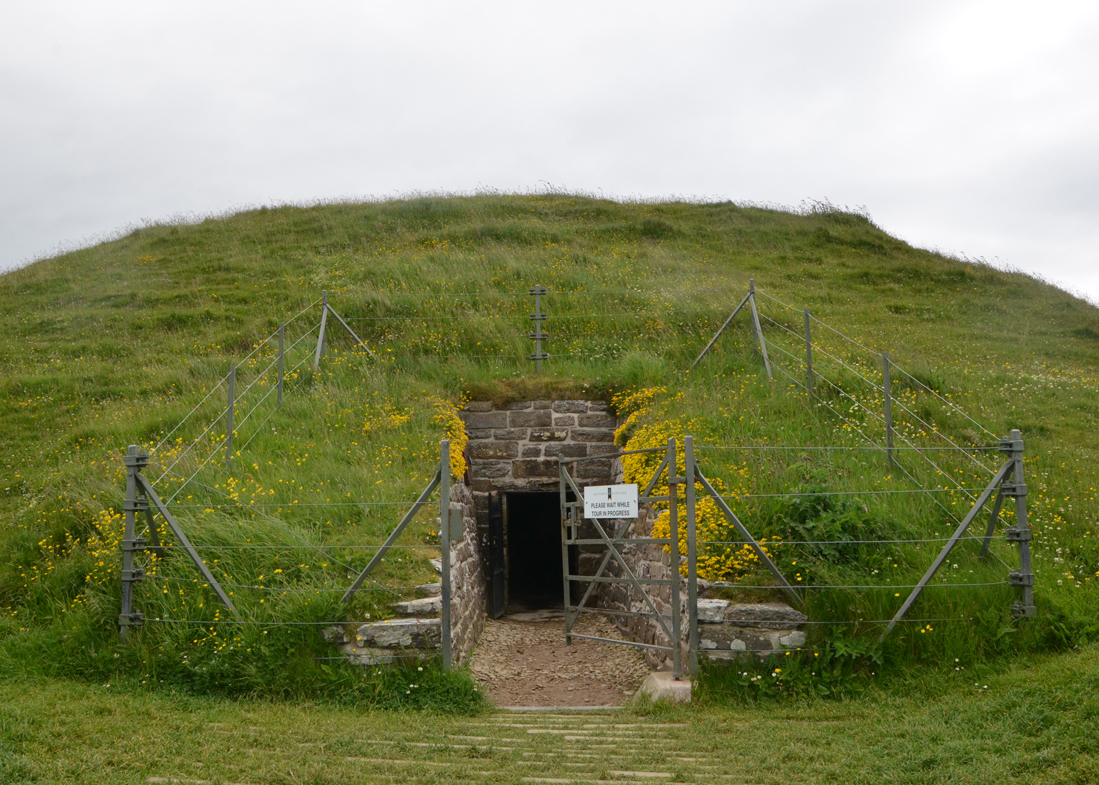
“Maeshowe stands as a monument to the Neolithic people’s understanding of the cosmos, a timeless link between the earth, the heavens, and the passage of life itself.”
M. A. J. Williams

Maeshowe, an iconic Neolithic chambered cairn, is located in Stenness parish on the Orkney Islands in Scotland. Estimated to have been constructed around 3000-2800 BCE, it is an ancient monument that holds immense historical significance.

The name “Maeshowe” is derived from Old Scandinavian, meaning “Meadow Mound,” as the area was once a meadow, and this is corroborated by Dr. Berit Sanders of Lund University. This large cairn is part of a collection of prehistoric sites in Orkney, including the Barnhouse Settlement, the Standing Stones of Stenness, and the Ring of Brodgar, all of which are culturally and historically significant. Despite the site’s prominence, Maeshowe is considered unique because of its architectural features and its alignment with certain celestial events.
Maeshowe is a large tumulus or mound, with a central chamber reached through a passage. The cairn has been historically categorized as a “passage grave” due to its long passage and the burial chamber inside, although human remains found at the site are minimal, with only fragments of bones and a portion of a skull being discovered. The cairn’s structure, combined with the long passage that leads into its chamber, hints at ceremonial purposes, with a heavy emphasis on alignment with astronomical events.

The site was first excavated in July 1861 by antiquarian James Farrer, following the recommendation of David Balfour and George Petrie, both of whom had worked on the excavation of Skara Brae. According to Farrer’s detailed account, Maeshowe’s exterior measured approximately 92 feet (28 meters) in diameter, 36 feet (11 meters) in height, and about 300 feet (91 meters) in circumference at the base. The cairn was surrounded by a trench, 40 feet (12 meters) wide and varying in depth from 4 to 8 feet (1-2 meters). It was located roughly 6 miles (9 km) from Stromness and 9 miles (14 km) from Kirkwall. The mound was originally conical in shape, but when the site was later placed under government care in 1910, a concrete roof was added, and the mound was reshaped to its present-day form.
Maeshowe’s architectural and cultural significance is immense, not just because of its historical construction but also due to the alignment with astronomical events. It is closely aligned with the midwinter solstice, and during this event, the setting sun illuminates the entrance passage and the chamber inside. This alignment is similar to that of other nearby megalithic sites in Orkney, such as the Ring of Brodgar and the Barnhouse Stone, which is positioned to align with Maeshowe’s entrance. The Barnhouse Stone is believed to have once marked the location of an older structure, perhaps a henge, before Maeshowe was built. The alignment of the Barnhouse Stone, along with the structure at Maeshowe, indicates that there was a deliberate attempt to align the site with solar phenomena, possibly for ritual or ceremonial purposes.
There is a possibility that the earlier structure at Maeshowe may have been replaced by the cairn, as suggested by the remains of Structure Eight at the nearby Barnhouse Settlement. This structure, built around 2600 BCE, was likely a ritual site, and it has been hypothesized that it may have replaced the original building at Maeshowe. The cairn’s construction, combined with the alignment to solar events and the Barnhouse Stone, suggests a strong connection to ritualistic practices. In fact, the phenomenon of “Solar Flashings” occurs at Maeshowe around 22 days before and after the winter solstice, where sunlight briefly flashes into the chamber through the entrance passage. This fleeting light could symbolize the return of the sun and the coming of brighter, warmer days.

One of the most intriguing aspects of Maeshowe is the discovery of runic inscriptions, the largest group of runes found in the world to date, along with carvings of a dragon. These runes were inscribed during the 12th century CE by a group of Norsemen who sought shelter in the cairn during a winter storm. The Norsemen’s involvement with Maeshowe is further corroborated by the Orkneyinga Saga, which describes an event in 1153 CE when a band of Viking warriors, led by Earl Harald, took refuge in Maeshowe during a snowstorm. The saga mentions the looting of the cairn by these Norsemen, though there is no definitive evidence of this event. Farrer himself believed that the Norsemen had ransacked the cairn, though he acknowledged that it could have been in a dilapidated state by the time they reached it. The saga and the runic inscriptions indicate that Maeshowe was a well-known and accessible site to the Vikings, who may have used it for shelter or perhaps for other ritualistic purposes. The inscriptions found inside the chamber, including the phrase “Jórsalafarar brutu Orkhaug,” meaning “Jerusalem-travelers broke Orkahaugr,” confirm that the Norsemen recognized the site as Maeshowe.
The idea that the cairn once held a great treasure is suggested by some of the runic graffiti that refers to a “great treasure” being removed from the site. However, there is no physical evidence of a treasure, and the only items discovered during the 1861 excavation were horse bones and a part of a human skull. The notion of treasure may have had a different meaning in the ancient context, perhaps referring to objects of ritual significance rather than material wealth. A Grooved Ware pot discovered in Structure Eight of the Barnhouse Settlement contained flint, a material highly valued in Orkney at the time, which could have been regarded as a treasure hoard.

The blocking stone at Maeshowe, located within the entrance passage, further supports the theory that the site was used for ceremonial purposes. The alignment with the midwinter solstice, as well as the proximity to other ritual sites such as the Barnhouse Settlement and the Ness of Brodgar, suggests that Maeshowe played a key role in the religious practices of the Neolithic inhabitants of Orkney. As excavations continue at the Ness of Brodgar, it is possible that new discoveries will shed light on the exact role of Maeshowe within the larger ceremonial landscape of Orkney.
Maeshowe’s cultural significance extends beyond the Viking period, as it represents a central landmark in the prehistory of Orkney. The site has been associated with various local traditions, some of which suggest that the cairn continued to hold significance well into the medieval period. One such tradition, recorded by George Marwick in the 19th century, recounts how young women were required to bring ashes to the top of Maeshowe during every full moon. This suggests that Maeshowe was still seen as a place of ritual activity even long after its original construction.

Another theory, often popularized in folklore and myth, is that Maeshowe served as a portal to the “otherworld.” According to this view, the tomb was not only a burial place but also a gateway to the realm of the dead, where the souls of the deceased could pass on to the afterlife. This idea ties in with the rich local folkloric tradition of Celtic and Norse mythology, where certain places, often linked to the earth and the cosmos, were believed to be the intersection of worlds.
The history of Maeshowe is a testament to its enduring importance in the landscape of Orkney. The cairn continues to fascinate archaeologists and visitors alike, and as research progresses, we may gain further insight into the role it played in the ancient rituals of Orkney’s inhabitants.


Isla Skye
Isla is an American Irish mother of 3, teacher, author and herbalist that splits her time between the states and Ireland. She has been studying folklore as well as the druids and related practices for over 20 years. Her hobbies are family time, reading, camping, hiking, spending time with her many animals as well as writing and research.

Isla is an American Irish mother of 3, teacher, author and herbalist that splits her time between the states and Ireland. She has been studying folklore as well as the Druids and related practices for over 20 years. Her hobbies are family time, reading, camping, hiking, visiting sacred sites, spending time with her many animals as well as writing and research.
Leave a Reply