
“Woods and groves are the sacred repositories; and the spot being consecrated to those
pious uses, they give to that sacred recess the name of the divinity that fills the place,
which is never profaned by the steps of man. The gloom fills every mind with awe;
revered at a distance and never seen but with the eye of contemplation.”
Tacitus
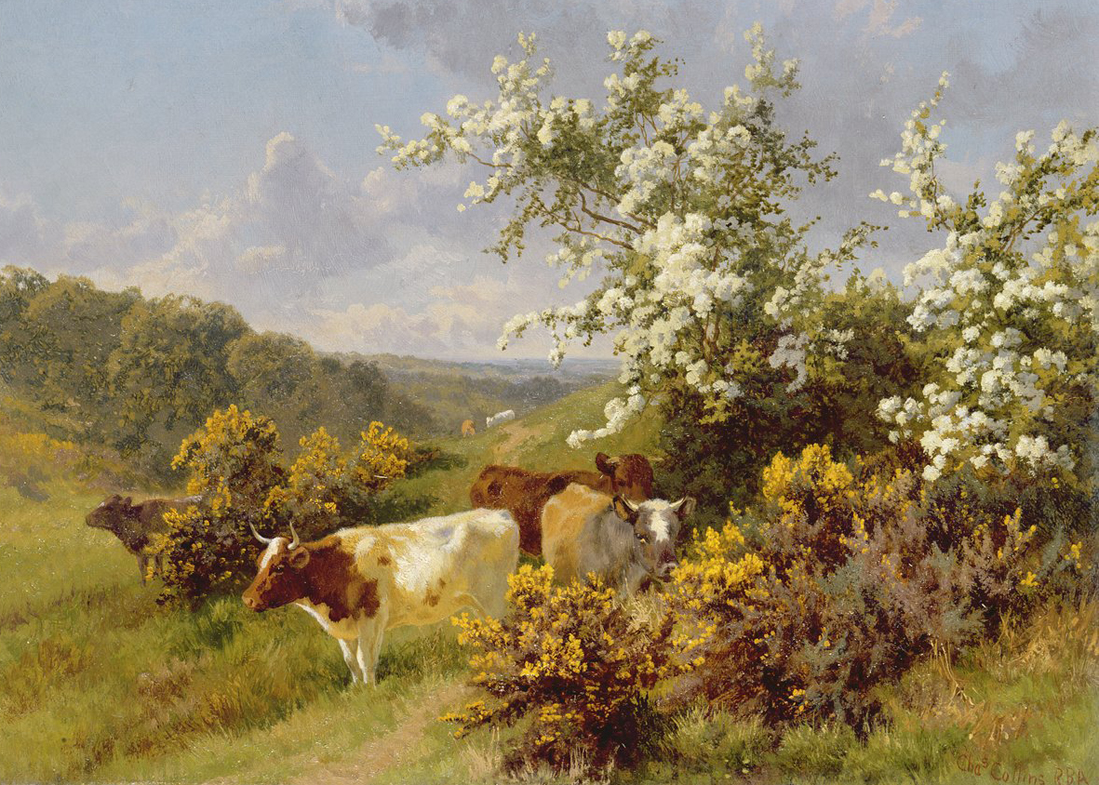
All art by Charles Collins
Perhaps Tacitus was referring to memory groves of the mind when he spoke about the Druids’ sacred groves? I doubt that he ever set foot in one and was probably going on what the Druids told him. I would not put it past them to have played a royal punning practical joke on him and their classical historians.
Each of us contains many, many memory groves of information within our own personal
memories. We can each visit and recite from these memory groves over and over, perfectly without failing (even though this ability may not be obvious to us, since we take it for granted). We’ve naturally created memory groves for ourselves as we’ve experienced life and engaged in discourse with other people. We probably could have created more such memory groves, but the modern educational system did not properly train us for or instruct us in this technique. This lack of proper memory training is primarily due to the use of books, libraries and files as aids to memory and the retrieval of knowledge. That is how we are educated today. We are taught to use books as references rather than to rely upon our own memories. Such was not the case among the ancients and the Druids in particular. They were taught techniques that allowed them to remember the histories, laws, lore and traditions of their people.

Modern scholars point out how oral traditions unreliably preserve information. They consider that the followers of such traditions corrupt orally preserved knowledge. What these scholars fail to realize is that speakers and poets of many ancient civilizations studied and developed techniques of the mind and memory that assisted them in preserving and maintaining traditional knowledge (such as the Coimgne). These memory techniques were developed and used because they did not readily have the necessary materials to write them down. How such oral traditions could have been constructed so that the knowledge would have been easily remembered and accurately retained without change is what a Memory Grove and the Ogham lists are all about. As has been previously stated, we each contain many memory groves of information that represent a personal oral tradition (albeit an informal and somewhat untrained one). Just what are these memory groves that we each contain and how is it that we modern people can retain such knowledge reliably?
The Stories of Numbers and Letters
The first memory grove that we normally encounter in our modern lives is the story of numbers. This ability is closely related to the memory grove of letters that we are also taught at about the same time. Each of us could probably reliably tell the story of the numbers from one to one million or the letters from A to Z., as well as retaining thousands of word spellings, definitions, songs, poems and stories. If we needed to repeat the numbers we’ve learned, we’d simply count them off, using the memory of the numbers from one to ten and the concepts of decimal structure (i.e. tens, hundreds, thousands, millions, etc.). Most of us retain these counting memories for our entire lives. The story of numbers remains the same story for each of us in the languages that we’ve learned from birth: In the case of English, the number “one” would be followed by “two” and then “three” and then “four” and so, on up to a million or more.
The repetition of the sequence of the numbers has an internal relationship. This internal structure of relationships helps us to keep the story of the numbers straight. Because we have an idea of their structure and sequence, we can easily and accurately repeat each number in its proper place. The entire process may be very dull and obvious, but the numbers are accurate and repeatable. The story of the letters (“A, B. C…Z”) or the alphabet is similar to that of numbers though the relationships differ. Each of these sequences is accurately remembered and has been so remembered for hundreds if not thousands of years. The numbers and the alphabets are a part of our current oral tradition and
re accurately remembered by most of society. The ability to accurately remember information is one that most of us possess though we do not develop it beyond the fundamental skills that are required by our present society and lifestyle. It’s clear from these two examples that humans can accurately remember large quantities of information if its structures and sequences are well defined.

The Rhythm of Sequences and Songs
Let me touch on a few more of the ways that we are taught to remember knowledge in our
modern world, before I discuss the ways in which the Druids of old went beyond us in these
skills. The examples of numbers and letters probably have you saying, “So what?” Such
common, simple examples warrant the making of such a remark. A way in which most of us
remember more complex knowledge is by the use of the techniques of sound, rhythm and tonal qualities. This may seem like a complicated academic approach to memorizing, but is really no more complicated than the techniques of numbers and letters. The most common examples of sound, rhythm and tonal qualities that each of us experiences in today’s world are called “songs”.
Each of us can probably remember hundreds of songs accurately, though we may not eloquently perform them. Their words and tunes are each accurately remembered within our brains. While listening to a performance, most of us could certainly tell when and where a performer might have departed from the correct reproduction of the words or the music of our favorite songs. Professional singers and entertainers have larger repertories of songs in their own memories that dwarf those of the average person. This is because they have trained themselves in the art and possess a focus on music and art. Actors and stage performers also evidence this type of memory accuracy and training in their oral recitals and film or television performances. Each of them accurately remembers the words of the plays, scripts or performances that they have studied. This ability to remember and recreate is found in their individual performances in the specific nuances of inflection, mood, setting, emotional stresses, and delivery.
We have all seen how such performers can accurately remember and recite their repertories each time that we go to a play, attend an opera, listen to a radio or watch a television. The ability to accurately remember is a common ability to most of mankind. This ability is not exceptional. It need not be limited to actors, musicians and stage performers. We can each accomplish such acts of accurate memory storage and recital. We just do not practice the ancient memory techniques enough in today’s world. One of the main reasons for this loss of mental discipline in modern life can be attributed to reliance on written notes, computer files and books.

Searles O'Dubhain
Searles O’Dubhain is an American Celtic scholar, writer and story teller who has been practicing Druidry for over 30 years. Searles created ‘The Summerlands’, one of the very first beloved online Celtic pagan communities in the early 90’s. He additionally published ‘Ogham Divination’, that lays a detailed and creative pathway of recreating and discovering the ancient ways of the Druids. This and much more available on his website.
Leave a Reply