
“Persons desiring to train this faculty (of memory) must select places
and form mental images of the things they wish to remember and store
those images in the places, so that the order of the places will preserve the order of things, and the images of the things will denote the things themselves, and we shall employ the places and images respectively as a wax writing tablet and the letters written on it.”
Marcus Tullius Cicero (circa 106-42 BCE) in regard to Simonides in De Oratore, II, lxxxvi, 351-4 as provided in The Art of Memory by Frances A. Yates
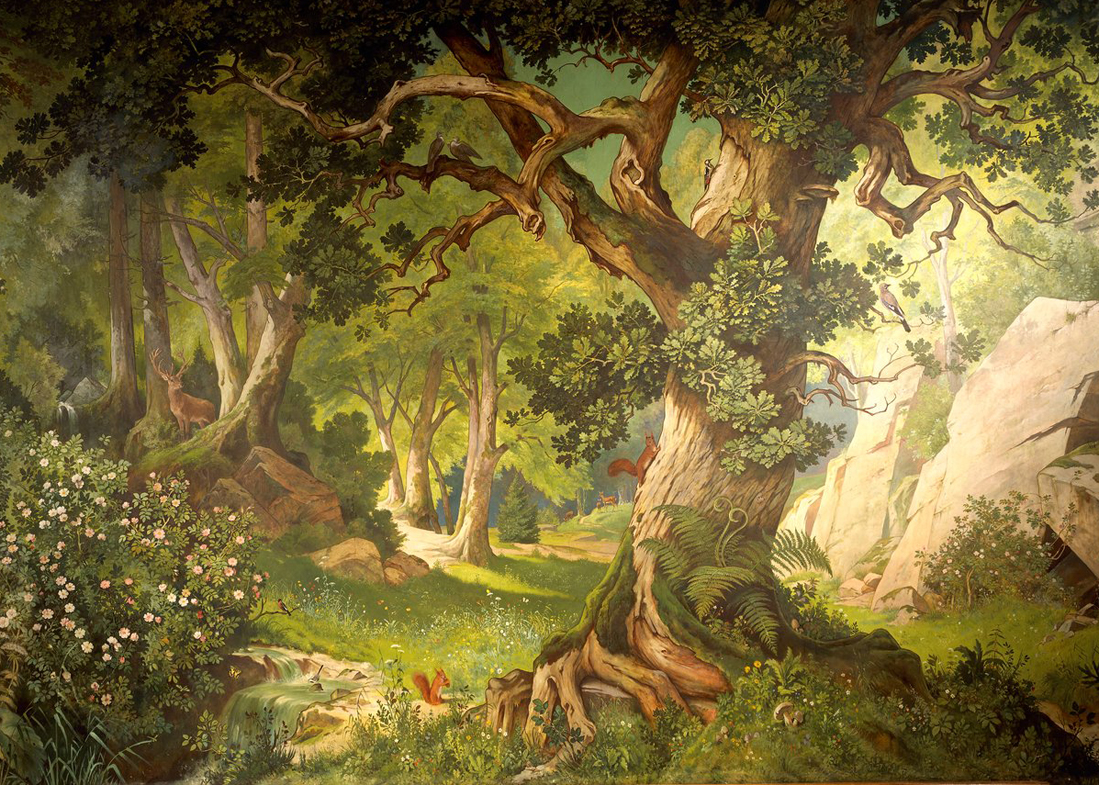
All art by Christian Jank
Many debates occur about whether oral memory techniques are reliable and accurate. Many scholars would have us believe that the memories of the Draoithe and Filidh were no better than a party of youths playing the game of “Post Office.” In this game, a phrase is passed around a circle of people, repeated in whispers from one to another until it returns to the original sender. In the process of its transmission of information, the tale or phrase is changed until it becomes completely different and unrecognizable to its author. While this phenomena is observably true among untrained and casual memories at parties, I maintain that it is far from the truth when considering the trained minds and memories of the Druids and other ancient scholars.
It is in the science and the art of memory that we will discover how oral history may be preserved within memory theaters and groves of the mind. As with the techniques of memory mastery, let us begin as the ancients did, at the beginning of the art of memory with a story.
The Father of Memory

The Greek Poet Simonides of Ceos chanted a poem at a feast hosted by Scopas of Thessaly in which he included a praise passage regarding the Gemini Twins, Castor and Pollux. Scopas attempted to only pay the poet for half of the poem, saying that Castor and Pollux should pay the other half, since the praise was half theirs. And half his. At some point in the feast, a message was given to Simonides that the Twins were waiting outside to see him. When he went out to see them, the roof of the banqueting hall collapsed crushing his host and all the guests beyond recognition. The families were unable to determine which body was which and could not accomplish their burials. Simonides was able to visualize the feasting hall, the names of the guests and the order of their seating. It is said that from this experience, he was able to determine that orderly arrangement is one of the prerequisites to accurate recollection.
The Five Parts of Rhetoric
Marcus Tullius Cicero, another orator and person of phenomenally reputed memory, taught that memory was one of the five parts of rhetoric and that the use of places and images were essential to improving the recollection of long rhetorics with unfailing accuracy. Cicero defined the five parts of rhetorics as:
Invention, being the discovery of true things in detail so that one’s case is well supported.
Disposition, defining the arrangement of the details in the order that they have been discovered.
Elocution, selecting words suitable to describe what has been discovered.
The Mnemonic Principle
Memory, preserving the firm perception in the soul of things and words.
Pronunciation, dignifying the presentation of words and truth through a varying of the qualities of the voice and the posturing of the body.
An early anonymous work on rhetoric is known as Ad Herennium and was preserved because it was thought to be by Cicero. It describes a way of using vivid images to fix ideas in memory so that they will last in the long-term memory:
We ought, then, to set up images of a kind that can adhere longest in memory. And we shall do so if we establish similitudes as striking as possible; if we set up images that are not many or vague but active; if we ornament some of them, as with crowns or purple cloaks, so that the similitude may be more distinct to us; or if we somehow disfigure them, as by introducing one stained with blood or soiled with mud or smeared with red paint, so that its form is more striking, or by assigning certain comic effects to our images, for that, too, will ensure our remembering them more readily. The things we easily remember when they are real we likewise remember without difficulty when they are figments. But this will be essential – again and again to run over rapidly in the mind all the original places in order to refresh the images.

The Artificial Memory
Another early work on memory is Instititutio Oratia by Quintilian circa 1st century CE. Quintilian details the rules for creating the artificial memory used by early poets and speakers. The artificial memory is described as being:
…a spacious house divided into a number of rooms. Everything of note therein is diligently imprinted on the mind in order that thought may be able to run through all the parts without let or hindrance. The first task is to secure that there will be no difficulty in running through these, for the memory must be most firmly fixed which helps another memory. Then what has been written down, or thought of, is noted by a sign to remind of it. This sign may be drawn from a whole ‘thing’, as navigation or warfare, or from some ‘word” for what is slipping from memory is recovered by the admonition of a single word… These signs are then arranged as follows. The first notion is placed… in the forecourt; the second… in the atrium; the remainder are placed in order all around … and are committed not only to the bedrooms and parlors, but even to statues and the like. This done, when it is required to revive the memory, one begins from the first place to run through them all, demanding what has been entrusted to them, of which one will be reminded by the image. Thus, however numerous are the particulars which it is required to remember, all are linked one to another as in a chorus nor can what follows wander from what has gone before to which it is joined, only the preliminary labor of learning being required.
What I have described of as being done in a house can also be done in public buildings, or on a long journey, in going through a city, or with pictures. Or we can imagine such places for ourselves.
We require therefore places, either real or imaginary, and images or simulacra that must be invented. Images are as words by which we note things we have to learn, so that as Cicero says, ‘we use places as wax and images as letters’.
Here in the works of Cicero, in the anonymous author of Ad Herennium, and in Instititutio Oratia by Quintilian, we find descriptions and details of how to order, to construct and to use artificial memory as an aid in performance, poetry, rhetoric and public speaking. It is my opinion that the Druids were aware of these feats of memory by their contemporary poets and scholars, using similar techniques to assist their own phenomenally renowned memories. The idea of recording memories as writings within the mind and using its symbols as indices into lists of objects and places is exemplified by the Ogham lists in the Auraicept na n-Éces, the Scholars Primer of the Filidh. Among the trees of the Nemeton and within the structure of Ogham as well as its mandalas and diagrams, we will find our own Druidic memory groves of the mind.
To be continued…

Searles O'Dubhain
Searles O’Dubhain is an American Celtic scholar, writer and story teller who has been practicing Druidry for over 30 years. Searles created ‘The Summerlands’, one of the very first beloved online Celtic pagan communities in the early 90’s. He additionally published ‘Ogham Divination’, that lays a detailed and creative pathway of recreating and discovering the ancient ways of the Druids. This and much more available on his website.
Leave a Reply