
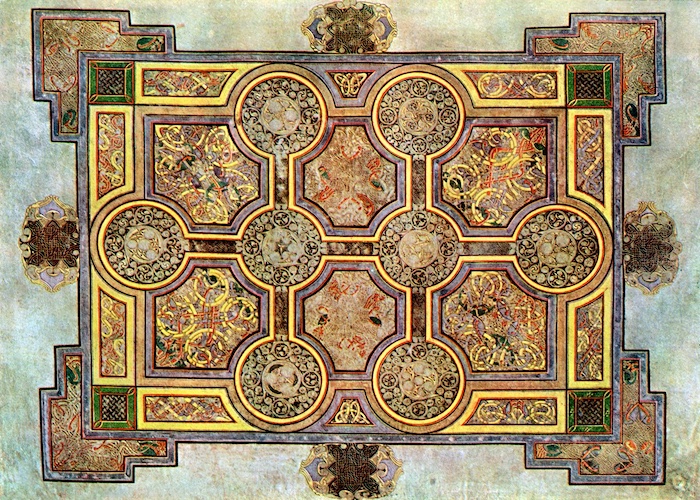
Art is from the Book of Kells
In the first year of study, a fledgling Filidh (known as a Fochlac) would study Ogham, grammar, and tales only. No poetry was involved. In the second year of the Mac Fiurmedh, the knowledge base was built upon a study of Ogham, introductory poetry and more tales. The third year of study covered Ogham, philosophy, poetry, and advanced grammar. At the completion of this study, one was considered a “Dos”.
In the fifth year of study, the curriculum included Brethna Nemed (“Law of Privileges”), Eman (“poems with couplets sharing form and meaning”/ simple spells), and even more of the tales. At the completion of this study, one was considered a “Cana” (a singer of tales and poems…perhaps even a Bard?). Year five included more grammar and more tales. The sixth year of study introduced the secret Language of Poets, Nuath (“Poetic Elegies”) and more tales. In the seventh year one studied the Brosnacha (“miscellanies”) and the Laws of Bardism. At this point, the study moved beyond mental and physical exercises into more esoteric practices. The eighth year saw the study of Prosody, Dindshenchas (“Place name origins”), Teinm Laegda (“Divination by use of song”), Imbas Forosnaí (“Illumination by use of the Hands”), Dichetal Do Chennaibh (“Inspiration by means of the Fingers”). This was the Filidh level of Cli (this word seems to be associated with the body and heart as well as with apple trees). After the 8 th year, a Filidh was expected to be able to compose his/her own incantations, poems and spells. In the ninth year, Sennat (“Poems of Ancient Wisdom”), Luasca (“Chants of swinging and Rhythmic Oscillation”), Nena (“Truthsaying?”), Eochraid (“Warding and shielding?”), Sruith (“Veneration” – Calling the Ancestors?) were studied.
In addition to continuing a study of poetry and lore, the Filidh learned the technique of Duili Feda (“Mastery of the Elements”) in the tenth year. At this level, one became an Ánrad (A Filidh of second degree which in Old Irish means “a hero, warrior, champion”), a formidable Druid/Filidh of great power. The following year centered around the poetic form called Anamain, “Magical Toning and Use of the Breath.” In the final year of study, the Ánrad studied and wrote: Cetals, “Religious Chants”; the Four Arts of Poetry; more tales; Anruth, “Glorious Victories.” Achieving the spiritual knowledge of this year qualified one to the title of Ollamh, “Master Druid/Filidh/Poet/Doctor.” Such Druid greats as: Morann Mac Main, Amergin, Nede Mac Adne, Cathbad, and Mug Roith, practiced their arts at this level of Draíocht.

The Ollamh was the highest level of the Filidh in ancient Gaelic society. These masters were on a level with kings (indeed, the King of Tara could not speak until after the chief Ollamh had first spoken). The job of the Ollamh went beyond mere words and music, serving to bridge the gap between this world and the Otherworld at times. Specifically chosen music and poetic meter accompanied poetical recital.
These meters were chosen from the “Dan Direach” (a body of poetic knowledge containing over a hundred separate meters, each a specific poetic significance and application). Each such meter had an individual title, such as “Rannaigheacht dialtach mhor,” (“great one-syllabled versification”), and an accompanying explanatory formula. The music that was provided to accompany poetic recitals was normally played on the harp, using the three strains of the poet:
- The “Goitrai” or the “ Sorrowful Strain,” so that anyone who heard the music would weep;
- The “Geantrai” or the “Joyful Strain,” so that the listeners should laugh in delight;
- The “Suantrai” or the “Sleep Strain,” so that dreams would come along with sleep.
Beyond the three strains, the accompaniment of the harp, and the hundred poetic meters, as well as the thousands of carefully remembered and recited words, was the Magick of Filidecht. It is my belief that this Magical power of the harp and the three strains was derived from the Ogham, and its ability to link words, music, dúile and cosmos. Just as Amergin stilled the waves and cleared the mists; or as the Dagda called forth the seasons with his harp, so it was (and is) that the Ogham have tied Filidecht to the harmony of the stars:
“Come Daur-dablao, Come Cetharchair, Come summer, Come winter, Mouths of harps and bags and pipes!”
Twelve years of study were required to become an Ollamh. Before I attempt to develop the specific links between the Ogham, music, the planets and the stars, let’s see what keys were used by the Filidh to pass through the doorways of the Wise. As I’ve previously stated, it is my thinking that the Ogham were such keys. They are the Eochra Éocsi.

Let’s see how the Ogham were used in Celtic Magic, Draíocht and Filidecht. Discovering such techniques (and their use as keys) is difficult at best, because such information was not well documented. In fact, the use of Ogham by the Celts and the Druids seems to have been purposely concealed (many statements exist in the writings regarding the attitude that Ogham were reserved for the “learned” classes). There are references to the practice of “crannchur” (the casting of lots using wood or stone).
There is also mention of “fidlanna” (a word that means “the placing and/or carving of Ogham fedha for use in divination”). The game of “fidchell” (wood wisdom) was an early forerunner of chess and a favorite of kings and nobility (as well as the gods…it was sometimes played to determine the fate of mortals). The Ogham are also mentioned to be the “eochra éocsi” (keys of wisdom/seership) in several texts. To discover the ways that Ogham were used, I had to seek my own “Imbas Forosnai” and await that “sudden knowledge of illumination” that comes out of the darkness, as well as using some good old fashioned common sense. It is my belief that each Druid eventually established his/her own set of Magical Ogham meanings.
These meanings and associations would have come out of the “inner work” that each student was expected to perform (in this, the Ogham would be akin to the Runes, which Odin was said to have “received” while suffering a shamanic death, a sacrifice of himself to himself). The Ogham tables would then have become the “keys” to that Druid’s own personal or family gods. These keys would then have been used to divine the future, commune with the Gods, or to travel spiritually (pathworking, Imbas Forosnai). I further believe that this type of “secret wisdom” is implied within the Ogham structure known as Fionn’s Wheel (or Fionn’s shield). There are many legends about this Magical structure that tell how Fionn and his shield acquired wisdom and Draíocht, but that is another story. There were other general and Magical meanings to the Ogham, but these seem to have been lost in the fires of history. One thing that appears to be obvious from their structure and their associated lists of correspondences is that the Ogham were used to allow the Druids and Filidh to become “Masters of Memory.”

Searles O'Dubhain
Searles O’Dubhain is an American Celtic scholar, writer and story teller who has been practicing Druidry for over 30 years. Searles created ‘The Summerlands’, one of the very first beloved online Celtic pagan communities in the early 90’s. He additionally published ‘Ogham Divination’, that lays a detailed and creative pathway of recreating and discovering the ancient ways of the Druids. This and much more available on his website.

Leave a Reply