
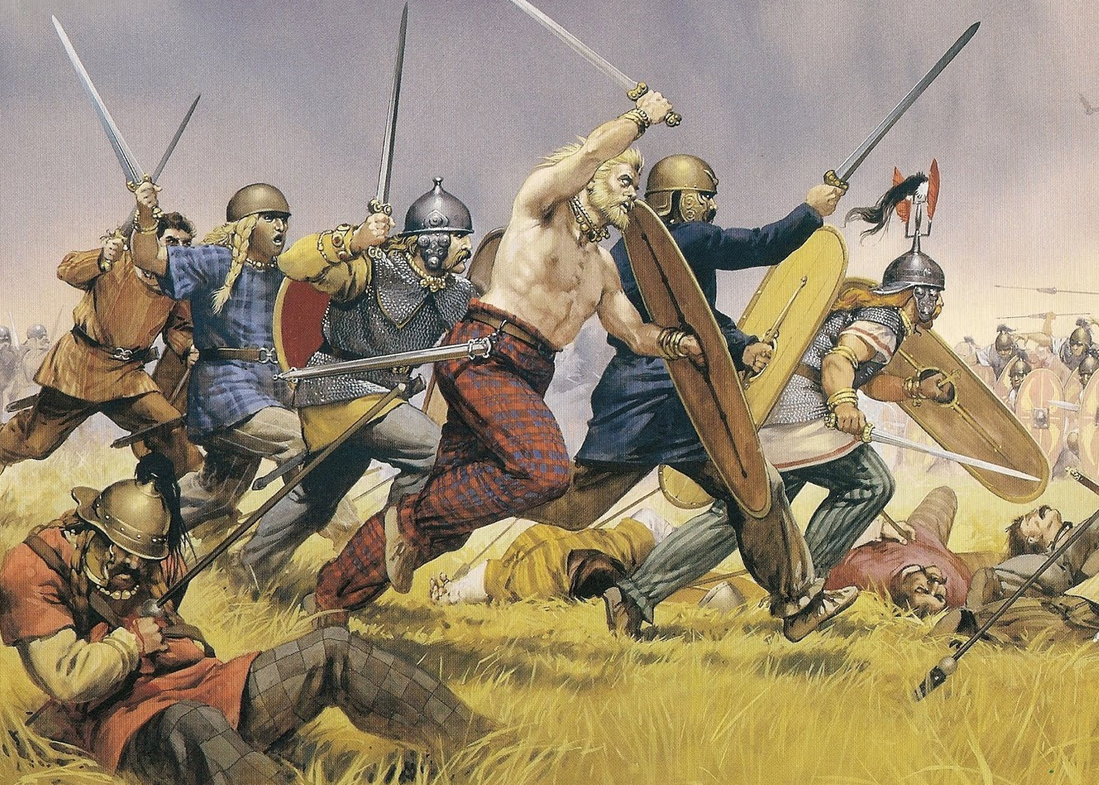
“For the sake of honor, a virtuous man will stand his ground and perform brave deeds. But as we have noted before, there is no name for those who carry this sort of quality to the extreme, being absolutely without fear, not even being afraid of earthquakes or waves, as they say of the Celts”
Aristotle (Greek, 384 – 322 BCE)
Cover art by unknown artist
While a lot of learned material that surrounds the Druids and various Celtic nations concerns the positive aspects of wider cultural norms, there is of course another side regarding warfare and sacrifice as well as a widespread belief in the head being of spiritual significance. These particular topics are generally skimmed over in the modern spiritual community but there are many breadcrumbs embedded in these historical transcriptions and classical quotes that can serve as guideposts to the challenges that beset them and therefore allow us yet another window to better understand them. The various Celtic tribes were undoubtedly renowned in the classical world for their fierceness and skilled use of weaponry.
We can speculate given their once large expanse that they simply would not have been as successful otherwise. We could wonder to what extent they destroyed or allowed conquered people to join their individual communities. Ultimately, we will never be certain but historical evidence points to it being a mix of both and more of the latter. They were not ones to murder a conquered people unless strongly provoked. In fact Greek writer Polybius in the 2nd century BCE went as far to say they merely “…rendered many of the neighboring peoples subject to them, whom they overawed by their audacity.”1

Ultimately what often became the cause of defeat was not their lack of military prowess but their lack of ability to formally unite under one king or recognize themselves as one united people in general. Their loyalty to their individual tribe was often so strong that to pledge loyalty to someone else, even for the greater good, was not without challenges. This issue was highlighted by Roman historian Tacitus when he said, “They were once ruled by kings, but are now divided under chieftains into factions and parties. Our greatest advantage in coping with nations so powerful is that they do not act in concert. Seldom is it that two or three states meet together to ward off a common danger. Thus, while they fight singly, all are conquered.”
The Romans in continental Gaul often exploited this fact not only on the mainland but also in Britain. Roman politicians frequently bartered and made promises of protection to various leaders in exchange for loyalty and may have possibly even held hostages with force to increase persuasion. The Romans were easily able to pick off various nations one by one and to add insult to injury, they committed genocide against a purported hundreds of Druids on the Isle of Angelsey in modern Wales. The Druids most certainly would have helped establish a social and political means of rousing any sense of unity amongst their people.
Of course there are absolutely instances where a particular leader was successful in joining multiple tribes to battle together. Particularly, those stories of Calgacus in Caledonia, Bouddica in Britain and even later on with Brian Boru in Ireland and Robert the Bruce in Scotland come to mind. The back and forth battles between all of these various cultural groups from the Gauls and Germanic people with the Romans, Greeks and Britons in the classical era are well known and documented. Alliances and land ownership changed dramatically within just a few hundred years. Interestingly, the Gauls came one battle away from nearly completely eliminating the Roman entity in its entirety before it really even gained a foothold in Europe in the famous Battle of Allia led by Brennus of the Senones in 387 BCE.2

If it wasn’t for disease ravaging the remaining Gaulish soldiers causing them to retreat while Rome was at their mercy, we may very well have an entirely different classical as well as religious Roman Catholic history and likely world. While the Gauls were originally allies with Greece, the pillaging of the Temple of Delphi effectively ended that relationship in 283 BCE and was another pivotal event. Both of these large and well known battles may have easily shaped classical writers for lifetimes to come in how the ‘Celts’ were framed and often said to be “pillagers, loud and warlike” among other negative stereotypes. In other instances, they were said to be lazy and a “sloth following on ease crept over them, and they lost their courage along with their freedom”… and this too “happened to the long-conquered nations of Britain; the rest are still what the Gauls once were”.3
Again, where classical quotes are concerned, we always have to keep in mind, the impact of personal bias, stereotypes and second hand information without context. The Greeks and Romans were also again, equally if not much more so, participating in the same sort of violent and brutal behavior where warfare was concerned but also in the treatment of slaves. Armies of Romans were often made of slaves whereas Celtic armies were mostly freemen representative of their own nations. There is in reality equal evidence they valued peace and avoided war if they could, such as when the Gaulish king Cavarus intervened putting an end to war with the Byzantines.4 As was already mentioned, women counselors as well as the Druids were said to intervene as well to encourage peace between various nations.
One of the best stories regarding a likely win for the Celtic tribes comes to us from modern day Scotland. Tactius said that when amassing a force against Rome, they “…had made up their minds to be either avenged or enslaved, and convinced at length that a common danger must be averted by union, had, by embassies and treaties, summoned forth the whole strength of all their states. More than 30,000 armed men were now to be seen, and still there were pressing in all the youth of the country, with all whose old age was yet hale and vigorous, men renowned in war and bearing each decorations of his own.” Calgacus was largely responsible for bringing the Native Scottish tribes together and was Chieftain of a ‘Caledonian’ tribe near the Mons Graupius mountain range. His name meant “possessing a blade”. He is described by Roman writer Tacitus as “…one superior to the rest in valour and in birth”. As Romans marched towards their main granaries and winter storage sites, the Caledonians were faced with the likely choice of fighting or starving over winter. Calgacus is described as giving a rousing speech to his troops before the famous Battle of Mons Graupius in approx 83 or 84 CE. The Caledonians were said to number in the 30,000 range and the Roman army was 20,000 to 30,000 as well. Approximately 10,000 Caledonians were said to be killed before the remainder fled into the woods. Tacitus claimed only 360 Romans were killed, however among them was their army’s commander Aulus Atticus which is arguably, insightful.

Calgacus nor the stealing of granaries or resources are mentioned by Tacitus again and for that reason, it’s assumed Calgacus escaped and this was in actuality a win for the Caledonians. The entire account of this battle including Calgacus’s speech has been highly debated by historians as fictitious in order to falsely herald Julius Agricola’s victory and deeds to his political allies back in Rome. Agricola was, after all, Tacitus’s father in law. While Rome may have intended on going back to the area and establishing a more permanent residency, the reality is they declared this battle a win for themselves, declared the entirety of Britain for Rome but also left immediately and did not return to that part of Scotland.
Hadrian’s Wall, named after the new Roman emperor Hadrian, was built a few years later from 117 CE onward, seemingly to serve as a protective barrier between themselves and the Calendonians. What many Roman historians believe may have happened was that when the Caledonians retreated, if the Romans had chosen to advance, they would have likely been picked off one by one and their own demise or retreat would have been imminent. The large difference in numbers that are claimed to have been slain are also suspect. The Caledonian retreat, if there genuinely was one, may have been a ‘retreat’ but likely only a partial retreat in that it was a return to the landscape and forest where they could maneuver and execute their own military tactics better. Ultimately, it is very telling that Rome never returned and more than that, built a barrier.
Tacitus’s pseudo retelling of Calgacus’s speech before the famous battle…
“Whenever I consider the origin of this war and the necessities of our position, I have a sure confidence that this day, and this union of yours, will be the beginning of freedom to the whole of Britain. To all of us slavery is a thing unknown; there are no lands beyond us, and even the sea is not safe, menaced as we are by a Roman fleet. And thus in war and battle, in which the brave find glory, even the coward will find safety. Former contests, in which, with varying fortune, the Romans were resisted, still left in us a last hope of succour, inasmuch as being the most renowned nation of Britain, dwelling in the very heart of the country, and out of sight of the shores of the conquered, we could keep even our eyes unpolluted by the contagion of slavery. To us who dwell on the uttermost confines of the earth and of freedom, this remote sanctuary of Britain’s glory has up to this time been a defence. Now, however, the furthest limits of Britain are thrown open, and the unknown always passes for the marvellous. But there are no nations beyond us, nothing indeed but waves and rocks, and the yet more terrible Romans, from whose oppression escape is vainly sought by obedience and submission.

Robbers of the world, having by their universal plunder exhausted the land, they rifle the deep. If the enemy be rich, they are rapacious; if he be poor, they lust for dominion; neither the east nor the west has been able to satisfy them. Alone among men they covet with equal eagerness poverty and riches. To robbery, slaughter, plunder, they give the lying name of empire; they make a solitude and call it peace. Do you suppose that the Romans will be as brave in war as they are licentious in peace? To our strifes and discords they owe their fame, and they turn the errors of an enemy to the renown of their own army, an army which, composed as it is of every variety of nations, is held together by success and will be broken up by disaster. These Gauls and Germans, and, I blush to say, these Britons, who, though they lend their lives to support a stranger’s rule, have been its enemies longer than its subjects, you cannot imagine to be bound by fidelity and affection. Fear and terror there certainly are, feeble bonds of attachment; remove them, and those who have ceased to fear will begin to hate. All the incentives to victory are on our side. Think, therefore, as you advance to battle, at once of your ancestors and of your posterity.”5
Regardless of exaggerations and stereotypes, what does seem to hold true to a large extent is that the various Celtic nations were definitely a society built upon the warrior class and they were indeed a force to be reckoned with. The kings, chieftains and warriors were some of the most respected and loved members of society aside from the Druids themselves. Often embedded amongst more stereotypical phrases were seemingly genuine praises of their honor, fearlessness and skill. They were said to launch into a condition described as manic ferocity where they knew no fear which reminds us of the Irish Cú Chulainn’s warp spasm or salmon leap. They were also quite famously well known in both Europe, Asia as well as Egypt as being highly sought after as both independent and bands of warrior mercenaries.
These were highly trained men or women that aided any king or leader who hired them for their high level of skills in combat and weaponry.6 Two of the most famous rulers to hire the Gauls was Dionysius I of Syracuse and Egyptian ruler Ptolemy Philadelphus. Dionysius was said to hire “two thousand Celts and Iberians” (probably the Senones as well) to aid the Spartans against the Boeotian League of Greek Nations of which they were victorious.7 The Greek Hieronymous of Cardia went on to say that “…none of the Eastern kings would wage war without Gaulish mercenaries.” Knowing this, it seems fitting that the growing popularity of the Galatian warrior ethos, from approximately 300 BCE through to 300 CE, was arguably a critical time frame where a more identifiable ‘Celtic’ culture came into being from an archaeological perspective.

The Gauls in general were feared enough that often kings, before being attacked or even attempting to defend themselves, were said to purchase peace with large sums of money.8 This reputation was often affirmed by themselves in various quotes regarding their bravery, although, still second hand. One of the most famous examples of this is when they were said to have replied to Alexander the Great, the famous Greek leader of Macedon when questioned on what they feared and it being assumed they would have been afraid of him. Instead they replied that “…they feared no one unless it were that Heaven might fall on them.”9 King Conchobor in the Táin Bó Cuailgne made an interestingly similar comment when he swore that he would fulfill his task, “…unless the sky with its showers of stars fall upon the surface of the earth or unless the ground burst open in an earthquake, or unless the fish-abounding, blue-bordered sea come over the surface of the earth.”
Early Irish, Scottish and Welsh literature is genuinely chock full of warrior ethos mentality and gives a real sense of the cultural importance of instilling pride in one another as leaders, warriors and kinsmen. Related to this, one of the critical roles of the Bard was extolling their chieftain and tribe’s good deeds through the ages using storytelling, poetry and music. It’s worth noting that in the Early Medieval Period in both Ireland and Scotland, Vikings purposefully and typically only attacked religious sites, sparsely populated areas and coasts where there would have been few warriors to stand against them.
Undoubtedly, each locale’s foes would have been and looked different and to that end, there were likely unique means of dealing with their enemies. Military training, the proliferation of skills and the ability to protect themselves as well as competing in various competitions to test out their abilities was still very common throughout the area through the Late Medieval Period and arguably into the present. We need look no further than the tales of The Fianna or Cú Chulainn of Irish mythology and the Irish Annals to glean a window into the Irish warrior ethos in particular. The various Irish and Scottish highland games are no doubt a remnant of a much older tradition and events like the Áenach Tailteann or Tailteann Games being held near to the festival of Lughnasadh in Ireland.
In Ireland, when a boy came of age, typically from fourteen through to seventeen, he was given a spear and a shield and became known as a warrior, or gaiscíoch. There may have been some ritual surrounding this coming of age event and for example there are whispers passed down through the generations that young people were made to sleep in caves alone like Oweyngat, the Morrigan’s cave in County Roscommon. After which, and surely being tested in some capacity by the sovereignty goddess Herself, when they came out, they were born again, and less fearful for it. Usually for a few years before a teen settled down with a piece of land to call his own, these young warriors would have joined a ‘Fian band’ of other men often called, maic báis ‘sons of death’ or mac-tíre, ‘sons of the land’ and the name in Irish for wolf, where they were said to behave like wolves.

They would typically roam the countryside causing havoc, stealing or other mischief and likely some level of violence. A lot of the interactions between these warrior brigands and the early Catholic church are recorded in texts such as the example in Muirchú’s Vita sancti Patricii §1.23 where these brigands were accused of being “pagan, fierce, wicked and evil” and are ultimately converted by St. Patrick. The story here focuses on a brigand leader by the name of Macc Cuill. He had it in his mind to kill St. Patrick and waiting along a route he was to be found with his fellow boys, said, “Look, here comes the man who seduces and perverts people, who has the practice of performing tricks in order to deceive people and to seduce many. Let us go and set a trap for him to find out whether that god in whom he glories has any power.” One of their warriors feigned sickness so that St. Patrick would come close enough that they could kill him. Instead, St. Patrick said from a distance, “It would not be strange if he had been ill,” and the boy died on the spot. After which, they believed in St. Patrick’s power and were all converted. It’s important to remember this text is very pseudo and speculated to have not been based on real events at all. However, it does give some hypothetical insight into pre-Christian Irish society.
The popular method of fighting amongst themselves was thought to be that rather than risking the loss of so many of their tribesmen, they would line up facing one another and yell obscenities and insults. When they were ready, their chosen warrior from each opposing side would fight to decide the outcome versus the entire group fighting. It is unclear whether each man had to fight to the death but it is assumed so.10 One of the most famous of these duels happened as already described just before the famous Battle of Clontarf between the Irish and Norse alliances. This often may have been more of a ritualistic practice and a larger battle would have ensued regardless of the outcome but on a smaller scale, such as between neighboring tribes, their grievances may have been solved this way more often.
It was said that they had a special knack for psychological warfare tactics and used similar yelling and insult tactics with the Romans which often worked fairly well. Trumpets and horn instruments such as the carnyx were also used effectively as scare tactics.11 When leaders were defeated in battle, they often committed suicide as that was considered a more noble way to go than suffer in defeat or slavery. Consider Brennus fleeing from Delphi, the Dying Gaul statue depicting suicide and Boudicca in Britain committing suicide after defeat.12 It may have been considered a great glory to die in battle in general and these practices are echoed in many other neighboring cultures. In some personal instance it also may have been more favorable to die than be killed or live to become a slave by the enemy.

Often, with encroaching and foreign enemies, there would have unfortunately been little choice but to fight which is why from an even wider cross cultural lens in Europe at this time, there was great importance placed on the warrior class. The warriors were their society’s protectors of their time and a flat out necessity for survival. Additionally, there was importance placed on fortifying homesteads through embanked towns and stone forts as already mentioned as well. There is evidence that the burial of warriors was nuanced and might have depended on the circumstance as well as their status. Many were buried with items to take with them into the afterlife while others were burned or even allowed to lay where they were slain. Some tribes seemed to have a unique practice of leaving their dead on the open battlefield, at least in Gaul, as a means of excarnation. It was believed that the souls of the slain would go immediately to the Otherworld upon being eaten by vultures.13 Birds in general were thought to be messengers of the Otherworld, particularly where carrying the dead is concerned and we see this echoed in the association with the Irish war goddess Badb, part of the sovereignty goddess, The Morrígan’s triad. Additionally, often birds or wings were put on top of their protective helmets in battle.14
There was a large and nearly undoubted head cult amongst the Celtic people although many historians propose this may have been spread from Roman influence. They believed the head was in essence the seat of the soul and held great significance when it was taken. Various Greek and Roman writers said they would collect the heads of their slain enemies after battle and hang them from their horses necks. When they returned home they would parade around town displaying their heads proudly and sometimes hang them over their doorframe or preserve them in cedar oil.15,16 Additionally, in the Irish Annals it was said that “… Áed defeated them and slaughtered the Gall-Gaedil, and Áed brought many heads away with him; and the Gaels were entitled to do that killing, for [the Gall-Gaedil] did just as the Vikings did.”17

It nearly goes without saying that taking heads was a very well practiced and referenced activity within both the Irish historical and mythical tales. Another quote from the 10th century Irish poem Sén Dollotar Ulaid states that “Magically came the men of Ulster to the battle of Drumcree; they brought Eochaid his sons’ heads after the fight. Magically came the men of Ulster to rugged Britain and carried off the heads of Bruide and Arthur son of Dungal.”18 Although speculative, to steal someone’s head may have been to steal their essence, truly incapacitating the enemy not just physically, but spiritually. Another possibility was that it may have been perceived that only by losing their head was the soul released so that the person could not return in any capacity amongst the living.
A Gaulish nation known as the Ambiens once decapitated every single head from slain soldiers in their battle with a neighboring tribe, the Armorica. They tied them upright in lines together held up by a wooden framework and arranged their own dead soldiers in a unique ritualistic framework as well. In France, within the famous archaeological site of Rupertesque we find a rich evidence of the head cult as well as shapeshifters with stag legs and missing heads. As late as the 4th century, people were still being buried somewhat en masse with their heads cut off such as illustrated in the recently discovered gravesite near Great Whelnetham in Suffolk, England.
Decapitation itself was naturally a cross cultural phenomenon around the world and definitely common throughout the Medieval Period in Europe as has been historically played out when criminals, enemies or slain leaders had their heads cut off with an ax or guillotine and displayed on pikes. Finally, there are countless archaeological examples affirming a head cult from statues and carvings to finding headless bodies on ancient battlefields. Celtic art in general from the continent through to Ireland often features stylized heads and faces. Many of these heads displayed in art of course may not and likely were not enemies, but rather, were leaders, ancestors or Gods and Goddesses. Nonetheless, their focus of power was in the head and face.
Quite famously, many nations were said to sometimes go into battle naked, possibly painting various swirl patterns or animals they wished to draw strength from across their bodies as was already discussed. There may have been a ritual significance to being naked in battle, it was simply an act of exhibiting fearlessness in general or oneness with their tribesmen or the most logical explanation is that clothes would impede their movement in battle.19,20,21 These legends stemmed from specific tribes and the Gaesatae, Tolistobogii and the Trocmi were all quoted as throwing off their clothes before battle with the Romans. The Celtic peoples are often credited with inventing the first chain mail as the earliest example was found in a chieftain’s burial located in Ciumesti, Romania. They often wore chainmail as well as helmets, and shields for protection, especially chieftains or renowned warriors. Although, many of the common warriors may have worn standard leather. Their wooden shields were sometimes covered in leather or bronze and usually patterned with various metal studs, artistic swirls or animal patterns. These may have also been animals they wished to draw strength from, much like the drawings they may have painted on their bodies. Nearly undoubtedly they would have worn a torc which held spiritual significance, possibly of protection.

The depictions of warriors from Gaul through to Ireland in the classical era through to the Medieval Period were of a similar but nonetheless unique style, especially in regards to the tartan pattern, artwork and the inclusion of gold metalwork. As already mentioned, they may have fastened birds or wings to their helmets but also fastened horns from various animals. A great horned example is the Waterloo Helmet found near London. Other helmets were a more straightforward design but nonetheless displayed incredibly ornate designs and spirals such as the Agris Helmet. They may also have fastened helmets with horns on their horses as well, which, there is a stunning example of in the Royal Scottish Museum. If they weren’t wearing a helmet they may have spiked their hair up with a chalk substance to look taller and more fearsome. All warriors would have undoubtedly been trained and skilled in the sword, spear, dagger or chariot. The Gauls additionally used arrows to kill prisoners, and for hunting, dipping them in hellebore as a poison, but it’s unclear if they used them in warfare.22,23 Slings were also used, particularly in defensive hill forts or castles. Huge stockpiles of carefully selected sling pebbles have been found behind various types of defensive walls, particularly in Ireland. These weapons and modes of warfare are described in equal measure throughout Irish mythology as well as historical accounts. As mentioned, the sword and spear were viewed to some extent as sacred and mythical, sometimes taking on lives of their own.
“The clothing they wear is striking — shirts which have been dyed and embroidered in varied colours, and breeches, which they call in their tongue bracae; and they wear striped coats, fastened by a fibula on the shoulder, heavy for winter wear and light for summer, in which are set checks, close together and of varied hues. For armour they use long shields, as high as a man, which are wrought in a manner peculiar to them, some of them even having the figures of animals embossed on them in bronze, and these are skillfully worked with an eye not only to beauty but also to protection. Some of them have iron chain-mail, but others are satisfied with the armour which Nature has given them and go into battle naked. In place of the short sword they carry long broad-swords which are hung on chains of iron or bronze and are worn along the right flank. And some of them gather up their shirts with belts plated with gold or silver. The spears they brandish, which they call lanciae, have iron heads a cubit in length and even more, and a little under two palms in breadth; for their swords are not shorter than the javelins of other peoples, and the heads of their javelins are larger than the swords of others. Some of these javelins come from the forge straight, others twist in and out in spiral shapes for their entire length, the purpose being that the thrust may not only cut the flesh, but mangle it as well, and that the withdrawal of the spear may lacerate the wound.”
Diodorus Siculus, Library of History
Chariot use was an important means of travel as well as warfare method and was very effective. It was most certainly used from mainland Europe through to Ireland. Many Roman writers mention that the Gaulish fighting unit involved with chariots was called the “trimarcisia”, “three riders” which possibly had ritual significance. The main warrior was accompanied by two supporters. The driver would bring the chariot to the head of battle, at which point the warrior would leap from the chariot and engage the enemy. The driver would wheel off to the side and retrieve the warrior when he needed to retreat. If he was injured, his supporting man would take his place. Their horsemen were said to be exceptionally skilled and maneuver very well, on the backs of horses. Many Irish and Scottish descendants commonly rode bareback and maneuvered horses very well in this traditional fashion up through the 18th century. 24,25,26
Chariot use is also mentioned in Irish literature in the Vita Sancti Columbae, The Life of St. Columba when it was said that, “And the saint, likewise, prophesied of the king of the Cruithne, who was called Eochaid Laib, and explained how he escaped riding in his chariot after he was defeated.” In the Dindshenchas it was said that during a great fair held by the ‘pagan Gaels’ they had, “Horses, swords, fair chariots, spears, shields, and the faces of men; dew, the fruit of forest trees, colours of foliage, day and night, ebb and heavy water-fall.” Chariots may have likely had some significance regarding death as well as there are multiple burials that included a chariot such as the famous Hochdorf Chieftain’s Grave. It’s speculated this was included in order to carry their beloved leader to the Otherworld but likely also so that the chariot was of use in the afterlife.

Although surely not equally common as men, there are instances where women have been mentioned as fighting in or leading battles. Many women were well known as fierce warriors or trainers such as the case with the legendary Scathach who was the famous Irish hero Cú Chulainn’s personal trainer. She was considered the most talented warrior in all the land as well as a prophetess. Another famous hero, Finn MacCumhail was also raised and trained by women called the ‘banfeinni‘, female warrior hunters. In fact, it was only in 697 in Ireland in particular that women were exempted completely from warfare. This law was known as the Lex Innocentium, the Law of the Innocents or Cáin Adomnáin. This law was suggested and put forth by the ninth abbot of Iona, Adomnán who died just shortly later in 704.
The motivation for this law is said to have come after him and his mother Ronnat were visiting the aftermath of a battle in Bregia, present day county Meath. They witnessed terrible scenes of violence and women strewn about the battlefield, one with her head lying in one place and her body with a child still trying to suckle and cling to her breast in another. The child was said to have a stream of milk upon one of its cheeks, and a stream of blood upon the other. Adomnán claimed that “The work which the best of women had to do, was to go to battle and battlefield, encounter and camping, fighting and hosting, wounding and slaying. On one side of her she would carry her bag of provisions, on the other her babe. Her wooden pole upon her back. Thirty feet long it was, and had at one end an iron hook, which she would thrust into the tress of some woman in the opposite battalion. Her husband behind her, carrying a fence-stake in his hand, and flogging her on to battle. For at that time it was the head of a woman, or her two breasts, which were taken as trophies.” What’s interesting about this is the mention of taking breasts as trophies as this practice was also echoed when Bouddica famously stormed the British Roman cities where her armies were said to viciously cut off the breasts of the aristocratic women they slaughtered.

It was said that “By granting permanent exemption from military service to [them], he [Adomnán] redefined peace as a contract by which the entire population were bound never to take action that would drive [the protected groups] to violence, even in self-defence.” This mention of self-defense is very important to understanding the underlying cultural context and the importance placed on the training of women. In addition to women being henceforth exempted from warfare, severe punishments for killing and other forms of assault on women were also outlawed and it was deemed worthy of execution or having to pay a hefty fine for the killing of a woman. However, if a woman committed murder, she was to be put out to sea on a boat with one paddle and it was deemed that it was God’s decision whether to let the ocean take her or let her survive in some other distant place. The cultural underpinnings in regards to ancient women fighting alongside their men are possibly this; women passionately fought and died for their kin not only likely out of necessity but this was the better option rather than not only yourself, but your children becoming slaves, enduring rape and torture of the enemy. If your men died, and you couldn’t defend yourself, you died as well in one way or another, so you’d be better off fighting beside them to increase your odds of winning.
It was quite normal that if you didn’t win in battle, the better option was suicide as already mentioned and this was echoed yet again throughout Gaul on numerous occassion.27,28 Unfortunately, in our violent and tragic human history, women or men killing their own children or themselves to be spared a worse fate or for the honor in it has even happened up into recent times such as during WWII by Jewish people suffering in Nazi Germany. In ancient history, in every cultural corner of the world, there seems to be a prevalence of the idea that it was more honorable to die defending one’s self in battle or to take one’s own life than have it taken by your enemy. It’s important to remember here again that reincarnation and the Otherworld were a huge crux of their belief system and the fear of torture, rape and slavery, the dishonoring of their bodies and soul, may have been far greater than death.
There is an additional aspect regarding the coupling of men and women and that in some Celtic29, German30, Indian31 and Native American32 cultures, when the husband died, the wife (in some instances, the husband) killed themselves to be with their spouse, often by self immolation, sometimes referred to as ‘widow-burning’. However, this was thought to be purposeful and at their own will rather than forced upon them although there is an argument to be made for cultural pressure of many of these or similar phenomenons surrounding death practices. As another example, a bronze age grave in modern Ukraine was discovered where a woman was buried alive with who is perceived to be her deceased husband and willingly, judging by the way her arms are lovingly placed around him.

Women warriors of Gaul were frequently described all the way through the 1st century in quotes like those of Plutarch where he said “…Here the women met them, swords and axes in their hands, and with hideous shrieks of rage tried to drive back fugitives and pursuers alike, the fugitives as traitors, and the pursuers as foes; they mixed themselves up with the combatants, with bare hands tore away the shields of the Romans or grasped their swords, and endured wounds and mutilations, their fierce spirits unvanquished to the end.”33 The Gaulish women were quoted to be stronger than Roman and Greek women due to their peculiar favor of all things martial and robust as well as being purposely trained in sports and warfare tactics.34 It was claimed that “In fact, a whole band of foreigners will be unable to cope with one of them in a fight, if he call in his wife, stronger than he by far and with flashing eyes; least of all when she swells her neck and gnashes her teeth, and poising her huge white arms, proceeds to rain punches mingled with kicks, like shots discharged by the twisted cords of a catapult.” 35
One of the most harrowing accounts of women fighting comes to us from Paulus Orosius, likely a Briton who was captured by Irish raiders and held as a captive for many years. He escaped and moved to Galicia by 405 CE. He studied history and claimed that in 105 BCE the Cimbri, Teutones, Tigurini, and Ambrones, Gallic and German tribes had formed a conspiracy and army to destroy the Roman Empire. When the great battle began near the Rhone River, the Gaulish alliance would prove successful and Roman losses were enormous. However, as they continued onward pressing towards Rome and engaging more Roman armies, they suffered various terrible defeats and it was said that over three hundred and forty thousand Gallic soldiers, women and children were slain.
Once their husbands were killed, the women of the Tigurini and Ambrones (in their wagon supply chains behind the armies) made an offer that if their chastity were to remain and they were assigned a humble duty for work, they would not take their own lives. Their offer was refused and afterwards, they killed both their children and themselves rather than suffer in rape and slavery. The women of the Teutones and Cimbri were said to have put up a fight until the end and held the Romans at bay for a long time until they too finally succumbed to Roman voracity. It was said specifically that the sight of seeing their fellow women being scalped by the Romans sent them into a panic.36 With all of this said, by the 1st century it was alluded by one Roman writer that women were not participating in war any longer but instead concerned themselves with all matters of the homestead, particularly with farming.37 It may have been that women were trained but only concerned themselves with war and fighting when it was absolutely necessary and unavoidable. However, it’s quite empowering to know that the option was there, acceptable and open for women to be a warrior regardless if they felt called to it and that they were seemingly encouraged to learn self defense at minimum.
One of the most famous Celtic warriors was no doubt Boudica, Bouddica or Boadicea, Queen of the Briton Iceni tribe located in modern day Norfolk, Britain. Her name meant ‘victory’ and she was described as being of royal descent and possessing great intelligence. She was tall, with tawny hair that fell below her waist, and was told to have had a harsh voice and piercing glare.38 Boudicca’s husband, Prasutagus was ruler of their tribe, an independent ally of Rome. In his will, he left half of the kingdom to the emperor Nero and half to his wife and two daughters thinking this would appease the Romans. However when he died in 61 CE, the kingdom was annexed and taken by Roman authority. The Roman’s agreed to let the Iceni stay independent as long as Prasutagus was ruler in exchange for his loyalty.

However, upon his death, Roman centurions pillaged their house, Boudicca was flogged and her young daughters were raped.39 All of Iceni people of any rank were essentially reduced to slavery. Completely abhorred by the Roman’s treatment, the Iceni along with the neighboring tribe of Trinovantes among others organized a revolt with Boudicca as their leader. Interestingly enough and not coincidentally, this revolt took place at the same time as when Suetonius Paulinus, the Roman Governor at the time was leading many Roman forces to destroy the Druid stronghold of Anglesey in modern day Wales.40 This undoubtedly may have contributed to a larger revolt as well. Prior to the famous battle, Dio Cassius illustrates one of the only documented uses of divination invoking the Goddess Andraste, using animals when he describes Boudicca releasing a rabbit from the folds of her dress to foretell the events of the impending battle.41 She was also said to make a powerful speech before the battle declaring that “This is not the first time that the Britons have been led to battle by a woman.”42,43
Her forces went on to burn through three major towns including Londinium (London), Verulamium (St. Albans) and Camulodunum (Colchester). A thick layer of red soot still remains in Colchester today from where Colchester was leveled and burned to the ground, which is known as Boudicca’s Destruction Horizon.44 Colchester was a particular area of local hatred as it held a monument to Emperor Claudius that was built by Briton slave labor. Archaeological digs nearby have uncovered countless bodies presumed to be slaves that were bludgeoned to death, some that had their heads cut off and displayed on a pike. Her forces killed approx. 80,000 people, mostly citizens. Ultimately, Boudicca’s army became trapped and cut off by their own supply train behind them and the enemy in front of them. In close quarters, they were picked off quickly by Roman soldiers. Boudicca is said by Tacitus to have taken her life by poison rather than becoming a Roman slave. It’s unknown what happened to her daughters but they likely took the same poison as their mother as Tacitus describes a complete massacre where the Roman soldiers spared no woman or child.45 Her revolt nearly caused emperor Nero to withdraw all Roman forces from Britain. However, the governor Suetonius Paulinus returned from Anglesey and was able to suppress the revolt in its entirety. This telling battle and the fierce warrior woman Bouddica still echoes so strongly through time, a testament to the justice that was owed and a force to be reckoned with that still inspires us deeply.

The idea of the various Celtic nations and Druids specifically engaging in sacrifice is a nuanced and complicated claim. For one thing, what was called sacrifice was often putting their criminals or war prisoners to death or killing animals to be eaten. They may have been ‘sacrificed’ in honor of a God or Goddess or to receive an answer by way of divination, but they weren’t doing anything unique. If true sacrifice was performed on an innocent person, one of their own, it was most likely rare or it was done by a willing participant, truly believing it would benefit their tribe to some divine end. This is illustrated well by Roman writer Maurus Honoratus who describes a Gaulish ritual where a member of the peasantry willingly offered himself as sacrifice believing that his offering would end a disease that had come to plague their tribe. He was fed well for a year and then at the end, paraded around town, adorned in wreaths and ‘verbenus’, likely sacred vervain before being put to death.46
Caesar made mention in regards to the Gauls that those succumbing with disease or engaged in battle offered victims as it was thought that a “…life of a man be offered for the life of a man.” for the Gods to be appeased. As illustrated in the above scenario, this wasn’t an exact number for number exchange. One person being sacrificed may have been perceived as saving many. Caesar also makes mention of the large wicker man essentially, “…figures of vast size, the limbs of which formed of osiers they fill with living men, which being set on fire, the men perish enveloped in the flames.” They considered it better and more pleasing to the Gods when these were people guilty of any offense, even petty theft. However, when the supply of criminals was lacking, Caesar claimed they would sacrifice the innocent.47 A possible interpretation of this last bit of information is the clever omission by Caesar of which he was well known to do that these were willing innocent participants. That’s not to say this was a healthy or good practice by any means whatsoever, just that cultural context is likely missing.
Victims would likely have been sacrificed during disease, famine, before or after war and possibly during fire festivals. Caesar mentioned again that after war, “…they sacrifice whatever captured animals may have survived the conflict, and collect the things into one place.”48 One of the most striking pieces of evidence that at least the Gauls sacrificed criminals comes from Roman writer Strabo that…“People relate a particular custom of the Kimbri (Cimbri) as follows. Their wives accompany them on their campaigns and are attended as prophetesses by grey-haired priestesses, dressed in white, having fastened on them flaxen cloaks with a bronze brooch, barefoot. Now, they would go sword in hand up through the camp to prisoners; they put wreaths on them and led them to a bronze bowl of around twenty amphoras. And they had a ladder which <the senior priestess> used to climb and then leaning over the cauldron she cut the throat of each one as he was raised up. On the basis of the blood pouring forth into the bowl they performed a sort of prophecy, whilst other women cut them open and examined the inner organs, proclaiming victory to their own side. And in their contests, they would strike the hides stretched across the frames of their wagons so as to produce an extraordinary noise.”

The Druids were famously said to preside over all sacrifices likely to carry them out or interpret over a person’s dying movements if the purpose was divination. There is a fascinating inscription from the 1st century in Gaul that reads “Arete the Druidess, high priestess, guided by her dreams, offered a sacrifice to Silvanus and the local nymphs.” The Druids were recognized for this in Gaul by quite a few Roman writers and it was said that the vates or ovates specifically occupied themselves with sacrifices and the study of nature.49 It was said that no one should perform a sacrifice without a Druid for the offerings should be sent to the Gods by the hands of men or women who were experienced in the divine and the language of the Gods through mediation.50 As was the case with the Gaulish Cimbrians, it was said they had a practice of keeping prisoners captive for five years until they were impaled in honor of the Gods.51 Bog bodies have been discovered hinting at a ‘three fold’ death by cutting the throat, strangling them with a noose and drowning in sequential order. Many bog bodies are thought to have been related to sacrifice due to their placement in a watery location as well as there being no signs of struggle. These are often speculated to have been failed kings or chieftains whereby some had their nipples ripped off and possibly hinting to a symbolism of taking their status from them as to suck a king’s nipples was to swear allegiance.
When we turn our attention to animal sacrifice, it’s important to remember that millions of animals are still essentially sacrificed to be eaten today. In many Indigenous and Native cultures of the world, the Celtic legacy included, every part of the animal was valued and not wasted. This belief system makes sense and was appropriate for that time in our history when commodities were not readily available. It makes sense they wouldn’t waste their death either, and instead view it not only as giving them sustenance but as a chance to make an offering to their deities, especially if they thought the animal or person was passing away into the same Otherworld as their deities were located in. Roman writer Pliny made a fascinating and quite famous quote about a Druid ritual concerning animals where he said…“Having made all due preparation for the sacrifice and a banquet beneath the trees, they bring thither two white bulls, the horns of which are bound then for the first time. Clad in a white robe the priest ascends the tree, and cuts the mistletoe with a golden sickle, which is received by others in a white cloth. They then sacrifice the victims, offering up their prayers that God will render this gift of his auspicious to those to whom he has so granted it. It is the belief with them that the mistletoe, taken in drink, will impart fecundity to all animals that are barren, and that it is an antidote for all poisons. Such are the religious feelings which we find entertained towards trifling objects among nearly all nations.”

The most common offerings were not people or animals at all but instead, inanimate objects such as jewelry, coins, weapons, pots, wooden carvings and other household goods. Countless wooden and metal effigies of various bodily ailments are found in sacred springs, likely offerings in exchange for healing of that specific complaint. ‘Bog butter’ is thought to have been specifically given in exchange for increased milk production of their livestock. ‘Sacrifices’ of bread and wine were also made with bare feet that were freshly cleaned before taking harvests of sacred plants.52 Thousands of wine amphoras have been found with the tops cut off while they did not have to be cut to pour the wine alluding to a ritual offering of wine and it is still tradition in Ireland for fisherman to offer alcohol into the sea in exchange for a good fishing trip. Most offerings took place near or in water as water was perceived to be a gateway to the Otherworld. There were curious folktales passed down through the generations across the world that had to do with someone being murdered and in Ireland specifically, ghostly figures, people who were murdered, were given the task to guard a treasure53 or you had to kill and essentially sacrifice an animal for the treasure to be revealed.54 Another legend claims that willing sacrifices or possibly deceased relatives of natural causes were buried in the foundation of a house to make it secure or protect it which also alludes to some form of ancient sacrificial belief. Harkening to this idea is the story of the famous beginnings of St. Columbus’s abbey on Iona, Scotland which is worth quoting in full…
“A British monk at lona, probably St Odhran. There is a curious story in the old Irish Life, quoted by Reeves here, about St. Odhran expressing his willingness to be the first to be buried in lona, and then dying. The principal and now only cemetery in lona is still called Reilig Odhran, the cemetery of Odhran, Reilig or Relic being a common Irish term for a cemetery, and connected with Reliquiae. The story referred to may be founded on this of Adamnan concerning ‘ Brito,’ or on some other tradition of a real conversation between Columba and Odhran, distorted by passing through minds on which pagan ideas retained considerable hold. It all but implies that Odhran offered himself to be buried alive, to which local tradition long after added the still more ghastly circumstance, that once, when the tomb was opened, he was found alive, uttering such fearful words that the grave had to be closed immediately. (It is claimed that when they opened his coffin, he claimed that heaven and hell was not what they were alleged to be.) Celtic hagiology affords at least one other example of a supposed parallel to the Hindu custom of dharna, in the voluntary self-cremation of Miliuc, St. Patrick’s old master (Muirchu in Stokes, Tripart, 276). He says, ‘It is not, I believe, more than forty, or perhaps fifty years, since a priest committed his body to the flames for the purpose of saving his soul by an incrematory sacrifice. But the legend of St. Odhran has possibly arisen out of the ancient superstition that a building could be made secure by walling up a human being alive.”55

Arguably, self immolation is still occuring as a ‘sacrifice’ in the world today when as already mentioned, Tibetan Buddhist monks have chosen to commit themselves to this act in order to make a stand against Chinese imperialism and control. One of the main references to sacrifice in Ireland occurs in the Lebor Gabála Érenn, where it was said that each year on the plain of Mag Cetne on Samhain, the Nemedians paid tribute to the Fomorians, the gods of darkness, by giving them “…2/3 of their people and produce, including progeny, corn, wheat and milk.”.56 In later years, after Christianization, St. Patrick defeated a character named Cromm Cruaich, who was uncannily similar to Balor of the Fomorians, dark and primordial.
He “…caused every tribe to live without peace.” There is a poem in the Dindshenchas that references the practices of giving sacrifices to Cromm Cruaich near Mag Slecht and it was said that “For him ingloriously, they slew their hapless firstborn with much wailing and paril, to pour their blood round Cromm Cruaich… milk and corn (wheat), they would ask from him speedily, in return for a third part of all their progeny: great was the horror and outcry about him.”57 Naturally, it goes without saying that a lot of things claimed in Irish mythological texts is very symbolic rather than literal. Many scholars feel that these stories could simply be at their core a story of a darker primordial aspect of the earth taking life as it naturally does in the autumn and winter months. With that said, the ancient Irish definitely held ‘hostages’ and kept prisoners and to what manner and means they put them to death and how or if they were sacrificed to any specific God will remain somewhat of a mystery.

All of these topics covered surrounding war and sacrifice in particular are speculative as there were good and bad on all sides. There were undoubtedly unique and nuanced beliefs and practices between tribes. There is always the issue of bias and missing cultural context to consider. This idea of putting someone to death as a sacrifice was again, most importantly, not unique to Celtic culture. It was so prevalent at that time in our history, it may have been an inspiration for the story of Christ’s own sacrifice himself. Most cultures of the world practiced sacrifice of their criminals and war prisoners as well as suicide so this is not surprising but it has for some reason permeated the Druid legacy.
Sacrifice over time became singularly more about the original and equally old but more straightforward offerings of bread, butter, milk and alcohol as well as basic respect and reciprocity or donating our energy to a just cause. It became understood that what you put time and energy into, what you focused on asking for from the universe, nature or the Gods, would more likely see fertility and fruition come to it. It’s also important to note that spirituality and folk belief were a part of every facet of a more ancient life, living in closer relationship with nature and the constant natural signs all around us. Spirituality and ritual wasn’t in addition to their life as it is today, but instead, permeated through most daily functions and perceptions.
References
1. Histories. Polybius, trans. Evelyn S. Shuckburgh. New York: Macmillan, 1889.
“In the early times of their settlement they did not merely subdue the territory which they occupied, but rendered also many of the neighboring peoples subject to them, whom they overawed by their audacity.”
2. Rankin, David. Celts and the Classical World. Routledge, London, 1987. Pg. 105.
3. Complete Works of Tacitus. trans. Alfred John Church and William Jackson Brodribb. New York: Random House, 1876.
4. Histories. Polybius, trans. Evelyn S. Shuckburgh. New York: Macmillan, 1889.
“When the Gaulish king, Cavarus, came to Byzantium and showed himself eager to put an end to the war, earnestly offering his friendly intervention, both Prusias and the Byzantines agreed to his proposals.”
5. Complete Works of Tacitus. trans. Alfred John Church and William Jackson Brodribb. New York: Random House, 1876.
6. Epitome of the Philippic History of Pompeius Trogus, trans. Rev. John Selby Watson. London: Henry G. Bohn, 1853.
“There were so many Gauls, however, at that time that they filled all Asia as with one swarm. The kings of the east then carried on no wars without a mercenary army of Gauls; nor, if they were driven from their thrones, did they seek protection with any other people than the Gauls. Such indeed was the fear of the Gauls, and their constant success in battle, that rulers thought they could neither maintain their power in peacetime, nor recover their power if lost, without the assistance of the Gauls. Hence, being called by the king of Bithynia to his aid, and having gained him the victory over his enemies, they shared his kingdom with him, and called their part of it “Gallograecia.””
7. Diodorus Siculus. Library of History (Books III – VIII), trans. C. H. Oldfather. Cambridge: Harvard University Press, 1935.
“From Sicily, Celts and Iberians to the number of two thousand sailed to Corinth, for they had been sent by the tyrant Dionysius to fight in an alliance with the Lacedaemonians, and had received pay for five months. The Greeks, in order to make trial of them, led them forth; and they proved their worth in hand-to-hand fighting and in battles and many both of the Boeotians and of their allies were slain by them. Accordingly, having won repute for superior dexterity and courage and rendered many kinds of service, they were given awards by the Lacedaemonians and sent back home at the close of the summer to Sicily.”
8. Epitome of the Philippic History of Pompeius Trogus, trans. Rev. John Selby Watson. London: Henry G. Bohn, 1853.
“Success encouraging them, they set off in separate groups, some to Greece, and some to Macedonia, laying waste all before them with the sword. Such indeed was the fear of the Gauls, that even kings, before they were attacked, purchased peace from them with large sums of money.”
9. The Geography of Strabo, ed. H. L. Jones. Cambridge: Harvard University Press, 1924.
10. Histories. Polybius, trans. Evelyn S. Shuckburgh. New York: Macmillan, 1889.
“It is also their custom, when they are formed for battle, to step out in front of the line and to challenge the most valiant men from among their opponents to single combat, brandishing their weapons in front of them to terrify their adversaries. And when any man accepts the challenge to battle, they then break forth into a song in praise of the valiant deeds of their ancestors and in boast of their own high achievements, reviling all the while and belittling their opponent, and trying, in a word, by such talk to strip him of his bold spirit before the combat.”
11. Histories. Polybius, trans. Evelyn S. Shuckburgh. New York: Macmillan, 1889.
“It is also their custom, when they are formed for battle, to step out in front of the line and to challenge the most valiant men from among their opponents to single combat, brandishing their weapons in front of them to terrify their adversaries. And when any man accepts the challenge to battle, they then break forth into a song in praise of the valiant deeds of their ancestors and in boast of their own high achievements, reviling all the while and belittling their opponent, and trying, in a word, by such talk to strip him of his bold spirit before the combat. When their enemies fall they cut off their heads and fasten them about the necks of their horses; and turning over to their attendants the arms of their opponents, all covered with blood, they carry them off as booty, singing a tribute over them and striking up a song of victory, and these first-fruits of battle they fasten by nails upon their houses, just as men do, in certain kinds of hunting, with the heads of wild beasts they have mastered.”
“For there were among them such innumerable horns and trumpets, which were being blown simultaneously in all parts of their army, and their cries were so loud and piercing, that the noise seemed not to come merely from trumpets and human voices, but from the whole country-side at once. Not less terrifying was the appearance and rapid movement of the naked warriors in the van, which indicated men in the prime of their strength and beauty: while all the warriors in the front ranks were richly adorned with gold necklaces and bracelets. These sights certainly dismayed the Romans; still the hope they gave of a profitable victory redoubled their eagerness for the battle.”
“The Gauls are terrifying in aspect and their voices are deep and altogether harsh; when they meet together they converse with few words and in riddles, hinting darkly at things for the most part and using one word when they mean another; and they like to talk in superlatives, to the end that they may extol themselves and depreciate all other men. They are also boasters and threateners and are fond of pompous language, and yet they have sharp wits and are not without cleverness at learning. Among them are also to be found lyric poets whom they call Bards. These men sing to the accompaniment of instruments which are like lyres, and their songs may be either of praise or of obloquy.”
12. Histories. Polybius, trans. Evelyn S. Shuckburgh. New York: Macmillan, 1889.
“40,000 of them were slain, and some 10,000 taken prisoners, among whom was one of their kings, Concolitanus: the other king, Aneroestes, fled with a few followers; joined a few of his people in escaping to a place of security; and there put an end to his own life and that of his friends.”
13. Silius Italicus, Punica. Walter Coventry Summers, John Percival Postgate, Ed.
“The Celts who have added “-iberian” to their name came as well [to the battle]. To these men death in battle is glorious; they consider it a crime to burn the body of such a warrior, for they believe that if the body is devoured on the battlefield by the hungry vulture that the soul will ascend to the gods in heaven.”
14. Diodorus Siculus. Library of History (Books III – VIII), trans. C. H. Oldfather. Cambridge: Harvard University Press, 1935.
“On their heads they put bronze helmets which have large embossed figures standing out from them and give an appearance of great size to those who wear them; for in some cases horns are attached to the helmet so as to form a single piece, in other cases images of the fore-parts of birds or four-footed animals.”
15. The Geography of Strabo, ed. and trans. H. C. Hamilton and W. Falconer. London: George Bell & Sons, 1903.
“In addition to their folly, they have a barbarous and absurd custom, common however with many nations of the north, of suspending the heads of their enemies from their horses’ necks on their return from battle, and when they have arrived nailing them as a spectacle to their gates. Posidonius says he witnessed this in many different places, and was at first shocked, but became familiar with it in time on account of its frequency. The heads of any illustrious persons they embalm with cedar, exhibit them to strangers, and would not sell them for their weight in gold.”
16. Diodorus Siculus. Library of History (Books III – VIII), trans. C. H. Oldfather. Cambridge: Harvard University Press, 1935.
“The heads of their most distinguished enemies they embalm in cedar oil and carefully preserve in a chest, and these they exhibit to strangers, gravely maintaining that in exchange for this head some one of their ancestors, or their father, or the man himself, refused the offer of a great sum of money. And some men among them, we are told, boast that they have not accepted an equal weight of gold for the head they show, displaying a barbarous sort of greatness of soul; for not to sell that which constitutes a witness and proof of one’s valour is a noble thing, but to continue to fight against one of our own race, after he is dead, is to descend to the level of beasts.”
17. Fragmentary Annals of Ireland, 573 to 914. Written in 15th century by anonymous.
18. Sén Dollotar Ulaid, Magically Came the Men of Ulster. Approx. 900 CE. Translated by Michael Newton from the edition of Gwynn, “Sén Dollotar.”
19. Histories. Polybius, trans. Evelyn S. Shuckburgh. New York: Macmillan, 1889.
“The Insubres and Boii were clothed in their breeches and light cloaks; but the Gaesatae from vanity and bravado threw these garments away, and fell in in front of the army naked, with nothing but their arms; believing that, as the ground was in parts encumbered with brambles, which might possibly catch in their clothes and impede the use of their weapons, they would be more effective in this state.”
20. Diodorus Siculus. Library of History (Books III – VIII), trans. C. H. Oldfather. Cambridge: Harvard University Press, 1935.
“Some of them have iron chain-mail, but others are satisfied with the armour which Nature has given them and go into battle naked.”
21. Rose, H.J. A Handbook of Latin Literature. London, 1967.
“I have added the words of Quintus Claudius in which that battle is pictured: In the meantime a Gaul came forward, who was naked except for a shield and two swords and the ornament of a neck-chain and bracelets; in strength and size, in youthful vigour and in courage as well, he excelled all the rest.”
22. The Geography of Strabo, ed. and trans. H. C. Hamilton and W. Falconer. London: George Bell & Sons, 1903.
“It is said they have other modes of sacrificing their human victims; that they pierce some of them with arrows, and crucify others in their temples; and that they prepare a giant figure of hay and wood, into which they put cattle, beasts of all kinds, and men, and then set fire to it.”
23. Pliny the Elder, The Natural History, trans. John Bostock and H. T. Riley. London: Henry Bohn, 1855.
“The people of Gaul, when hunting, tip their arrows with hellebore, taking care to cut away the parts about the wound in the animal so slain: the flesh, they say, is all the more tender for it.”
24. Diodorus Siculus. Library of History (Books III – VIII), trans. C. H. Oldfather. Cambridge: Harvard University Press, 1935.
“In their journeyings and when they go into battle the Gauls use chariots drawn by two horses, which carry the charioteer and the warrior; and when they encounter cavalry in the fighting they first hurl their javelins at the enemy and then step down from their chariots and join battle with their swords. Certain of them despise death to such a degree that they enter the perils of battle without protective armour and with no more than a girdle about their loins. They bring along to war also their free men to serve them, choosing them out from among the poor, and these attendants they use in battle as charioteers and as shield-bearers.”
25. Caesar’s Gallic War, trans. W. A. McDevitte and W. S. Bohn. 1st Edition. New York: Harper & Brothers, 1869.
“Their mode of fighting with their chariots is this: firstly, they drive about in all directions and throw their weapons and generally break the ranks of the enemy with the very dread of their horses and the noise of their wheels; and when they have worked themselves in between the troops of horse, leap from their chariots and engage on foot. The charioteers in the mean time withdraw some little distance from the battle, and so place themselves with the chariots that, if their masters are overpowered by the number of the enemy, they may have a ready retreat to their own troops. Thus they display in battle the speed of horse, [together with] the firmness of infantry; and by daily practice and exercise attain to such expertness that they are accustomed, even on a declining and steep place, to check their horses at full speed, and manage and turn them in an instant and run along the pole, and stand on the yoke, and thence betake themselves with the greatest celerity to their chariots again.”
“[… the Britons] generally retreated even designedly, and, when they had drawn off our men a short distance from the legions, leaped from their chariots and fought on foot in unequal [and to them advantageous] battle.”
26. Complete Works of Tacitus. trans. Alfred John Church and William Jackson Brodribb. New York: Random House, 1876.
“Their strength is in infantry. Some nations fight also with the chariot. The higher in rank is the charioteer; the dependents fight.”
27. Historiarum Philippicarum in Epitomen Redacti A.M. Iuniano Iustino Liber XXVI.
“The Gauls, on learning this, while they themselves also were preparing for battle, slew victims on the auspices of the battle; the war beginning with murder. 3 So fierce a rage had fallen upon their minds, that they could not spare the age at which the enemy had spared them, and wage an extermination war with the mothers of their children and children, for whom wars are wont to be undertaken. 4 Accordingly, as if they had redeemed their life by crime, and the victory, just as they were bleeding from the recent slaughter of their people, they proceed to battle with no better outcome than an omen; 5 Indeed, while they were fighting the furies of the murderers before they had surrounded the enemy, and when they looked before the eyes of the slain, all were slain.”
28. Pausanias. Pausanias Description of Greece with an English Translation by W.H.S. Jones, Litt.D., and H.A. Ormerod, M.A., in 4 Volumes. Cambridge, MA, Harvard University Press; London, William Heinemann Ltd. 1918.
“Women and adult maidens, if they had any spirit at all in them, anticipated their end when the city was captured. Those who survived suffered under imperious violence every form of outrage at the hands of men equally void of pity or of love. Every woman who chanced to find a Gallic sword committed suicide. The others were soon to die of hunger and want of sleep, the incontinent barbarians outraging them by turns, and sating their lust even on the dying and the dead.”
29. Caesar’s Gallic War, trans. W. A. McDevitte and W. S. Bohn. 1st Edition. New York: Harper & Brothers, 1869.
“Their funerals, considering the state of civilization among the Gauls, are magnificent and costly; and they cast into the fire all things, including living creatures, which they suppose to have been dear to them when alive; and, a little before this period, slaves and dependents, who were ascertained to have been beloved by them, were, after the regular funeral rites were completed, burnt together with them.”
30. Complete Works of Tacitus. trans. Alfred John Church and William Jackson Brodribb. New York: Random House, 1876.
“This they count their strongest bond of union, these their sacred mysteries, these their gods of marriage. Lest the woman should think herself to stand apart from aspirations after noble deeds and from the perils of war, she is reminded by the ceremony which inaugurates marriage that she is her husband’s partner in toil and danger, destined to suffer and to dare with him alike both in war. The yoked oxen, the harnessed steed, the gift of arms proclaim this fact. She must live and die with the feeling that she is receiving what she must hand down to her children neither tarnished nor depreciated, what future daughters-in-law may receive, and may be so passed on to her grandchildren.”
31. “Widow-Burning .” Macmillan Encyclopedia of Death and Dying. . Encyclopedia.com. 3 Jun. 2022 <https://www.encyclopedia.com>
32. The Ethics of Suicide Digital Archive. Oxford University Press. May 23, 2015. https://ethicsofsuicide.lib.utah.edu/region/americas/north-american-native-cultures/
33. Plutarch. Plutarch’s Lives. with an English Translation by. Bernadotte Perrin. Cambridge, MA. Harvard University Press. London. William Heinemann Ltd. 1920. 9.
34. Roman History, Dio Cassiuss, trans. Earnest Cary. Cambridge: Harvard University Press, 1927.
“Similarly, Roman historian Marcus Borealis had this to say during an invasion of Rome by the Celts: ‘The women of the Celtic tribes are bigger and stronger than our Roman women. This is most likely due to their natures as well as their peculiar fondness for all things martial and robust. The flaxen haired maidens of the north are trained in sports and war while our gentle ladies are content to do their womanly duties and thus are less powerful than most young girls from Gaul and the hinterlands’.”
35. Ammianus Marcellinus. With An English Translation. John C. Rolfe, Ph.D., Litt.D. Cambridge. Cambridge, Mass., Harvard University Press; London, William Heinemann, Ltd. 1935-1940.
36. Orosius, Book 5, Chapters 16-24 : 105 to 73 B.C. Adapted from the translation by I.W. Raymond (1936)
37. Silius Italicus, Punica. Walter Coventry Summers, John Percival Postgate, Ed.
“Rich Gaul sent her people, men who have knowledge about the entrails of beasts, the flight of birds, and the lightning strikes from heaven. While one minute they are celebrating by chanting the primitive songs of the native language, the next minute they are stamping the ground dancing and clashing their shields noisily in time to the music. That is what men do for their past-times and in solemn gatherings. All other labour is done by the women; the men think it unmanly to throw seed into the furrows and to turn the soil by working the plough; but the wife of the Gaul is never idle, for she does every task but those of war.”
38. Roman History, Dio Cassiuss, trans. Earnest Cary. Cambridge: Harvard University Press, 1927.
“[In AD 60] a terrible disaster occurred in Britain. Two cities were sacked, eighty thousand of the Romans and of their allies perished, and the island was lost to Rome. Moreover, all this ruin was brought upon the Romans by a woman, a fact which in itself caused them the greatest shame … The person who was chiefly instrumental in rousing the natives and persuading them to fight the Romans, the person who was thought worthy to be their leader and who directed the conduct of the entire war, was Boadicea, a Briton woman of the royal family and possessed of greater intelligence than often belongs to women … In stature she was very tall, in appearance most terrifying, in the glance of her eye most fierce, and her voice was harsh; a great mass of the tawniest hair fell to her hips; around her neck was a large golden necklace; and she wore a tunic of divers colours over which a thick mantle was fastened with a brooch. This was her invariable attire.”
39. Complete Works of Tacitus. trans. Alfred John Church and William Jackson Brodribb. New York: Random House, 1876.
“Suetonius while thus occupied received tidings of the sudden revolt of the province. Prasutagus, king of the Iceni, famed for his long prosperity, had made the emperor his heir along with his two daughters, under the impression that this token of submission would put his kingdom and his house out of the reach of wrong. But the reverse was the result, so much so that his kingdom was plundered by centurions, his house by slaves, as if they were the spoils of war. First, his wife Boudicea was whipped and his daughters raped. All the chief men of the Iceni, as if Rome had received the whole country as a gift, were stripped of their ancestral possessions, and the king’s relatives were made slaves. Provoked by these insults and the dread of worse, reduced as they now were into the condition of a province, they flew to arms and stirred to revolt the Trinobantes and others who, not yet cowed by slavery, had agreed in secret conspiracy to reclaim their freedom. It was against the veterans that their hatred was most intense. For these new settlers in the colony of Camulodunum drove people out of their houses, ejected them from their farms, called them captives and slaves, and the lawlessness of the veterans was encouraged by the soldiers, who lived a similar life and hoped for similar privileges. A temple also erected to the Divine Claudius was ever before their eyes, a citadel, as it seemed, of perpetual tyranny. Men chosen as priests had to squander their whole fortunes under the pretence of a religious ceremonial. It appeared too no difficult matter to destroy the colony, undefended as it was by fortifications, a precaution neglected by our generals, while they thought more of what was agreeable than of what was expedient.”
40. Complete Works of Tacitus. trans. Alfred John Church and William Jackson Brodribb. New York: Random House, 1876.
“On the shore [of Anglesey] stood the opposing army [of Britons] with its dense array of armed warriors, while between the ranks dashed women, in black attire like the Furies, with hair dishevelled, waving firebrands. All around, the druids, lifting up their hands to heaven, and pouring forth dreadful imprecations, scared our soldiers by the unfamiliar sight, so that, as if their limbs were paralysed, they stood motionless, and exposed to wounds. Then urged by their general’s appeals and mutual encouragements not to quail before a troop of frenzied women, they bore the standards onwards, smote down all resistance, and wrapped the foe in the flames of his own brands. A force was next set over the conquered, and their groves, devoted to inhuman superstitions, were destroyed. They deemed it indeed a duty to cover their altars with the blood of captives and to consult their deities through human entrails.”
41. Roman History, Dio Cassiuss, trans. Earnest Cary. Cambridge: Harvard University Press, 1927.
“Let us, therefore, go against (the Romans), trusting boldly to good fortune. Let us show them that they are hares and foxes trying to rule over dogs and wolves.” When she (Boudica) had finished speaking, she employed a species of divination, letting a hare escape from the fold of her dress; and since it ran on what they considered the auspicious side, the whole multitude shouted with pleasure, and Boudica, raising her hand toward heaven, said: “I thank you, Andraste, and call upon you as woman speaking to woman … I beg you for victory and preservation of liberty.”
42. Complete Works of Tacitus. trans. Alfred John Church and William Jackson Brodribb. New York: Random House, 1876.
“Boudicca, in a [chariot], with her two daughters before her, drove through the ranks. She harangued the different nations in their turn: “This,” she said, “is not the first time that the Britons have been led to battle by a woman. But now she did not come to boast the pride of a long line of ancestry, nor even to recover her kingdom and the plundered wealth of her family. She took the field, like the meanest among them, to assert the cause of public liberty, and to seek revenge for her body seamed with ignominious stripes, and her two daughters infamously ravished. From the pride and arrogance of the Romans nothing is sacred; all are subject to violation; the old endure the scourge, and the virgins are deflowered. But the vindictive gods are now at hand. A Roman legion dared to face the warlike Britons: with their lives they paid for their rashness; those who survived the carnage of that day, lie poorly hid behind their entrenchments, meditating nothing but how to save themselves by an ignominious flight. From the din of preparation, and the shouts of the British army, the Romans, even now, shrink back with terror. What will be their case when the assault begins? Look round, and view your numbers. Behold the proud display of warlike spirits, and consider the motives for which we draw the avenging sword. On this spot we must either conquer, or die with glory. There is no alternative. Though a woman, my resolution is fixed: the men, if they please, may survive with infamy, and live in bondage.”
43. Complete Works of Tacitus. trans. Alfred John Church and William Jackson Brodribb. New York: Random House, 1876.
“Rousing each other by this and like language, under the leadership of Boudicea, a woman of kingly descent (for they admit no distinction of sex in their royal successions), they all rose in arms. They fell upon our troops, which were scattered on garrison duty, stormed the forts, and burst into the colony itself, the head-quarters, as they thought, of tyranny. In their rage and their triumph, they spared no variety of a barbarian’s cruelty. “
44. Complete Works of Tacitus. trans. Alfred John Church and William Jackson Brodribb. New York: Random House, 1876.
“The natives enjoyed plundering and thought of nothing else. By-passing forts and garrisons, they made for where loot was richest and protection weakest. Roman and provincial deaths at the places mentioned are estimated at seventy thousand. For the Britons did not take or sell prisoners, or practice war-time exchanges. They could not wait to cut throats, hang, burn, and crucify–as though avenging, in advance, the retribution that was on its way.”
45. Complete Works of Tacitus. trans. Alfred John Church and William Jackson Brodribb. New York: Random House, 1876.
“[The decisive battle.] The engagement began. The Roman legion presented a close embodied line. The narrow defile gave them the shelter of a rampart. The Britons advanced with ferocity, and discharged their darts at random. In that instant, the Romans rushed forward in the form of a wedge. The auxiliaries followed with equal ardour. The cavalry, at the same time, bore down upon the enemy, and, with their pikes, overpowered all who dared to make a stand. The Britons betook themselves to flight, but their waggons in the rear obstructed their passage. A dreadful slaughter followed. Neither sex nor age was spared. The cattle, falling in one promiscuous carnage, added to the heaps of slain. The glory of the day was equal to the most splendid victory of ancient times. According to some writers, not less than eighty thousand Britons were put to the sword. The Romans lost about four hundred men, and the wounded did not exceed that number. Boudicca, by a dose of poison, [ended] her life. Poenius Postumius, the Prefect in the camp of the second legion, as soon as he heard of the brave exploits of the fourteenth and twentieth legions, felt the disgrace of having, in disobedience to the orders of his general, robbed the soldiers under his command of their share in so complete a victory. Stung with remorse, he fell upon his sword, and expired on the spot.”
46. Maurus Servius Honoratus. In Vergilii carmina comentarii. Servii Grammatici qui feruntur in Vergilii carmina commentarii; recensuerunt Georgius Thilo et Hermannus Hagen. Georgius Thilo. Leipzig. B. G. Teubner. 1881.
“[57] The sacred famine of the Avri is an abomination, so that the sacred gates are opened. others receive “sacred things” with devout words, whence also the sacred spring. to another it is sacred for the unholy or sacrilegious. but the word is drawn according to the custom of the Gauls. for as often as the Massilians were suffering from a pestilence, one of the poor offered himself to be fed for an entire year by public expenditures and finer foods. He afterwards, adorned with verbenis and sacred garments, was drawn around the whole city with execrations, that the evils of the whole city might fall upon him, and so he was cast out. but this is read in Petronius. it must be remembered that Aeneas did this in secret, in order that he might commend the Trojans to Dido because of the similarity of their unhappiness;”
47. Caesar’s Gallic War, trans. W. A. McDevitte and W. S. Bohn. 1st Edition. New York: Harper & Brothers, 1869.
“All the Gauls are extremely devoted to superstitious rituals; and on that account they who are troubled with unusually severe diseases, and they who are engaged in battles and dangers, either sacrifice men as victims, or vow that they will sacrifice them, and employ the druids as the performers of those sacrifices; because they think that unless the life of a man be offered for the life of a man, the mind of the immortal gods can not be rendered propitious, and they have sacrifices of that kind ordained for national purposes. Others have figures of vast size, the limbs of which formed of osiers they fill with living men, which being set on fire, the men perish enveloped in the flames. They consider that the sacrifice of peoples guilty of theft, or in robbery, or any other offense, is more acceptable to the immortal gods; but when a supply of such people is wanting, they have the right to even sacrifice the innocent.”
48. Caesar’s Gallic War, trans. W. A. McDevitte and W. S. Bohn. 1st Edition. New York: Harper & Brothers, 1869.
“They worship Mercury in particular, as their god and have many images of him, and regard him as the inventor of all arts. They consider him the guide of their journeys and marches, and believe him to have great influence over the acquisition of gain and mercantile transactions. Next to him they worship Apollo, Mars, Jupiter, and Minerva; respecting these deities they have for the most part the same belief as other nations: that Apollo averts diseases, that Minerva imparts the invention of manufactures, that Jupiter possesses the sovereignty of the heavenly powers; that Mars presides over wars. To him, when they have determined to engage in battle, they commonly vow those things which they shall take in war. When they have conquered, they sacrifice whatever captured animals may have survived the conflict, and collect the other things into one place. In many states you may see piles of these things heaped up in their consecrated spots; nor does it often happen that any one, disregarding the sanctity of the case, dares either to secrete in his house things captured, or take away those deposited; and the most severe punishment, with torture, has been established for such a deed.”
49. The Geography of Strabo, ed. and trans. H. C. Hamilton and W. Falconer. London: George Bell & Sons, 1903.
“Amongst [the Gauls] there are generally three divisions of men given special status: the bards, the vates, and the druids. The bards composed and chanted hymns; the vates occupied themselves with the sacrifices and the study of nature; while the druids joined to the study of nature that of moral philosophy. The belief in the justice [of the druids] is so great that the decision both of public and private disputes is referred to them; and they have before now, by their decision, prevented armies from engaging when drawn up in battle-array against each other. All cases of murder are particularly referred to them. When there is plenty of these they imagine there will likewise be a plentiful harvest. Both the druids and others assert that both the soul and the world are indestructible, but that sometimes fire and sometimes water have overwhelmed them.”
50. Diodorus Siculus. Library of History (Books III – VIII), trans. C. H. Oldfather. Cambridge: Harvard University Press, 1935.
“And it is a custom of theirs that no one should perform a sacrifice without a “philosopher”; for thank-offerings should be rendered to the gods, they say, by the hands of men who are experienced in the nature of the divine, and who speak, as it were, the language of the gods, and it is also through the mediation of such men, they think, that blessings likewise should be sought. “
51. Diodorus Siculus. Library of History (Books III – VIII), trans. C. H. Oldfather. Cambridge: Harvard University Press, 1935.
“…criminals they keep prisoner for five years and then impale in honour of the gods, dedicating them together with many other offerings of first-fruits and constructing pyres of great size.”
52. Pliny the Elder, The Natural History, trans. John Bostock and H. T. Riley. London: Henry Bohn, 1855.
“Similar to savin is the herb known as selago. Care is taken to gather it without the use of iron, the right hand being passed for the purpose through the left sleeve of the tunic, as though the gatherer were in the act of committing a theft. The clothing too must be white, the feet bare and washed clean, and a sacrifice of bread and wine must be made before gathering it: it is carried also in a new napkin. The druids of Gaul have pretended that this plant should be carried about the person as a preservative against accidents of all kinds, and that the smoke of it is extremely good for all maladies of the eyes.”
53. Irish Folk Duchas, The Schools’ Collection, Volume 0834, Page 104.
“Before the treasure is got one of the men is supposed to be killed that is digging for the treasure otherwise the treasure will not be got.”
54. Irish Folk Duchas, The Schools’ Collection, Volume 0230, Page 005.
“There is a bull watching the treasure. The treasure is in an “alth”. There is a knif to kill the bull. The person who seeks the treasure has to kill the bull with the knife before he gets the treasure.”
55. Adamnan, William Reeves. Adamnani Vita S. Columbae. 1892. Pg. 242.
56. Macalister, Stewart, Lebor Gabála Érenn, Vol. 6 – Index, pg. 76.
57. Gwynn, Edward. The Metrical Dindshenchas. Part IV. Dublin, 1924. Pg. 21.

Isla Skye / The Druid's Cauldron Historical Society
Isla Skye is a writer, photographer, herbalist and teacher of 20 years who lives in Mayo, Ireland.
We are a registered non-profit, The Druid’s Cauldron Inc. 501(c)(3) The Druid’s Cauldron is an independent journal established in 2016, dedicated to the preservation and exploration of the druids, filid/poets, culture, native wisdom, and the living traditions of the isles. We exist to recover folklore, herbalism, spiritual philosophy, and ecological knowledge embedded in the whispers of our ancestors.
Through deep research into traditional folklore, herbalism and mythology as well as personal artistic endeavors, we seek to cultivate a deeper relationship with the land, the seasons, and to one another. We are committed to serious inquiry and evidence-based information, or it is alluded that it’s personal philosophy and labeled as such. The Druid’s Cauldron is a space for the curious, the contemplative, and those who feel called to remember older ways of being in right relationship with the land and each other.
Leave a Reply