
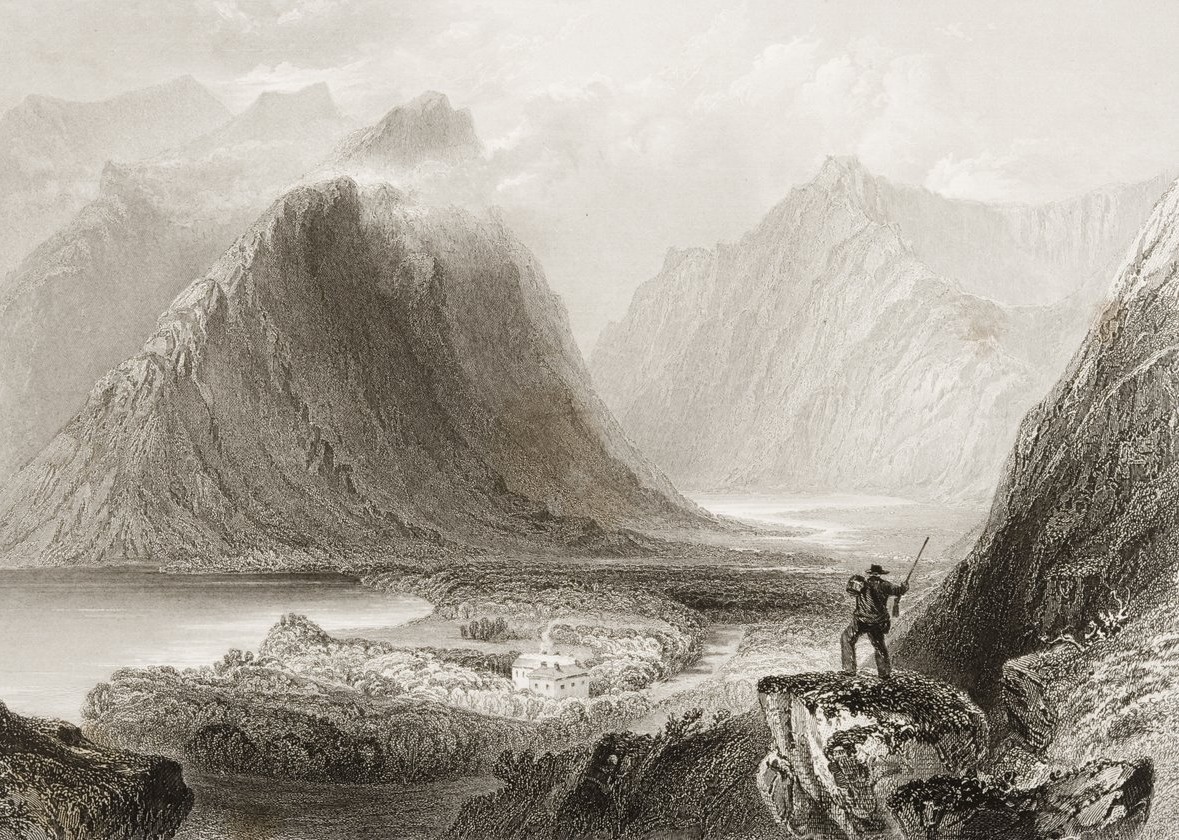
Cover art is ‘County Mayo’ by William Henry Bartlett
Notes: This is a praise-poem of Ireland’s provinces and territories — a genre the Irish called a molad or praise-poem — cataloguing the characteristic virtues, qualities and gifts associated with each region. It moves systematically through:
Ailech — the great royal fortress of the northern Uí Néill in Donegal, associated with warrior kings.
Ulster — praised for its fierce valor but also its treachery and passion — a very characteristic Ulster stereotype in Irish literature.
Meath — the central province, seat of the high kingship at Tara, praised for its dominance.
Brega — the rich coastal plain north of Dublin, famous for its judges and learned men.
Leinster — praised for its generosity, musicality and feasting culture.
Ossraige — the kingdom of Kilkenny/Laois, blessed by its saints.
Munster — divided into Desmond (south) and Thomond (north, the territory of the Dál Cais and the Uí Briain).
Connacht — praised for its wealth in cattle and its fierce western warriors.
Fland Fína himself is identified at the end as son of Ossa, a chief sage, composing on the bank of the river Réin — a lovely detail that grounds this sweeping geographical vision in a single specific moment of composition. The poem ends with a reminder that all these gifts have flowed since the time of Niall of the Nine Hostages, ancestor of the dominant Uí Néill dynasty — a political as much as a poetic statement.
Fland Fína sang:
- […] of God, noble free elders of prosperity —
- It has flowed into every holy church, between land and wave and shore: the learning of wisdom, the devotion of God, the labor of faith and protection.
- It has flowed from the monks of the territories — the swift rendering of alms; and their equal together — the half-penny in the head-tax.
- It has flowed from the dwelling of Ailech — of wonderful kings and high kings; the rush of bright weapons, fame with valor, that men of full-worth cannot withstand.
- It has flowed from the dwelling of Ulster — the surpassing of victory and of prime-strength; treachery, ardor, affection, a challenge upon energy; battle, beauty of form, comeliness, bravery.
- It has flowed from the great plain of Meath — warrior-service, generosity, open-handedness; valor, fierceness, wonderful beauty of border — dominance over the territory of Ireland.
- It has flowed from the territory of wealthy Brega — handsome mercenaries, boars of towers; judges, bards, hundreds of crosses; swimming, hunting, feasting, horsemanship.
- It has flowed from Leinster — to my satisfaction, from Étar to Indeón; generous, lively, famous men — gentle, musical, ale-feasting ones.
- It has flowed from Leinster — lasting fame — and to the host from Tomar; the plundering of Cuille, a track across the Suir, and blows across Indiún.
- It has flowed to the children of sharp Crimthann, to the seed of Labraid of full-partnership; bravery over the kindreds of men — nobility of weapons, the brightness of the Gaels.
- It has flowed from red Raigne — beautiful men with great victories; the blessing of every saint with his hundred — and it is upon the Ossraige it has flowed.
- It has flowed from Munster without hardship — a company of kings, queens and royal poets; without aggression against mighty Niall — happiness, ease, settledness.
- It has flowed from dark Desmond — supreme sovereignty over great Ireland; brightness of chastity after clear deeds — generosity, excellence, truth.
- It has flowed from heavy Thomond — a noble, lasting lordship of Aulam; a great bestowal greater than every grace — to the seed of Conall son of Lugdach.
- It has flowed from the territory of fair Connacht — wealth of milk-yields, pride, honor; generosity, strength, victory and fame — from the territory of Cruachain of the weirs.
- It has flowed from the west of Connacht — fierce, sharp, deed-mighty men; cattle to the lords of every tower — small and gentle their bestowal.
- It has flowed to the seed of noble Muiredach — the sovereignty of Medb of great renown; men of bloom, ever rough, householding — of every strong inheritance.
- It has flowed from the north of Connacht — the reporting of land over heavy burden; men of victory bestow their limbs — the consumption of provisions of the seed of Conall.
- It has flowed from the territory of sharp Conall — brave heroes of the blue-grey sword; fierce men with beauty of border — the high stars of Ireland.
- Fland the fair — Fína son of Ossa, chief sage of the knowledge of Ireland; on the bank of the stream of Réin in its selling — he found his due as he fully received it.
- These are the modes with victory that are owed from every land in turn; from the day that noble, strong Niall seized power — it is long and great since we have received it.

The Druid's Cauldron
We are a registered non-profit, The Druid’s Cauldron Inc. 501(c)(3) The Druid’s Cauldron is an independent journal established in 2016, dedicated to the preservation and exploration of the druids, culture, native wisdom, and the living traditions of the isles. We exist to recover folklore, herbalism, spiritual philosophy, and ecological knowledge embedded in the roots of the early Irish Gaelic and broader Celtic world.
Through deep research into traditional folklore, herbalism and mythology as well as personal artistic endeavors, we seek to cultivate a deeper relationship with the land, the seasons, and to one another. We are committed to serious inquiry and evidence-based information, or it is alluded that it’s personal philosophy and labeled as such. The Druid’s Cauldron is a space for the curious, the contemplative, and those who feel called to remember older ways of being in right relationship with the land and each other.
Leave a Reply