
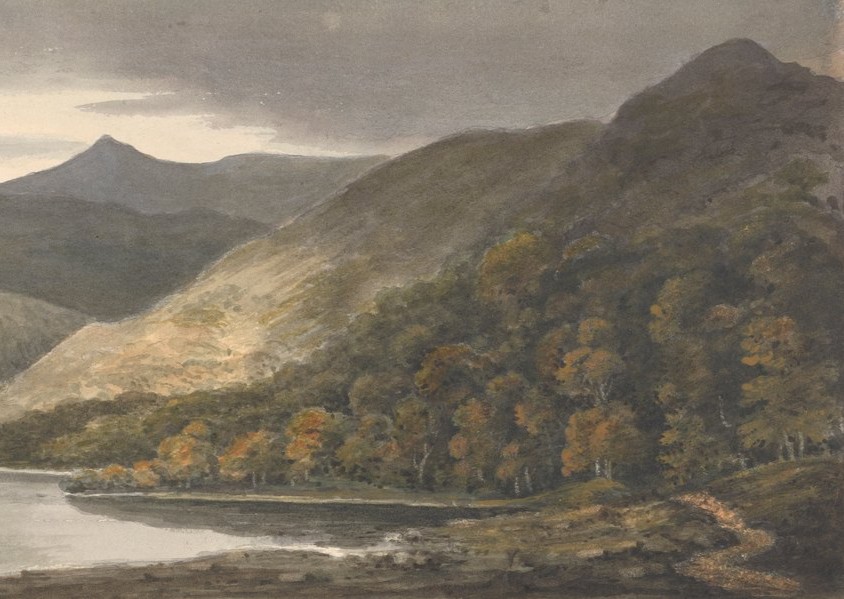
Cover art is ‘Killarney’ by Isaac Weld
Book of Leinster
Notes: This text is a king-list interspersed with explanatory prose and poetry, recording the legendary and semi-legendary kings of Ireland from the Milesian conquest through to the historical period of the 5th century AD. It preserves mythological traditions about lake-bursts, fort-buildings, the origin of place-names, and the genealogies of the major Irish dynasties.
On the Kingships of Ireland
Here begins [the account] of the kingships of Ireland and their periods, from the time of the Sons of Míl to the time of Tuathal Techtmar.
In the fourth age of the world the Gaels came to Ireland — that is, in the time of David son of Jesse, when they were attempting [to build] the Temple of Solomon, and in the twentieth year of the reign of the king of the Assyrians, on a Thursday, on the first of May, on that day of the solar month. A battle was fought at Tailtiu between the sons of Míl and the Tuath Dé Danann. Three kings of the Tuath Dé Danann fell there along with their three queens. Mac Cécht fell by Éremón. Mac Cuill fell by Éber. Mac Gréine fell by Amairgen. Ériu [fell] before Suirge. Banba before Cacher. Fótla before Étan.
In the year after that, the building of Dún Étain by Suirge, and the building of Dún Fine by Cacher, and the building of Delginis Cualand by Setga, and the building of Dún Náir in Sliabh Modairn by Gosten.
At the end of a year after that — that is, after the Battle of Tailtiu — a battle was fought between Éremón and Éber in Mag Argetrois, contesting Druim Clasaig in the territory of Mane, and Druim Bethaig in Moenmaig, and Druim Finghin in Munster, on account of their fertility. Éber Find son of Míl fell in that battle, and on the other side fell Gosten, Sétga, and Suirge, the three chieftains.
Éremón seized the kingship of Ireland and cut two royal forts for himself — Ráith Oind in the territory of Cualu and Ráith Bethaig above the Éoir. He gave the kingship of the province of Leinster to Crimthann Sciathbél of the Domnannaigh. He gave the kingship of Munster to the four sons of Éber — Áer, Orba, Fergna, Feron. He gave the kingship of the province of Connacht to Ún mac Ucce and to Étan. He gave the kingship of the province of Ulster to Ébiur mac Ír, from whom come the Ulaid of Emain.
At that time the Cruithni came and seized Inber Sláine in Uí Cheinsealach. Crimthann let them [stay] for the benefit he received from a Cruithni druid in battle against the Tuath Fidga — a tribe of the Britons — whereby all those on whom it was sprinkled were dead, and they were not taken [i.e., could not be captured] except after their death. The benefit was this: the milking of six score white polled cows to be poured into the pits where the battle was to be fought — whence the Battle of Ard Lemnacht — and the entire Tuath Fidba fell through that treachery. So Catluan son of Cing seized great power over Ireland from Cruithentúaith. Éremón drove them out. Then came Cruithneachán son of Cing to seek women from Éremón. Éremón gave him the wives of the men who were drowned at the Dumhchas — Bres and Bróes and Buagne — and the guarantee of sun and moon upon them, so that land would never be inherited from men in Cruithentúaith rather than from women, for ever.
At that time of Éremón: the building of Dún Sobairche and Dún Chermna and Dún Binni and Cairge Brachaide in Murbulc by Mantan son of Cachir; and the building of the Causeway of Inber Mór in the territory of Uí Enechglais of Cualu by Amairgen son of Míl; and the building of Ráith Sailech in Fánait by Fulmán; and Ráith Rigbaird in Muirisc by Étan son of Occe.
In that time [came] the bursting of the seven [lakes] of Leinster, and the bursting of the seven Brosnachs of Éile, and the bursting of Eithne in Uí Néill, and the bursting of the three Socc [rivers] in Connacht, and the bursting of Loch Riach and Loch Ren and Loch Cimbe and Loch Findmaige in Connacht, and Loch Dá Chaech in Leinster, and Loch Laíg in Ulster. A battle was fought between Amairgen and Cacher at Cúil Cachir, and Cacher fell there. A battle was fought between Éremón and Amairgen — that is, the Battle of Bile Tened in Meath — and Amairgen the judge and poet fell there.
Éremón won the Battle of Comraire, where Én and Étan, the two sons of Occe, fell, and Ún son of Ucce. Éremón died thereafter in Argetrois, and his grave was dug there and his pillar-stone set — that is, at Ráith Bethaig above the Éoir — at the end of seventeen years of his reign. And his three sons seized the kingship of Ireland and divided Ireland in three: Mumne, Lugne, and Laigne. Mumne died of plague at Cruachain. Lugne and Laigne fell in the Battle of Ard Ladrand at the hands of the sons of Éber — Áer, Orba, Feron, Fergna — in the third year of their reign. They had their time in kingship until they fell at the hands of Iriél Fáid son of Éremón.
Iriél Fáid son of Éremón, the youngest of the children, then seized the kingship of Ireland. Twelve plains were cleared by him: Mag Rechet and Mag Éle in Leinster; Mag Commair and Mag Sléibe in Uí Néill; Mag Sanais in Connacht; Mag nDairbrech in Meath; Mag Techt in Uí Mac Cuais; Mag Lugna in Ciannacht Glinne Gaimen; Mag Faithne among the Airthera; Mag Inis in Ulster; Mag Culi Feda in Airgialla. And seven royal forts were dug by him: Ráith Croich in Mag Inis; Ráith Bachair in Latharna; Ráith Chuingeda in Semniu; Ráith Modig; Ráith Buirg in Slectae; Ráith Lochit in Glasscharn. Iriél fought the Battle of Ard Inmaith in Tethba, where Suirge son of Dub fell. He broke the Battle of Tenmag against Eochaid Echcend king of the Fomoire, and the Battle of Lochmag where Lug Roth son of MaFemis fell. Iriél died in Mag Muaide in the tenth year of his reign, as the historian sang:
Iriél, youngest of the children, son of the king of Fótla of fair hair, king of Sliabh Mis, king of Macha, broke four hard battles. The Battle of Cúil Marta — good that — where the sons of Éber were slain; their names in battle and in contest: Áer, Orba, Fergna, Ferón. The Battle of Ard Inmaith in the north, where Suirge of the stout rod fell; the Battle of Tenmag which was fierce, where Eochaid Echcend fell. The Battle of Lochmag — a recounting without taboo — where the son of MaFemis fell. Twelve plains, certain to us all, he cleared, with the good man. Of them, count Mag Séle: Mag Éle and Mag Rechet; Mag Sanais, Mag Techt without envy; Mag Fáithne with the Airthera; Mag nDairbrech in midland Meath; of them Mag Lugna in Ciannacht; Mag nInis in Ulster thereafter; Mag Cule Feda in Ferndmag. Iriél dug thereafter seven forts of royal forts: Ráith Chróich in fair Mag Inis; Ráith Chungida; Ráith Bachair; Ráith Lochit; Ráith Glaisse Cuilg; Ráith Móidig and Ráith Buirg. Ten years in kingship — he was a king — son of noble Éremón. Mumne and Luigne and Laigne, three sons of Odba without blemish; Tea of Temair, steadfast her guidance, the famous mother of Iriél.
Ethriel son of Iriél Fáid seized the kingship of Ireland and cleared six plains: Tenmag in Connacht; Mag Lugair in Luigne; Mag Belaig in Uí Turtri; Mag Gesilli in Uí Failgi; Lochmag in Conaille; Mag Roth in Uí Echach Coba. He fell in the Battle of Roirend at the hands of Conmael son of Éber, in revenge for his father, in the twentieth year of his reign — it is there he met his death at Conmael’s hand.
Of the deaths of these chieftains the historian sang thus:
The chieftains of the fleet over the sea, when the sons of Míl came — their names and their deaths shall be remembered by me to my day. Ebleo, Fuat, Brego, Blad the worthy; Lugaid Murthemne the warrior; Buas, Bres, Buagne of great strength; Donn, Ir, Éber, Éremón; Amairgen, Colptha without grief, Éber Herech, Herennan; Cualnge, Cualu, Nár indeed; Mumne, Luigne and Laigne; Fulmán, Mantán, Suirge of old; Áer, Orba, Feron, Fergen; Én, Ún, Étan, Gosten bright; Setga, Suirge, Sobairche; Palap son of noble Éremón and Cacher son of Mán, in revenge for Íth of the horses — thirty and ten chieftains.
Brego died in pleasant Brega; Murthemne died with great floods; Cualnge and Fuat — though not feeble — were slain by the Tuath Dé Danann. Cualu fell — I will not hide it — at the hands of Crimthann Sciathbél the scattered. Blad died of plague in pleasant Bladma. Nár and Ebleo in Ebliu. Amairgen the poet of the men died in the Battle of Bile Tened. Ír died at Scelic of the phantoms. The head of Inber Erennán died. Donn and Bile and Búan his wife; Díl and Érech son of Míl; Buas, Bres, Buagne with fame — they were drowned at the Dumhchas. Sobairche the slender fell at his fort before Eochaid Echcend. Mantan and Cacher of the wounds fell at the hands of Amairgen. The death of Fulmán with his men at the hands of Éremón at Slemain. Lugaid of the blades fell in battle against the Men of Domand. Luigne and Laigne fell at the hands of the sons of Éber, the blameless. The righteous four fell at the hands of Iriél son of Éremón: the four sons of Éber yonder — Áer, Orba, Ferón, Fergna. His fame passed across the companies. Mumne died in Mag Cruachain. That battle against the force of the tribe, that plain where Éber fell — they fell together — Gosten, Setga and Suirge; Ún son of Ucce, high his fortune; Én and Étan of many colors — Éremón of the pleasant blossoms drove them down in the Battle of Comraire. Suirge son of swift Dub fell at the hands of Iriél in Ard Inmaith. Éber son of Ír, man of the gold, at the hands of Palap son of Éremón. Proud Palap met a point in the treacherous Battle of Gesilli. That, briefly and compactly, is the death of the chieftain of the warrior-fleet.
O Christ above the children — remember — son of the grandson of Flann, the warrior of Luigne; O King of the blossoms and the judgments, you are the abbot and you are the chieftain.
Conmael son of Éber, first king of Ireland in Munster. He broke twenty-five [battles] against the seed of Éremón and was thirty years in the kingship of Ireland, until Tigernmas killed him in the Battle of Óenach Macha, in revenge for his father and grandfather. Of this the historian sang:
Conmael, first lord in Munster over Ireland — it was fitting; Ethriel fell willingly, and Ollach son of Ethriel. He broke with the blow of a dark sword against the famous seed of Éremón: the Battle of Éle, the battle of speckled Berri, the battle of Sliabh Betha of the hutted passes. The Battle of Ucha, the battle of crooked Cnucha, the battle of marshy Sliabh Modairn. Sémrath, the famous son of Imboth, fell in the early Battle of Modairn. The Battle of Cléire, the battle of the great Cairn of the diadem, where Ollach Imrind fell. The Battle of Loch Léin — he quickly broke it — against Mog Roth son of Mafemis. For thirty good years he was submitted to — the son of Éber. He fell in battle thereafter at the hands of Tigernmas son of Ollach. The Eóganacht together, the Ciannacht, the Galenga, the Luigne; Dál Cais, Uí Echach with their flocks — these are the clans of Conmael.
Tigernmas son of Ollach then seized kingship and broke three times nine battles within a year against the children of Éber. It is he who first introduced drinking-horns into Ireland. It is he who first smelted gold in Ireland, and also introduced colors onto clothing and equipment. It is he who first made ornaments and brooches of gold and silver. Iuchadan was the name of the craftsman who smelted the gold in the lands of eastern Liffey. He was seventy-seven years in the kingship of Ireland, and during that time he had nearly extinguished the children of Éber. He died in Mag Slécht at the great assembly of Mag Slécht, and three-quarters of the men of Ireland with him, worshipping Crom Cróich, the royal idol of Ireland, so that only one quarter of the men of Ireland escaped from it. Hence Mag Slécht.
In that time [came] the bursting of seven lakes: Loch nAlinne and Loch Cé in Connacht, and Loch nUair in Meath, and Loch Febail in Tír Eogain, Loch Sílend in Cairpre, Loch Gabur in Brega, and the Daball in Airgialla. The three dark rivers of Ireland: Fubna, Torand, and Calland.
He gave the quarter that escaped of the men [to rule] as kingship to Eochaid Étgudach son of Dáire Domthach, of the seed of Lugdach son of Íth. It is from him that the many-colored patterns on the clothing of Ireland were made: one color in the clothing of a slave; two colors in the clothing of a serf; three colors in the clothing of a slave-soldier and a young warrior; four colors in the clothing of a young nobleman; five colors in the clothing of a chieftain; six colors in the clothing of a king and an ollamh and a poet; seven colors in the clothing of a king and a queen. From that grew all the colors today in the clothing of a bishop. Whence Gilla Cóemain sang:
Tigernmas son of great Ollach, lord over the sharp-judging Banba; seventy-seven years to him in kingship over the Gaels. By him was smelted — a lasting, pleasant fame — ore of gold first in Ireland; green, blue, purple together — by him brought onto clothing. By him fell Conmael the fair, first king of Ireland in Munster; twenty-seven [battles] he broke against the children of Conmael Conganchnis. The Battle of Éle — evil its order — where the king Rochorb fell; the Battle of Lochmag without weakness — there Degerne fell. The Battle of Cúil Aird, bower of the young stag, and the Battle of Cúil Froechan. Great Fróechán — a deed that — the Battle of Mag Techt, the Battle of Commair. The Battle of Cúil Athgoirt in the west, the Battle of Ard Niad in Connacht, the Battle of Carn Feradaig of the encampments, the Battle of Cnamchaille in Connacht. The Battle of Cúil Feda — a clear cause — and the hard Battle of Congnáige; the Battle of Tethba, fierce its intoxication; the Battle of Cluan of gentle Muirisc. Two Battles of Cúil together: the Battle of Éle and the Battle of Berre; and seven battles — no lie — at Loch Luigdech in one day. Two other battles, if it be heard, at the same hour in Argetrois; three battles against the Fir Bolg; a battle against the Érainn — it was no dishonor. In the time of Tigernmas above, seven lake-burstings burst: Loch nÚair in Meath — a clear notable deed — Loch Cé, Loch nAlinne; Loch Silend in pleasant Cairpre; Loch Febail in Tír Eogain; Loch Gabor of the accommodating king; the bursting of Daball in Airgialla. The bursting of three dark rivers: Fomna, Torand and Calland. In Mag Slécht in impetuous Bréifne — the famous death of Tigernmas.
The Men of Alba, the Leinstermen, the half of Conn; the children of Lugdach in Liathdruim; Eogan, the children of Conall Cas — these are the seed of Tigernmas. Christ with strength and with fame, prevailing over every bright clean king; lord of nine great grades of heaven, King of the fruitful earth.
Sobairche and Cermna Find seized the kingship of Ireland — two sons of Ebric son of Éber son of Ír — of the Ulaid, the first kings of Ireland from Ulster. They divided Ireland in two, each from his own fort — Dún Sobairche and Dún Chermna. It is under Cermna that Eochaid Étgudach fell in the Battle of Temair. They were forty years in kingship. Sobairche fell at the hands of Eochaid Minn son of the king of the Fomoire. Cermna fell at the hands of Eochaid Find Faeburglas son of Conmael in the Battle of Dún Chermna. As is said:
The death of Sobairche of the fort at the hands of Eochaid Mind over the rampart; the death of Cermna in that fierce battle at the hands of Eochaid Find Faeburglas. Dún Sobairche with its swift hosting, a sea-front of red points before it; a headland against the great sea’s surge, a pleasant projection over Ireland. The Archoin of Emain that was attacked, a strong, thickset [place] against rushing; with brave, valiant warriors’ galleries, of the wonderful queens of Ulster. The place where the valiant queen dwelt, of Celtchair the hunter, the hero, the husband; Findabair the fair-haired of the bright locks — though she was a warrior she was a champion. Truly good, truly generous — a noble right, a valuable, well-shaped fortification. Many roads they made — a fort where the warriors of Emain used to be. When the Ulaid went from it as lords, as lords of a chieftain from the plain of chieftains, they gave their firm pledge of swans — the royal company of the bridle seized them. Noble kings I will enumerate, the noble seed of fair-moving Conaire; children in truth, as I relate: kings who held pleasant Ireland. Since it is Patrick who taught them, it is to him their fall is attributed. He raised two with great renown, the sons of Erc and Olcán. Since the son of Calprann blessed it, found a household for his noble children; a fort with width above the great hall — to doom the foreigners shall not overrun it. Sobairche of the hosts and spears, upholding the mounded Temair, dividing with him the pleasant plains of Banba, against the brave hero, against Cermna.
There stands the enduring fort, wise in mysteries, running forward, above the surging wave against its boundary, here on both sides of Ireland. It is Dún Sobairche of the spears, the secret dwelling-place of Ulster. Dún Cermna, not hidden in the south, over the plentiful sea of Munster. Good kings I enumerate — lords in truth as I relate — of sufficient strength that they were capable, they were of high dignity over Ireland. Ed [was] king at the time of great strife; Nuadu Fáil of the tribe of Temair; their bright clear divisions were between Sobairche and Cermna. Long ago is the sight of their ordering, long before the time of the Sons of Míl; over our men, as is related, that company of fortresses was submitted to.
Let us adore the King of the bright sun, the reason of my understanding, the hundred mysteries; he laid out every grace and every kingship, he formed the crowd of every fort.
Eochaid Faeburglas son of Conmael seized the kingship of Ireland. It is he who broke the Battle of Luachair Dedad and the Battle of Fossad Dá Gort and the Battle of Commair Trí nUisce and the Battle of Tuaim Drecon and the Battle of Druim Liathán. It is there that Smirgoll son of Imboth son of Tigernmas fell. He cleared seven plains: Mag Smerthach in Uí Failgi; Mag nAidne and Mag Luirg in Connacht; Mag nEmir and Mag Lemna and Mag Fubna and Mag Dá Gabul in Airgialla. He fell at the hands of Fiacha Labrainn son of Smirgoll son of Smerthu son of Enbath son of Tigernmas in the Battle of Carman, in revenge for his father. Whence the poet sang:
Eochaid Faebur of the warrior-band — there was no danger to his company. He spent, grandson of Éber thereafter, twenty years in kingship. At his hand without sloth fell Cermna Fáil of the fair blades, and Imboth grandson of Ollach, in the Battle of Commair Trí nUisce. The Battle of Fossad Dá Gort of the heroes; the Battle of Tuaim Drecon, fierce; against Smirgoll with his peoples, he broke the Battle of Luachair Dedad. Eochaid the fearsome fell before the grandson of Tigernmas of the chieftains; the son of Imboth, Smirgoll the good, in the conflict of Druim Liathán. He cleared with smoothness seven plains, suitably and correctly: Mag Smerthach in Uí Failgi; Mag nAidne, Mag Luirg, Mag Luigne; Mag Lemna and Mag nÉnir; Mag Fubna — fair its aspect — king of the son of Conmael with purity, beside Mag Dá Gabol. By the son of Smirgoll with brilliance — Fiacha Labrainn with diligence — he fell; thus was his danger. Eochaid Fáebor of the warrior-band.
Fiacha Labrainn son of Smirgoll son of Enboth son of Tigernmas seized the kingship of Ireland. In his time the bursting of the Fleisce and the Manna and the Labrainn. He fought a battle on the sea against the children of Éber. He fought the Battle of Gatlaig, where MaFemis son of Eochaid Faeburglais fell. He fought a battle against the Érainn of the Fir Bolg in the place where Loch Erne is. After breaking that battle the lake burst — that is, Loch [bursting] over all the Érainn at that time. Fiacha Labrainn fell in the Battle of Sliabh Belgadain at the hands of Eochaid Múmo son of Mafemis — from whom Mumu [Munster] is named.
Fiacha Labrainn the hero — I liken him to none — he seized with skill Eochaid the lord of the causes. He contrived through treachery in the fierce Battle of Gatlaig the son of Eochaid in arms — Mafemis the noble name. He slew in battle the noble Érainn of great fame; it was fitting indeed that the lake burst thereby. By Múmo — who was not gentle — fell the grey warrior; three times eight good years he ruled under Fiacha.
Óengus Olmucaid son of Fiacha seized the kingship of Ireland and broke the Battle of Cléire and the Battle of Cuirche and the Battle of Sliabh Calge — that is, it was broken in the territory of Corco Bascind against Martyrs. The Battle of Glaise Froecháin where Froechán the prophet fell. And he broke fifty battles against the Cruithni and against the Fir Bolg, and twelve battles against the Longbardi, and four battles against the Colosi. The Battle of Cúil Ratha in Desmond against Martyrs. And the Battle of Carn Richid against Martyrs likewise. And the Battle of Sliabh Cua against the Érainn. And the Battle of Ardachad where Smirgoll son of Smertha king of the Fomoire fell. In his time the bursting of Loch Oenbethe in Uí Cremthainn and Loch Sailech and Loch Cassan and Murbrucht between Eba and Ros Céte in Uí Fiachrach. He cleared seven plains: Mag nOensciad in Leinster; Mag Glinni Dechon in Cenél Conaill; Mag Cúli Cóel in Cenél Bógaine; Ailmag in Callraige; Mag Mucrima and Mag Luirg in Connacht; Mag Luachra Dedad, Mag ar Caill in Ciarraige Luachra.
Of this the historian sang:
Óengus Olmucaid the wonderful, he was king of mighty Banba; seven years thrice without envy, after the slaying of Eochaid Múmu. Good was the king, the choice lord, before whom a hundred hard battles were routed; beside the fifty with fortune he broke against the Men of Alba. He broke twelve battles thereafter in Letha against the Longbardi. Before Óengus of Macha, not foolish, four battles against the Colaisigh. The Battle of Cléire, the battle of sharp Cuirche, the battle of Sliabh Cailce with its hidden branches; the Battle of Ros Fraecháin with spear-points, and the Battle of Carn Ríchida. The Battle of Cuil Ratha, the Battle of Cua, against the Érainn — it is no shield-false tale; the Battle of Ardachad, great its fame, where Smirgoll son of Smertha met his end. The bursting of four lakes separately: Loch Oenbethi, Loch Sailech; Loch Cassán, Murbrucht — a clear notable deed — between Eba and Ros Céte. He cleared seven plains: Mag Glinni Dechon the bright-faced; Mag Mucrima, long of labor; Mag Cúli Cael, Mag nOenscíad; Ailmag, Mag ar Caill of the ditches; and Mag Luachra Dedad. All before the fair sapwood, with a hundred forts, the king Óengus the Noble.
Óengus Olmucaid fell at the hands of Enna nAirgdech son of Eochaid of Munster in the Battle of Carman. Whence the poet sang:
Óengus Olmucaid died; Énna son of Eochaid slew him in the Battle of Carman of the hundreds of heads, where the wonders of Ireland were. Enna was lord of Fál to the rampart — it is he who distributed to the Gaels horses and chariots — as I have heard — silver shields in Argetrois. Tell of his death after victory on the plains of great red Raigne; at the hands of Rothechtaid of the rout of Ross, at the hands of the son of Máen son of Fergus. He was king of Gialchad, shoulders of the grade, whose son was Nuadu Find Fáil; Sirna son of Déin was king and Rothechtaid was king. Nuadu maintained strength without division, he ruled the hosts of the seed of Bregand. Though of slow, noble, generous manner, he was king of Ireland alone.
Then came the company of Ulster and they seized the rough kingship; with them was counted the royal tower, the plain of the Sons of Míl alone. The belief of the threefold Trinity — king of every royal course, who ordered — there was, there is, there shall be against every sea; it is two, and it is three, and it is one man.
Enna Airgdech then seized the kingship of Ireland. It is he who made silver shields in Argetrois and gave them to the nobles of Ireland. He was twenty-seven years in the kingship of Ireland until he fell at the hands of Rothechtaid son of Máen son of Óengus Olmucaid in the Battle of Roigne.
Rothechtaid was king for twenty-two years until Setna Airt son of Art son of Éber son of Ír of the Ulaid killed him at Cruachain in protection of his son — that is, Fiacha Finscothach.
Setna was five years in the kingship of Ireland until his son killed him after returning from exile, at Ráith Cruachain.
Fiacha Finscothach son of Setna Airt son of Art son of Éber son of Ír son of Míled seized the kingship of Ireland after killing his own father, and also Munemon son of Cas Clothach in Munster. Fiacha was twenty years in kingship. Blossoms of wine in his reign, so that they were pressed into vessels of glass. He fell thereafter at the hands of Munemón.
Munemón seized the kingship of Ireland for five years. It is he who first put gold necklaces under the chins of people in Ireland — that is, muin maíne, treasure at the neck. He died of plague in Aidniu.
Aildergdóit son of Munemón son of Cas Clothach son of Airir Arda son of Rothechtaid son of Rosa son of Glas son of Nuadu Declám son of Eochaid Faeburglais son of Conmael son of Éber son of Míled. In his time there were gold rings on fingers. He fell at the hands of Sín son of Déin — as some say — or at the hands of Ollam Fótla son of Fiacha Finscothach in Temair — which is more likely.
Ollam Fótla son of Fiacha Finscothach [held] the kingship thereafter for forty years. From him the Ulaid are named — that is, Olléith from Ollam. And it is with him the Feast of Temair was first held. And it is with him Múr nOlloman was built at Temair. Six of his children seized the kingship of Ireland without conflict between them. He died alone in his fort.
Finnachta son of Ollam — snow of wine in his reign. He died of plague in Mag Inis among the Ulaid. Twenty years in kingship.
Slánoll son of Ollam — there was no disease in his reign, and it is not known what disease carried him off except that he was found dead; moreover no color faded, his body did not decay. And he was taken from the ground by his son at the end of forty years.
Geide Ollgothach son of Ollam seized the kingship of Ireland — sweeter than lute strings the voice and speech of every person in his reign. It is he who built Dún Cuili Sibrilli — that is, Kells. It is this that brought the white-headed cattle of Ireland to him. Fíac fell at the hands of Berngal son of Géde in revenge for his own father.
Berngal son of Géde seized the kingship of Ireland. In his time corn went out of Ireland on account of the abundance of war. He fell thereafter at the hands of Ailill son of Slánoll. Ailill son of Slánoll seized [the kingship] thereafter until he fell at the hands of Sirna son of Déin son of Denul. Of this Ferchertne sang:
Ollam Fótla of fierce valor built Múr nOlloman; the first fierce, valiant king with whom the Feast of Temair was made. Fifty good, pleasant-musical years he was in the high kingship over Ireland; so that from him, to be noble in name, the Ulaid took their naming. Six kings seized power with valor over Ireland from Ollam; two hundred and ten bold, envious years — none came between them. Finnachta, Slánoll with fortune, and Geide Ollgothach; Fíacc, Ailill the battle-wise with grace, and the fierce Berngal. Ollam was the highest without blemish, fierce son of Fiacha Finscothach; more noble than every royal, kingly in face, of the children of Ír son of Míled. Great children of Rudraige — a bright saying — brave heroes of the Red Branch; from their place — pride seized them — it is the lineage of Ollam.
Labraid Longsech — full his number — slew Cobthach in Dind Ríg, with a Leinster host over the sea-flood; from them the Leinstermen were named. Eochaid Múmo, greater than every surpassing, king of Ireland, son of MaFemis, from him the name of Munster, without sorrow; the name of Ulster from Ollam.
Sirna son of Dein son of Demail son of Rothechtaid son of Máen son of Óengus — it is he who separated the kingship of Ulster from Temair. It is he who avenged Rothechtaid son of Máen his great-grandfather’s father upon them. It is the Rothechtaid that the Ulaid had killed in treachery at Cruachain. Berngal fell at Sirna son of Dein’s hands then, together with Ailill. And Ailill fell at his hands thereafter. It is Sirna who was a hundred years at war against the Ulaid. He then seized kingship. It is he who broke the Battle of Aircheltra against the Ulaid, and the Battle of Sliabh Airbrig, and the Battle of Cind Duin in Asul, and the Battle of Móna Foíchnig in Uí Failgi against Martyrs and against the Érainn. In his time the first hosting in Ireland. And in his time the Battle of Móna Trogaide in Ciannacht — that is, Lugáir son of Lugdoth brought the Fomóire over Ireland.
The men of Ireland assembled for battle against Lugáir at Móin Trogaide. While they were smiting the battle a plague descended upon them so that the men of Ireland died there. And Lugóir died there, and Ciasarn king of the Fomoire, and Sirna king of Ireland — as some say. But other learned men say it was in Alind he fell at the hands of Rothechtaid Rotha son of Roan — which is more accurate.
Of this the poet sang thus:
Sirna the long-lived, noble the lord, a hundred and fifty ever-good years; his life, under a fair yoke, until he fell at the hands of Rothechtaid. The bursting of Scirtige in that time, and the bursting of Duailte. In the time it burst forth — Níth the sacred, the pearly — in the time of Sirna son of Déin. The beginning of a smooth-rodded hosting; everyone took from the territory of Meath going against the face of the Fomoire tribe. Sirna fought with rows of spears: the Battle of Cind Dúin, the Battle of Aircheltra; the Battle of Móna Foichnig — a worthy cause — and the two battles at Sliabh Airbrig. Famous there is the other battle fought on Móin Trogaide; where fell in the surges the men of Ireland and the Fomoire. Lugáir son of Loga fell pursuing the mutual wounding. And Ciasarn — without strife — good and it was not great for Sirna.
The Battle of Móna Trógaide in the east, where the Fomoire fell; it is he who brought it with a strong surge — Lugóir son of Lugdach Lamfind. From this is [the name] Móin Trogaide the strong — the lamenting of the youth of Ireland, and the Fomoire yonder — without the striking of a great battle.
The host that came to the ill battle, each of the two sides; they did not wound each other with brave spears — [only] dead men on Móin Trogaide. Ciasarn son of Dorcha the colored — he was king of the Fomoire tribe — came over Munster outward, with Lugair, in five battles. The Battle of Luachair, the battle of pleasant Clare, the Battle of Samhain, the Battle of Cnoc Ochair; the fifth battle without reproach — the great Battle of Móin Trogaide.
Sirna fell at the hands of Rothechtaid in Alind. Rothechtaid Rotha was seven years in the kingship of Ireland until the sacred fire of lightning burned at Dún Sobairche. It is he who first set up a four-horse chariot in Ireland.
Ellim Ollfínsnecta seized the kingship of Ireland for one year until he fell at the hands of Giallchath son of Ailill Olcháin son of Sirna.
Giallchath seized kingship for nine years and took the hostage of every fifth man in Munster until he fell in Mag Múaide at the hands of Art Imlig son of Ollfínsnechta.
Art Imlig seized the kingship of Ireland for twelve years and dug seven fortresses. Until Nuadu Find Fáil son of Giallchath killed him.
Nuadu Find Fáil was sixty years in the kingship of Ireland. He fell at the hands of Bress Nuado Rí son of Art Imlig.
Bress seized kingship and broke many battles against the Fomoire until he died at Carn Conlúain.
Eochaid Apbtach of Corco Laigde — one year in kingship thereafter. A plague every month of his reign — that is, twelve plagues in the year. Eochaid fell at the hands of Find son of Blatha son of Labrada Condilg son of Corpri son of Ollam Fótla — or he died of plague.
Find son of Blatha seized kingship for twenty years until he fell at the hands of Setna Innarraid son of Bres in Munster. Setna Narrad son of Bres — it is he who was the first to give cattle-wages to mercenaries in Ireland — that is, innarrad. He was twenty years in the kingship of Ireland until he fell at the hands of Simón Brecc.
Simón Brecc son of Aedan Glas son of Nuadu Find — six years in the kingship of Ireland. Until he fell at the hands of Duach Find son of Setna Innarraid.
Duach Find — ten years, until he was slain by Muridach Balgrach son of Simón.
Muridach — a month and a year in kingship until he fell at the hands of Enna nDerg son of Duach.
Enna Derg — twelve years in kingship until he died of plague on Sliabh Mis with a great multitude around him.
Lugaid Iardond son of Énna — nine years in kingship until he fell at the hands of Sírlam in Ráith Clochrain.
Sírlám son of Find — thirteen years in kingship until Eochaid Uairchess son of Lugdach killed him. His arm went through the floor while he was standing.
Eochaid Úairches — twelve years in exile on the sea; this is why he is called Úairches, from the banishment he was under from Sirlám. Another twelve years in kingship until he fell at the hands of the sons of Congal son of Lugdach Cál — that is, Eochu and Conaing Becfiaclach. The historians dispute about the [battle] in which Eochaid Uairches fell — Eochu Fiadmuine and Conaing Becfiaclach. Some say Eochu is a son of Congal, and that Conaing Becfiaclach is a son of Duach son of Muridach son of Simón, and that they share the same mother with Eochaid Uairches son of Lugdach.
Eochu and Conaing — five years in joint kingship, half to Eochaid and half to Conaing — that is, the northern half to Conaing. Eochu Fiadmuine fell at the hands of Lugaid son of Eochaid Uairches.
Lugaid — seven years until he fell at the hands of Conaing Becfiaclach.
Conaing Becfiaclach — ten years in the high kingship of Ireland. He was called Becfiaclach because no hour of fear or dread ever came to him. Until Art son of Lugdach killed him.
Art son of Lugdach son of Eochaid — six years in the kingship of Ireland. He fell at the hands of Duach Ladraig son of Fiacha Tolcgraig, and at the hands of Fiacha himself.
Ailill Find son of Art — nine years in kingship until he fell at the hands of Argatmár and Fiacha and Duach son of Fiacha together.
A battle was fought between Argatmár and Fiacha Tolcrach at Óenach Tailten, and it routed against Argatmár. Another battle between them in Brega, and Fiachra Tolcrach fell in that battle.
The men of Munster then assembled around Eochaid son of Ailill Find and Lugaid son of Eochaid Fiadmuine and Duach Ladrach — with the seed of Éremón — and they expelled Argatmár across the sea for seven years.
Eochaid son of Ailill Find during that time in the kingship of Ireland, until Argatmár returned across the sea and made peace with Duach Ladrach, and they killed Eochaid at Óenach Áne.
Argatmár — thirty years thereafter in kingship until he fell at the hands of Duach Ladrach and Lugaid Laídech son of Eochaid.
Duach Ladrach in kingship thereafter — ten years until Lugaid Laídech killed him.
Lugaid Laídech — seven years in kingship until he fell at the hands of Áed Ruad son of Bóduirn son of Argatmár.
How did Emain Macha get its name? Not hard. Three kings were over Ireland in joint sovereignty — of the Ulaid were they: Dithorba son of Dimman from Ushnagh of Meath; Áed Rúad son of Báduirn son of Argatmár from Tír Aeda; Cimbaeth son of Fintan son of Argatmár from Finnabair of Mag Inis. These kings then made a covenant: seven years for each of them in kingship. Three times seven years of suretyship between them: seven druids, seven poets, seven young lords. The seven druids to count it through spells. The seven poets to satirize and proclaim against [any violator]. The seven chieftains to wound and burn [the violator] if any of them did not yield the kingship at the end of seven years — to the keeping of the truth of lordship: that is, the mast-yield of every year, and no dye of every color failing, and no women dying in childbirth. Each of the three made three circuits in kingship — that is, sixty-six [years each]. Áed Rúad died first among them — he was drowned at Ess Rúaid, and his body was brought into that fairy-mound. Hence Síd nÁeda and Ess Rúaid. This Áed left no child but one daughter — Macha Mongrúad was her name. She claimed her father’s share of the kingship. Cimbaeth and Dithorba said they would not give kingship to a woman. A battle was fought between them, and the battle routed before Macha. She ruled seven years in kingship. Dithorba fell in Corund thereafter.
He left five good sons — Baeth, Bras, Bétach, Uallach, and Borbchas. They claimed the kingship. Macha said she would not give it to them, for she had not received it through sureties but through battle by force. A battle was fought between them. Macha broke the battle against the sons of Dithorba, so that they left a slaughter before her. She sent them into exile in the wilderness of Connacht.
Macha then took Cimbaeth to her as a husband and for the leadership of her warriors around her. When Macha and Cimbaeth had united, Macha went to seek the sons of Dithorba in the guise of a leper — tresses of rye and rotten wood wrapped around her — and found them in Bairend of Connacht, cooking a wild boar. The men asked her for news, and she told them. And they gave her food at that fire. One of the men says: “The eye of the hag is beautiful — let us unite with her.” He takes her with him into the wood. She ties that man with the strength of her power and leaves him in the wood. She returns to the fire. “Where is the man who went with you?” they ask. “It is shame to him,” she says, “to come to you after uniting with a leper.” “No shame,” say they, “for we will all do the same.” Each man takes her into the wood. She ties each of them by force and brings them in one bundle to Ulster. The Ulaid said to kill them. “No,” she said, “for it would be a violation of the truth of lordship for me. But let them be enslaved and let them build a fort around me, so that it will be the principal city of Ulster for ever.” She then marked out the fort for them with the pin of gold at her neck — Emuin — that is, eo muin — the neck-pin — the pin around the neck of Macha.
Four hundred and fifty years before the birth of Christ — and fifty other years after the birth of Christ — from the founding of Emain Macha to its destruction by the Three Collas after the breaking of the Battle of Achad Lethdeirg in Fernmag, where Fergus Foga son of Frachar Fortren, the stout lord of Ulster, fell in Emain Macha. Of this the sage of history sang:
O Emain, dear and beautiful, of whose assembly I tell — many a company from your shoulder seized the kingship of Ireland. O seat of pride, of the ship of the noble lords, the valiant, the gracious; you are the hollow of the class — with fame your wall of beauty is son of Cathbad’s. You were a chariot-city of heroes, tributed, plundering, not humble; you were slender, swift, hospitable, with the invincible host of Ulster. When your fame went abroad under its noise, you were heard to Troy across the sea-drum; the dark birds of the Modairn came with the daughter of Ruad son of Baduirn.
When the kings — as I say — were foretelling truly as I tell; it was a massed sovereignty of a fierce troop, when they had joint kingship over Ireland. It is better to enumerate these kings, resting a while on the seat of those hosts; let us name through a clear band of prayer the names of these great lords. Son of Dímain — a drum of great noise — a hero with men of excellent ability; a spear against [a pillar]… whose name was shapely Dithorba. Ruad son of Baduirn was of the Ulaid; a cry of every clear cry with debts; it was not foolish on account of the principal — also Cimbaeth son of Fintan. The sovereignty of Fuat, united righteously, over the borders after a fair circuit; it was not wrong to the law of the warriors for seven years for each single man. Sureties rested with nobles, seven nobles for each of them; it was close to the law before them, among druids and seven poets. Concerning the truth of lordship for each king with the tested sureties; concerning peace without fear, so that every tribe should be under fruit.
They settled Temair, three king-men over whom was not defeated; they encompassed the sovereignty of Fótla, three circuits each single man. Ruad was dead — ready of plunderings, proud of life, the battle-raven of every battle; none of his kindred [remained] in his place except Macha. Macha with pride, with beauty, the daughter of Ruad — a saying with swiftness; she seized against force over the nation the kingship of Ireland. The kingship is not by right of the royal sureties in the time of the truly clear lords; it was not a victory under the judgment of doom — until she won it through battle. She took to herself the white noble Cimbaeth without illegal compact; the five sons of Dithorba the captive — they were driven into exile.
Cimbaeth then, first lord of Emain Macha, twenty-eight years his reign. In Emain Cimbaeth died. Whence the poet [sings]:
Cimbaeth, pillar of the youth of Emain, who seized the fertile land of Temair; companion of Macha, great her pride, the battle-head of the Red Branch. Though the ditch was cut by glorious Macha, by the noble daughter of Áed Rúad; Emain of the warrior-heritages — its first lord was Cimbaeth.
Hear, historians, over the possessions — O noble Ulaid of Emain — the names of the kings who divided towers from Cimbaeth to Conchobar. Cimbaeth son of Fintan of the Plain; Eochu Emna, Eolochair; Umanchend son of fair Corrán; Conchobar Rot son of Cathaír; Fiacha son of capable Feidlimid, and Dáire son of Forgo; Enna son of Roth — not I [deceive]; and the Fíac son of Fiadchon. Findchad son of Bacc from his hill; Conchobar Mál son of Futh; Cormac son of Loíthech seized it — with Mocta son of Murcharad. Eochu son of Dáre of the wheel; Eochu Salbuide son of Lóc; Fergus son of Lete with fortune; Conchobar the fair son of Cathbad. Four hundred strong years — every historian of history relates — long was the reign of the wise men from Conchobar to Cimbaeth.
Macha, of whom Temair was a house, who dug invincible Emain — she arranged the company of the warriors, she spread the kingship before Cimbaeth. Four hundred and fifty years — every historian of noble judgment relates — though one may look at it with wise deed — until Christ was born after Cimbaeth.
Fergus Foga of the sudden valor, stout lord of Ulster in Emain; the fifteenth royal king, steadfast, seized Emain after Conchobar. The battle of the three Collas on Fernmag, after their coming from Temair; there was taken, after the blows of its beloved corner, Fergus son of Frachar Fortrúin. Desolate is Emain of Fál — the royal fortress was not wronged; for six good years from the [distant] battle to the faith. Nine hundred years without foundation of time, the mind says of the Red Branch, to Fergus Foga the warrior — from when there was a hero to when Cimbaeth was.
When Macha was with thousands of warriors in Temair and Cimbaeth; to the tribe of Temair, the land thereafter — though which of them was his contemporary. From the time of Nuadu Find Fáil to the time of Ugaine Mór; he changed in time every law, until Ireland was in proper order. Duach Ladrach, broadly renowned, father of Eochu the Victorious; it is he, without the blue-kingship, wise, who was coeval with Cimbaeth. Since Labraid’s swift spear-thrust [slew him] in Dind Ríg against Cobthach Cóel Breg; thirty years — not foolish — it was a step far [in time] after Cimbaeth. When Ulaid went from it as lords…
It is this Cimbaeth who fostered Ugaine Már son of Eochaid.
Macha was seven years in sovereignty after Cimbaeth until she fell at the hands of Rechtaid Rígderg son of Lugdach son of Eochaid son of Ailill Find son of Art son of Lugdach Lámdeirg son of Eochaid Uairches.
Rechtaid Rígderg seized the kingship of Ireland for twenty years until Ugaine Mór, the foster-child of Cimbaeth and Macha, killed him. It is he who killed Rechtaid Rígderg in revenge for his foster-mother.
After that the sovereignty of Ulster was separated from Temair.
Ugaine Mór son of Eochaid Buadach seized the kingship of Ireland and Alba and as far as the English Channel, and took the daughter of the king of the Franks as wife — Cessair Chrothach, daughter of the king of the Franks. She bore him twenty-five children — twenty-two sons and three daughters. Some say that Ugaine seized the kingship of all Europe. He divided Ireland into twenty-five parts: Cobthach Cóel Breg in Brega; Cobthach Murthemni in Murthemne; Loegaire Lorc in Liffey; Fuilliu in Feib; Ailbe in Mag Ailbe; Roigne in Mag Roigne; Cingiu in Argetrois; Nár in Mag Náir; Narb in Mag Nairb; Faife in Mag Femin; Tairr in Mag Tharra; Tríath in Mag Threithniu; Mál in Clíu Máil; Sen in Clochair; Bard in Clúain Corco Óche; Fergus Cnai in Desib Tuascirt; Oce in Aidniu; Máen in Máenmaig; Sanb in Aíu; Eocho in Seólu; Corand in Corund; Laeg in Line; Lathar in Latharnu; Marc in Mide; Muirisc in Mag Muirisc. Ireland was in that division three hundred years until the provincial kings came — that is, Conchobar and Cú Ruí and Eochu son of Luchta and Ailill son of Mata. Of this the historian sang:
Ugaine the proud, the wonderful, over the victorious land of Banba; his children divided correctly into twenty-five parts. Cobthach Cóel Breg over Brega; Cobthach Murthemne of the middle; Loegaire Lorc in Liffey; Fuilliu in Feib — not hidden. Náirne in the poisonous plain; Fer Rogen in Roigniu; Tarus in Mag Tharra newly; and Triath in Treithirniu; Sine in the clear, bright Luachair; Bard in the Meadows of Corcu Oige; Fergus Cnai in Déise territory; Ord in noble, bright Aidne; Móen in Móenmaig with great strength; Sanb in famous Mag Aí. Muridach Mál in Clíu Máil; Eochu in Seólmag — a noble, kingly course; Lathru over Latharnu on the side; Mairc over Mide of the Sons of Míl. Laeg in bright Linu — fine its color — son of Ugaine son of Eochaid; they divided the land that was proper — the twenty-two [sons] that were kings. Áine, fair Find of their appearance, Mairisc over Mag Muirisc — the other white-bright ones — three daughters of Ugaine. Six divisions of Ireland of old, when it was with the Tuath Dé Danann; thereafter it was counted under [the control of] Fál, by the Sons of Míled of Spain.
The division of the three grandsons of the Dagda spread, and the division of the three grandsons of Míled; the division of Sobairche and Cermna — it was a hundred years over Ireland. The division of the provincial kings — the crop — the division of Mog Nuadat and Conn; the nobler each division, the time the king was. The sons of Ugaine divided them. Three hundred lasting years in the rock, until the provincial kings came; a province without faith in the heart — the sons of Ugaine divided Ireland. There is none of his seed distinctive here except Cobthach and Loegaire; to the Tiber, the plundering Nath Í; the dividing lineage of Ugaine.
Eochaid grandson of Fland found every law, he sewed the noble, true history; a sage with noble, pleasant companions — the seed of Cobthach son of Ugaine.
Ugaine fell at the hands of his own brother — Bodbchad son of Eochaid — at Telach in Choscair in Mag Maireda in Brega.
None of the children of Ugaine left children except Cobthach Cóel Breg and Laegaire Lorc. And Fergus Cnai left two daughters — Maer and Medan; Maer was the mother of Eochaid son of Luchta, and Medan who fostered…
But the length of time does not allow this to be true.
It is from Cobthach [that come] the four families of Temair: Colmán and Áed Sláne; Conall and Eogan; and the three Connachta; and nine triocha-cét in each division; and nine triocha-cét of the Airgialla; and nine triocha-cét of the Déisi; and the Fothairt and Éraind and Albanaigh and Dál Ríatai and Dál Fiatach — that is, the royal lineage of Ulster. Cobthach was fifty years in the kingship of Ireland and his great-nephew killed him — that is, Labraid Longsech.
Loegaire Lorc himself seized the kingship of Ireland after Ugaine Mór until Cobthach Cóel Breg killed him through treachery. And that same Cobthach killed the son of that Loegaire — Ailill Áne. And he banished Labraid Longsech son of Ailill son of Loegaire Luirc across the sea, until peace was made with him, at the end of thirty years, and the province of the Galían was given to him — that is, Leinster. From that time there has been war between Leth Cuind and Leinster.
Cobthach Cóel Breg fell in Dind Ríg and thirty kings around him on the night of great Christmas — by Labraid Longsech in revenge for his father and grandfather. Three hundred and seven years from that night to the night on which Christ was born in Bethlehem of Judah.
Labraid Longsech seized the kingship of Ireland for nineteen years. The vengeance for the children of Cobthach fell in the time of Labraid Longsech. Until Labraid fell at the hands of Melge Molbthach son of Cobthach.
Meilge seized the kingship of Ireland. From him Loch Melge in Cairpre is named. When his grave was dug, the lake burst over the land. Melge fell at the hands of Mac Corb son of the grandson of Labtada in Munster.
Mac Corb — six years until he fell at the hands of Óengus Ollam grandson of Labrada.
Óengus Ollam — eighteen years in the kingship of Ireland until he fell at the hands of Irireo son of Meilge.
Irireo son of Melge seized kingship for seven years until he fell in Ulster at the hands of Fer Corb son of Mog Corb. Fer Corb fell at the hands of Condla Cáem son of Iarireo.
Condla — four years until he died in Temair.
Ailill Casfiaclach son of Condla — twenty-five years in the kingship of Ireland until Amadir Flidais Foltcháin killed him.
Amadir son of Fer Chuirb — five years in the kingship of Ireland until he fell at the hands of Eochaid Altlethan.
Eochaid Altlethan — eleven [years] until he fell at the hands of Fergus Fortamail.
Fergus Fortamail — twelve [years] until he fell at the hands of Óengus Turmech Temrach.
Óengus Turmech — it is with him the kinship of the Síl Cuind with Dál Ríatai and Dál Fiatach meets. Enna Airgdech son of Óengus Turmech — from him comes Síl Cuind. Fiacha Fer Mara — from him come the Éraind and the Albanaigh and Dál Fiatach. It was Óengus Turmech who lay with his daughter in drunkenness — Fiacha. He was cast out as an infant in a single coracle upon the sea from Dún Aignech with the mark of a king’s son — a purple cloak with a golden cup. Fishermen found him at Trá Brenaind in nets. So Fiacha Fer Mara stuck to him [as a name]. His children seized the kingship of Ireland and Alba: Eterscél Mór grandson of Ier — he was slain by Leinster in Alind — and Conaire Mór son of Eterscél; and Conaire son of Mog Lama, son-in-law of Conn — that is, the father of the three Cairbres: Cairbre Musc from whom the Muscraige; Cairbre Baschaín from whom Corco Bascinn; and Cairbre Rígfota from whom Dál Ríatai.
Óengus Turmech was sixty years in the kingship of Ireland until he died in Temair.
Conall Collomrach seized the kingship of Ireland until he fell at the hands of Niad Segamain.
Nia Segamain — seven years in kingship until he fell at the hands of Énna nAignech.
Enna Aignech — twenty-eight years in the kingship of Ireland until he fell at the hands of Crimthann Coscrach.
Crimthann Coscrach — four years until he fell at the hands of Rudraige.
Rudraige son of Sithride — from him the Dál nAraide. For these are the true Ulaid of Emain — the children of Colmán son of Fiacha Finscothach are the true Ulaid. Twenty-five of them seized the kingship of Ireland. For they are the three free peoples of Ireland: Conn, Araide, Eogan. Whence Eochaid [sang]:
Three free peoples of Ireland are reckoned: the hosts of Araide with the flocks of Ulster; Conn — a sweet-harped treasure of Codal — and the Eóganacht of Munster.
Rudraige son of Sithride — grandfather of Conall Cernach son of Amairgen and of Fergus son of Róig. Some others say Conchobar was son of Cathbad son of Rosa son of Rudraige; but according to others Conchobar son of Cathbad son of Rosa son of Fergus Fairge son of Nuadu Necht.
Every territory that Rudraige spread over Ireland, Fergus settled his children over them with the force of battle — that is, Cuir, Ciarraige, and Conmaicni.
Of this Senchan Torpéist sang:
Fergus fought twenty battles with his bravery beside the fianna of burial at seeking the right that was Rudraige’s. Rudraige the king, who spread Ireland with his following; ninety years he was in kingship over the Gaels. Every territory he spread with red battles without meekness; truly he seized it — Fergus filled it through his vengeance. He fought the Battle of Curchu; the battle of warrior-active Luachair Fellubar; seven battles in Clíu — the eighth against them in Glendamain. The Battle of Sliabh Mis; the Battle of Boirne, ever lasting in contests; he fought Commair — son of Róig — with three great roads. He fought the Battle of Réin at Fertais Milige; the Battle of Aí quickly; with the hard Battle of Cuil Sírinne. Two of them on a strand, where kings drowned with their brightness. A fame greatly heard — of Ross son of Róig Rodáine.
Rudraige was seventy years in kingship until he died of plague in Argatglind.
Fintait Már son of Niad seized the kingship of Ireland for three years until he fell at the hands of Bresal Bódíbad son of Rudraige.
Bresal Bódíbad — eleven years in the kingship of Ireland. A blight came upon the cattle so that none survived except a bull and a heifer in Glend Samaisce. Bresal fell at the hands of Lugaid Luaigne son of Fintait Már.
Lugaid Luagni — fifteen years until he fell at the hands of Congal Cláringnech son of Rudraige.
Congal Cláringnech — sixteen [years]. Until he fell at the hands of Duach Dalta Dedad. He was ten years in kingship until Fachtna Fathach killed him.
Fachtna Fathach — twenty-five years until he fell at the hands of Eochaid Feidlech.
Eochaid Feidlech — twelve years. He died of natural death in Temair.
Eochaid Airem, brother of Eochaid Feidlech — fifteen [years]. Siugmall burned him at Fremand.
Eterscél Mór son of the grandson of Ier, of the Érainn of Munster — five [years]. Until he fell at the hands of Nuadu Necht.
This is the time when Christ the Son of the living God was born, to save the human race.
The provincial kings thereafter: Conchobar son of Fachtna; Corpre Nia Fer; Tigernach Tetbannach; Cú Ruí son of Daire; Ailill son of Mátach.
Nuadu Necht of Leinster thereafter — two seasons until he fell at the hands of Conaire in the Battle of Clíach in Uí Dróna.
Conaire Mór son of Eterscél — seventy years in the kingship of Ireland until he fell in Bruden Dá Derga — or perhaps [the provincial kings] were here.
Lugaid Ríabderg — twenty-five years until he fell by his own sword through grief for his wife.
Conchobar Abratrúad — one year until he fell at the hands of Crimthann. This is the Lugaid Ríabderg whom the three sons of Eochaid Feidlech made with their sister Clothrainn. And this Lugaid made a son with his own mother — that is, Crimthann son of Lugdach king of Ireland. He is the one who went on the adventure from Dún Chrimthaind with Náir the fairy-woman, and was a fortnight over a month there. He brought many treasures back — the golden chariot, the gold chess-set, and the hundred of Crimthann. He died after coming out at the end of a fortnight over a month.
Cairbre Cattchend seized the kingship of Ireland — that is, the father of Morainn — five years until he died.
Feradach Fechtnach son of Crimthann — twenty years in the kingship of Ireland. He died of natural death.
Fiatach Find, from whom the Dál Fiatach — three years in the kingship of Ireland. Until Fiacha Findolaid killed him.
Fiachu Findolaid — seventeen years until he fell at the hands of Ellim son of Conrach.
Ellim — twenty years after killing Fiatach Findolaid. Eithne Imgel, daughter of the king of Alba, escaped across the sea, being pregnant, so that Tuathal son of Fiatach was born here. He was fostered twenty years in the east. And his mother came with him back across — he landed at Inber Domand.
And the brigands of Ireland came to meet him there — Fiachra Cassán and Findmall — eight hundred warriors was their number — and they gave him the kingship immediately. He broke thirty battles against the Ulaid, and twenty-seven battles against the Leinstermen, and thirty-eight battles against the Munstermen, and twenty-eight battles against the Connachtmen — so that in all [his victories] were a hundred and twenty-three.
The Feast of Temair was held by him thereafter. The men of Ireland came with wives, sons, and daughters. Tuathal took the sureties of sun and moon and every power that is in heaven and earth: that though the provincial kings of Ireland might be of equal power, they should not be of equal right with the children of Tuathal Techtmar except kingship [passing] to his children forever.
It is Tuathal Techtmar who took the Bórama tribute from Leinster in payment for the deaths of his two daughters — Fithir and Dárfini. That is: Eochaid Ancend king of Leinster came and took Dárine with him first. The Leinstermen said the woman he had left behind was better. Eochaid said “Let us say she has died,” and let us take the other woman. This was done. Fithir was then taken. When she saw her sister she died of shame. Dárfine died of grief for her. Tuathal went into Leinster, and Eochaid fled to his house. And then Tuathal imposed the Bórama: three times fifty hundred cows, three times fifty hundred pigs, three times fifty hundred mantles — each of them per year. Twenty kings paid it from Tuathal to Finnachta son of Dunchad son of Áed Sláne.
Finnachta remitted it for the sake of heaven, at the instance of Mo Ling of Luachair, and Mo Ling said:
Finnachta, over the Uí Néill, with a host that used to surround him — it is the boat on the wave, it is the wave on the shore.
And Adomnán rebuked [this] and said:
Today, whoever binds him fast — the grey-haired, toothless king — the cattle he remitted to Mo Ling: it is fitting that the lord does not get them.
The Bórama was then divided in three: a third to the Connachtmen, a third to the Airgialla, a third to the king of Temair and to the Clanna Néill.
Tuathal fell in Dál Araide in Mónai in Chatha through treachery, in the place whence the Olor and the Olarba spring, at the hands of Mál son of Rochride, king of the Province, after a hundred and ten years in kingship. He was thirty years in the kingship of Ireland.
Mál son of Rochride seized the kingship of Ireland for four years until he fell at the hands of Feidlimid Rechtaid son of Tuathal Techtmar in revenge for his father.
Feidlimid Rechtaid son of Tuathal Techtmar and son of Bán daughter of Scál — from her comes Cnoc Báne in Airgialla — that is, she is buried there. It is he who dug Ráith Maige Lemna against the Ulaid. Ten years in the kingship of Ireland until he died.
Cathair Mór son of Feidlimid — fifty years until he fell at the hands of his own Luagni in Temair.
Conn Cétchathach — thirty-five years (or twenty, as others say) until he fell at the hands of Tipraiti Tirech king of Ulster at Tuaith Amrois.
Conaire Cáem — eight years. Until he fell at the hands of Neimed son of Srabcind.
Art son of Conn — thirty years in the kingship of Ireland until he fell in the Battle of Mucrama at the hands of Lugaid Mac Con. Lugaid Lága and Ligurne Lagnech also laid hands on Art.
Lugaid Mac Con — thirty years until Cormac grandson of Conn banished him. He fell afterwards by the dart of Neit from the hands of Ferches son of Commain.
Fergus Dubdetach — one year until he fell in the Battle of Crinna at the hands of Cormac son of Art son of Conn.
Cormac grandson of Conn — forty years until he died in the house of Clettech after swallowing a salmon-bone in his throat — or it was demons who killed him after he was betrayed by Maelcend.
Eochaid Gunnat — one year until he fell at the hands of Lugaid.
Corpre Liphechair — seventeen years (or twenty-six) until he fell in the Battle of Gabra at the hands of Senioth son of Cirb of the Fothairt.
The two Fothaid — one year — until Fothad Cairptech fell at the hands of Fothad Airgdech. And Fothad Airgdech fell in Line in the Battle of Ollorba.
Fiacha Sroptine — thirty-one (or thirty-six) [years]. Until he fell at the hands of the Three Collas in the Battle of Dub Commair.
Colla Uais — four years until Muridach Tirech banished him.
Muridach Tirech — thirty years until he fell at the hands of Caelbad son of Cruind Ba Druí above the Daball.
Caelbad son of Cruind — one year. Until he fell at the hands of Eochaid Mugmedon.
Eochaid Mugmedon — seven years until he died in Temair.
Crimthann son of Fidach — sixteen [years]. Until he fell at the hands of Mongfind his own sister.
Niall of the Nine Hostages — twenty-six [years]. Until he fell at the hands of Eochaid son of Énna Cendselach at the English Channel.
Nath Í — twenty-three [years]. Until he died at Sliabh Elpa, having been struck by a lightning-bolt.
Of the periods and deaths of these kings the historian — that is, Gilla Cóemain — sang: Ireland on high, island of the kings, glorious seat etc.

The Druid's Cauldron
We are a registered non-profit, The Druid’s Cauldron Inc. 501(c)(3) The Druid’s Cauldron is an independent journal established in 2016, dedicated to the preservation and exploration of the druids, culture, native wisdom, and the living traditions of the isles. We exist to recover folklore, herbalism, spiritual philosophy, and ecological knowledge embedded in the roots of the early Irish Gaelic and broader Celtic world.
Through deep research into traditional folklore, herbalism and mythology as well as personal artistic endeavors, we seek to cultivate a deeper relationship with the land, the seasons, and to one another. We are committed to serious inquiry and evidence-based information, or it is alluded that it’s personal philosophy and labeled as such. The Druid’s Cauldron is a space for the curious, the contemplative, and those who feel called to remember older ways of being in right relationship with the land and each other.
Leave a Reply