
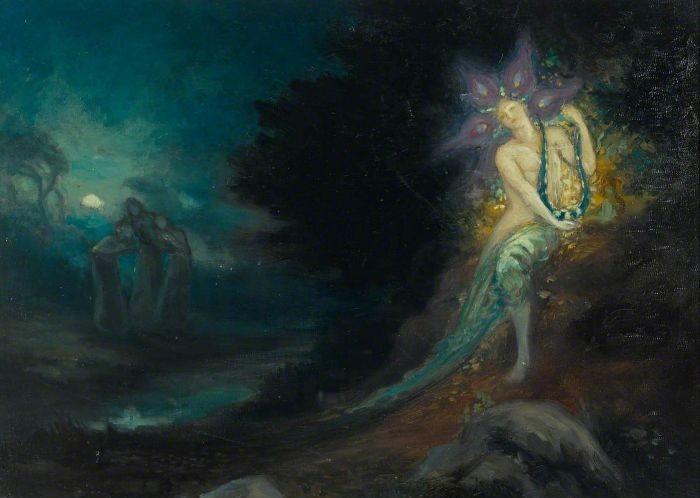
“The fairies were never far away, living in the green hills, hidden from ordinary eyes, but close enough to touch if you believed.”
John Montague
All art by George William Russell, A.E.
You may have heard the term ‘Shining Ones’ or ‘Shining Folk’ in relation to fairies.
There are a number of reasons for this description, including the brightness of their appearance at times, as well as being a euphemism for their wisdom, and often their otherworldliness. In fact, when we look at the folklore, as well as the older mythology, we can make an argument for all of the previous descriptions fitting both physical and non-physical traits.

In my previous post I wrote about the case of a boy who was visited by two beings dressed in white after he had taken bluebells from a fairy fort. Another unusual, yet more recent interpretation, sees the brightness as being something that manifests because human beings are unable to perceive the true reality of these forms. Instead, those who see them are culturally creating a shape, symbol, or experience which transcends known archetypes, thus manifesting as something brilliant and hard to define. This is very much in the realm of the ‘fairies as mytho-consciousness creations’, it might be said.
Many writers argue that fairies take the form of what is known by a person’s folklore or worldly experiences. Take this striking Irish example, for instance: The Shining Man.
“There was a man, “wan” night coming on a journey along a lonesome road. As he was coming along a man on a bicycle came “along-side” him. He was going to bid this man good night but he thought he looked very “peculiar.” All at once the road was all lit up and the bicycle was all shining and his close (clothes) were all shining. He was so stunned at the sight that he could do nothing but bless himself; and the man disappeared. So he had to keep on praying to the end of his journey.” https://www.duchas.ie/en/cbes/4493804/4422399
Here we have an experience which researchers like Vallee and Keel might frame as a UFO encounter but with the experiencer being unable to match the UFO to anything he previously had known, thus seeing a bicycle instead of a craft. This same argument has been made for those who see angels, fairies and otherworldly visitors. The shining aspect is again to the forefront.
Another example is a shining or white lady who turns up in folklore around the world.
In more recent times, these have been categorised as religious experiences, but the function and, indeed, effects, fits with those who would have very different views on what religion even is, as well as a vague fit into our ideas of ‘good’ and ‘evil.’ A lady in white is often documented to have appeared to children in European folklore, although post 10th century she tends to be associated with Marian apparitions and is usually benevolent. That said, the White Lady who appeared to children at Massabielle in France was said to have gestured to the children to follow her over the edge of a rocky cliff as she floated, orb-like, above them.

Sites such as Fatima and Lourdes were also long associated with fairy women and bright ladies long before the apparitions were Christianised. There is also a strong link to caves, natural springs and trees held sacred in Pagan folklore, which we also find in Irish folklore. Within Germanic folklore we find the White Lady as Die Weisse Frau, who wanders the countryside searching for her dead children. Here we have an accepted lineage dating back to German Paganism and Elves but, perhaps, we have an even more important clue as to the identity and distortion of who these shining or white beings originally were.
The Ljósálfar (The Light Elves) were said to be as bright as the sun and to look upon them was almost impossible because of their shining nature. (Just to add that many scholars see the distinction between light and dark elves as a Christian concept.) Is this related to the ambiguity in which Irish interpretations of fairies are understood, I wonder? This might suggest that there is no real separation, only how these beings are encountered.
Jacob Grimm wrote in his work, Teutonic Mythology, “The enchantment under which they suffer may be a symbol of the ban laid by Christianity on the divinities of the older faith.” This is important because the Dutch version of these beings are ‘Wise Women’ as opposed to ‘White Ladies’, which is attributed to a mistranslation of ‘wit’ in the folkloric record. This would also correspond and support the idea put forward by some scholars that it was the Christian demonisation of these beings which created the evil nature of their later incarnations and which repressed their Goddess-like original nature.
Another example of shining folk literally burning brightly is recorded by Wentz in his work The Fairy Faith in Celtic Countries. Wentz describes how a doctor and a companion were riding home from Limerick one night. As they approached Listowel the doctor writes that he witnessed what he thought was the light of a house about a half mile ahead of him. On approach, though, the light began to behave in a very mysterious manner, “Moving up and down, to and fro, diminishing to a spark, then expanding into a yellow, luminous flame.” As they rode on, the doctor and his companion then saw two further lights behaving in a similarly bizarre fashion. The doctor tells us that the lights were six feet high and four feet wide and within each one was, “…a radiant being having human form.” The two lights then glided towards each other until they touched and the beings inside were able to walk between each light as if it was one individual orb. Whatever the doctor was thinking, he was able to describe what he witnessed in further detail. He tells us that, “The beings bodies were formed of a pure dazzling radiance, white like the radiance of the sun, and much brighter than the yellow light or aura surrounding them.”

Within Irish folklore, though, this sighting is nothing unusual at all. It contains all of the customary and traditional motifs of meetings with the good people. In fact, the detail of the doctor’s description ties the encounter to countless others throughout the entire island. What is perhaps curious, or telling, depending upon how you see ‘fairies’, is the doctor calling these beings ‘spirits.’ This may be, perhaps, an unconscious referral to the belief that in many cases the fairies were both the dead and another type of spirit, or it may be that there was more of an acceptance of this crossover than there sometimes is today. Whatever the answer, this encounter is certainly one of more interesting and well described cases in the Irish folklore archives where a description of ‘shining folk’ clearly fits.
In many Irish fairy encounters we can notice a similar description. Sometimes it is an entire fairy mound itself which is seen to light up and spin, and at other times a parade of lights are seen to emanate from the rath or mound and take off across the sky. This aspect has been documented at the rath situated near Keadeen, Co. Wicklow and is recorded in the archives at Duchas.ie as well as being included in a previous post on this page. In this further example, the lights seem to foretell of a death. “One night about three years ago the Hartnetts who lived in Gardenfield were going to the fair in Drom and they saw a bright light shining over near Mrs. Dowling’s house. They said to themselves that it was very early Mrs. Dowling was up. Mrs. Dowling saw the same light that night moving up around Harnett’s house then it came down and it went into the fort and disappeared. That happened before Mr. Harnett’s death.” https://www.duchas.ie/en/cbes/4921974/4914569/4938134

Finally, this account recorded in 1926 is also interesting. The writer tells us “I was learning to speak Irish at the time. A gang of us would be sent over beyond Lough Gara every week to be taught by the master there. Some of us would go on bicycles and would often cycle home in the dark. We were nervous when we’d cycle by the lake as we would often see three lights skimming across the water. Sometimes the lights would appear in the trees at the lake edge and other times they would submerge beneath the water. Our parents put the lights down to the work of God. ‘Don’t worry about them, they’re only lost souls trying to get into heaven. They’re no harm.’”
So, as you can see, although the description of fairies as the ‘shining ones’ or ‘shining folk’ can definitely have allusions to wisdom, secrets, and inner transcendence, there is plenty of scope to also include this as a literal physical description. How we interpret that further is open to a wide variety of opinions, I feel.

David Halpin
David Halpin is a writer from Tallaght, now living on the Carlow/ Wicklow border. He has been writing about Irish Forteana and spirituality for over thirty years and has had his articles published in magazines and books throughout the world. David’s photographs of Ireland’s sacred sites have been published in journals and articles worldwide and in 2020 were included in An Taisce’s annual report on the Irish landscape. David is also a reviewer of esoteric writing and as well as publishing for The Occult Book Review, he also contributes regularly to newspapers, magazines and online publications. His articles have appeared in The Wild Hunt, New Dawn Magazine, Coire Ansic, and he is a regular contributor to Ancient Origins. David also runs the blog, Circle Stories, where he focuses his writing upon the topics of consciousness and folklore.
Leave a Reply