
“For king’s evil, a most effective cure of proved power is made of burdock roots, the common dock, bog-bean and rose-noble boiled in water, of which the patient must drink three times a day.”
Lady Wilde, Ancient Cures, Charms and Usages of Ireland, 1890
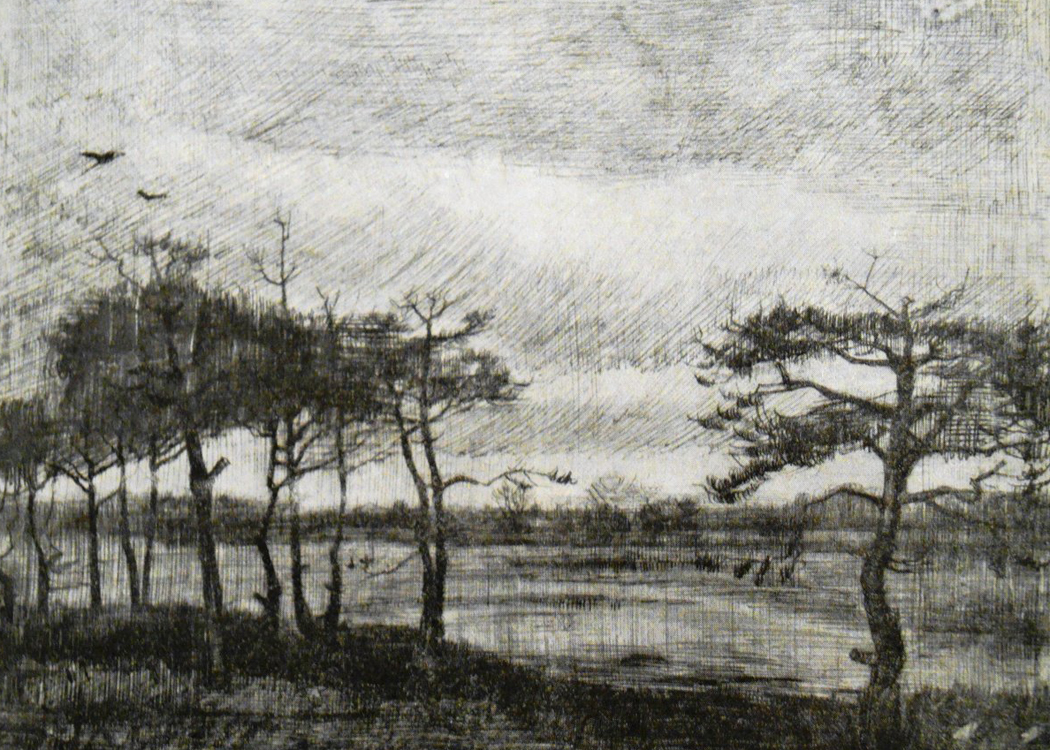
Cover art by Vincent Van Gogh
Bog bean or Menyanthes trifoliata is also called buckbean, marsh trefoil, water trefoil, marsh clover, water shamrock, bog hop and bocks. It’s called seib, trì-bhileach and pònair-churaich in Gaeilge and pónaire chorraigh in Scots Gaelic. The Greek name Menyanthes means ‘disclosing flower’. The common name bogbean as well as marsh clover refers to the way it frequently occurs naturally in bogs or other marshy environments. Additionally, the fruit of the bogbean is literally a small bean and the leaves look similar to that of a bean plant. The bogbean is a favorite, mostly due to the utterly adorable white and pink flowers. I think if left to my own devices, and in proper wellies no less, I could stare at bogbean an entire afternoon and still be completely entranced upon leaving it.

I really enjoy touching it as well and watching the transition of colors from pink to white. The bitterness of the leaves lend it to having been a common herb implemented in brewing beer and large amounts of leaves have been found in the ancient remains of Irish ráths or ringforts.1 In Ireland, it was used for clearing the blood, coughs,2 scurvy, skin complaints,3 stomach complaints,4 boils,5 bone disease,6 tuberculosis,7 rheumatism8 and as a kidney and liver tonic.9 Additionally, it was recommended as a generalized spring tonic in Donegal that was thought to keep sickness away the rest of the year. A local woman was said to gather the bogbean at the beginning of March, boil it in water for four hours, strain the liquid and put it in bottles. Each person in the house fasted through the month of March living mostly on this bogbean infusion.10
On the Isle of Man, the herb served as a digestive tonic and to treat fevers while in the Scotland it was used to treat headaches, asthma, coughs, ulcers and stomach or skin complaints.11,12 A local folk story in Scotland tells of an army man deemed to have an incurable ulcer by doctors in Edinburgh that went on to be completely healed by a local healer in Melness who treated him with bogbean infusions.13 In England and Wales it was predominantly recommended for stomach complaints as well and as a generalized spring tonic.14,15

Bog bean is very unique in that it’s the single member of the Menyanthaceae family and native to Europe, Eurasia and North America. The fact that it is native to both Europe and North America lends that it was likely important enough to be brought over the Asian land bridge with some of the first North American inhabitants. Bogbean has smooth elongated leaves that occur in groups of three and white flowers with fluffy anthers that typically bloom from May through July and it may have been associated with the Spring Equinox or Bealtaine. It’s a perennial hardy in zones 3 through 10, grows up to 30 cm or 1 ft and does well in full sun or part shade with moist marshy soil. Bogbean’s energy is bitter and moist. The leaves and roots are edible and have a pungent bitter flavor. It’s most commonly used as an infusion. Larger doses of bogbean can have a strong laxative effect.
Benefits
antirheumatic, blood tonic, digestive tonic, kidney tonic, liver tonic
Recipe
Bogbean Blood Purifying Infusion
Ingredients: 2 tbsp. bogbean roots, 1 tbsp. dandelion roots, 1 tbsp. Nettle
Instructions: Boil 32 oz or 4 cups of water and mix in herbs. Reduce heat and let them sit for three, six or nine hours. Strain and sip 1 cup per day while fasting.
References
- Sullivan, W. K., Introduction, in Eugene O’Curry, On the Manners and Customs of the Ancient Irish, 3 Vols., London, Williams and Norgate, 1873, ccclxxiv.
- Irish Folk Duchas, School Collection – Volume 1123, Page 265
- Irish Folk Duchas, School Collection – Volume 621, Page 127
- Irish Folk Duchas, School Collection – Volume 1033, Page 227
- Irish Folk Duchas, School Collection – Volume 1085, Page 271
- Irish Folk Duchas, School Collection – Volume 1124, Page 295
- Irish Folk Duchas, School Collection – Volume 665, Page 106
- Irish Folk Duchas, School Collection – Volume 254, Page 025
- Irish Folk Duchas, School Collection – Volume 206, Page 476
- Irish Folk Duchas, School Collection – Volume 1111, Page 466
- Quayle, George, Legends of a Lifetime: Manx Folklore, Douglas, Courier Herald, 1973, pg. 69.
- Shaw, Margaret Fay, Folkways and Folklore of South Uist, London, Routledge, 1955, pg. 47.
- Cullen, L. M., & Smout, T.C., Comparative Aspects of Scottish & Irish Economic & Social History 1600 – 1900, Edinburgh, 1977.
- Myddvai, Meddygon, Pughe, John and Williams, John, The Physicians of Myddvai, Wales, 1861, pg. 343.
- Wright, Elizabeth Mary, Rustic Speech and Folk-lore, London, Oxford Uni- versity Press, 1913, pg. 239.

Isla Skye
Isla is an American Irish mother of 3, teacher, author and herbalist that splits her time between the states and Ireland. She has been studying folklore as well as the druids and related practices for over 20 years. Her hobbies are family time, reading, camping, hiking, spending time with her many animals as well as writing and research.
Leave a Reply