
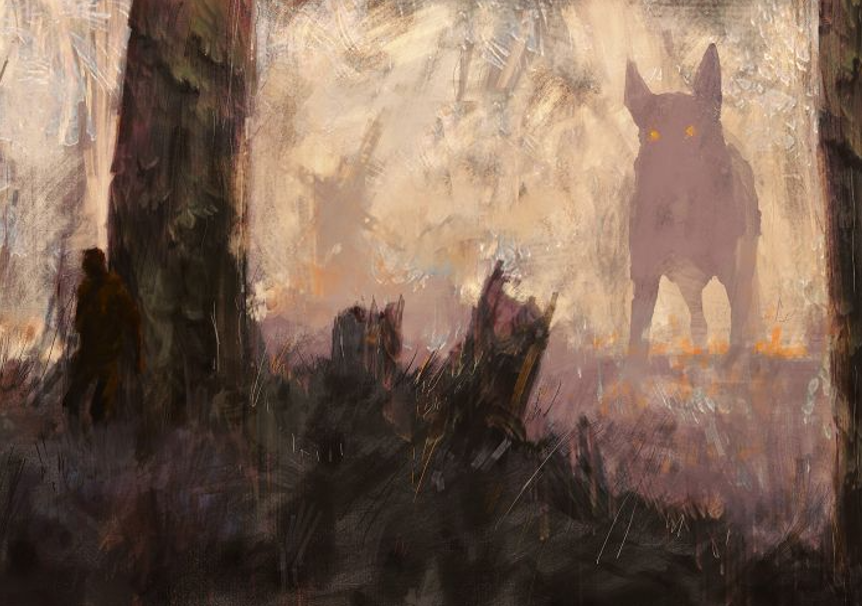
“She had ridden a little ahead of her husband … her horse became skittish and frightened. On trying to regain control of the horse, she saw the gwyllgi, a huge mastiff with glowing red eyes.”
– Professor T. Gwynn Jones, Welsh Folklore & Welsh Folk‑Custom, 1930
Cover art by Cze Peku

There is a prominent legend that spans across the entirety of the isles which is the belief in large black dogs with red or ghostly eyes haunting rural areas of the countryside and being a genuinely terrifying omen to witness. They were interpreted as chilling warnings, possibly of imminent death or spiritual danger. They were sometimes interpreted as spiritual entities in a shapeshifted form.
Digging a little deeper, some explanations place them as a sort of animal psychopomp, guiding souls towards the Otherworld in some capacity. This belief most certainly aligns with how dogs seem to have been perceived in the archaeological record as at minimum, companions related to traveling with their owners into the Otherworld. As mentioned in previous articles, there is evidence for dog ownership in the isles going as far back as the Mesolithic period and countless dogs have been found to be buried with their owners, presumably.
Interestingly, the Greek goddess Hecate is often depicted with black dogs as her companions and guardians of the liminal spaces she governs, such as the underworld, and crossroads. These black dogs act as mentioned, psychopomps, guiding souls and serving as a symbol of Hecate’s presence and power over transitions. In some myths, the Trojan Queen Hecabe is transformed into Hecate’s black dog as a punishment, becoming a loyal familiar to the goddess.
Here are a few local legends of the ‘black phantom dog’ folk motif…
Wales
The Gwyllgi is associated with rural Wales, especially Denbighshire, Wrexham, and other parts of North Wales. Unlike some other supernatural dogs, the Gwyllgi is not always aggressive but is still terrifying and best avoided. It is described in folkloric references and more modern first hand accounts as being a large black mastiff type of dog with glowing red or fiery eyes. Sometimes it’s said to be cloaked in a dark mist and radiating an aura of fear and terror.

The Cŵn Annwn or Hounds of Annwn, are ghostly, supernatural dogs believed to belong to Annwn, the otherworldly realm of the dead in Welsh tradition. The singular form is Ci Annwn. I mention them here even though their appearance is different because of their possibly related symbology in folklore related to dogs. These spectral hounds were white verses black but are most famously associated with a version of the Wild Hunt, a phantom procession of huntsmen and spirits seen as a harbinger of death or misfortune. The hunt is often led by Arawn, the mysterious ruler of Annwn, who appears in the Pwyll Pendefig Dyfed, First Branch of the Mabinogi and is referenced again in the Math fab Mathonwy, Fourth Branch. In later medieval Welsh lore, the leadership of the hunt shifts to Gwyn ap Nudd, a figure associated with the underworld and the fairy realm.
In some parts of Wales, the eerie cries of migrating geese were thought to be the calls of the Cŵn Annwn, as their nighttime honking resembled the baying of ghostly hounds. One of their most famous hunting grounds is said to be Cadair Idris, the legendary mountain in North Wales. It was believed that hearing the howling of the Cŵn Annwn near this peak foretold imminent death. Strangely, the growls of these hounds are said to work in reverse: they sound loudest when far away, but quieter as they draw closer, a chilling sign of their approach. In most tales, their arrival signals a death omen, especially for those who hear them during the night. The Cŵn Annwn embody the relationship between the mortal world and the Otherworld, serving as both guardians and hunters of lost souls.
England

The Barghest, sometimes called the Barguest is a legendary phantom hound said to prowl the shadowy Snickelways and hidden alleys of York. Often seen near the looming presence of Clifford’s Tower, this fearsome creature is known for appearing without warning, its eyes glowing with a ghostly fire. According to local legend, witnessing the Barghest is a dire omen, foretelling death or misfortune for those who cross its path.
The Black Shuck, also known as Old Shuck, Old Shock, or simply Shuck is the name given to a ghostly black dog said to roam the windswept coastline and rural paths of East Anglia, especially Norfolk and Suffolk. Descriptions of the creature vary, but it is often depicted as a large, spectral hound with glowing red or green eyes, sometimes headless, and always an omen of misfortune or death. One of the most infamous encounters occurred on August 4, 1577, at Holy Trinity Church in Blythburgh, Suffolk. During a violent storm, the Black Shuck is said to have burst through the church doors with a deafening clap of thunder. He ran down the nave past a terrified congregation, killing a man and a boy, and causing part of the steeple to collapse through the roof. As the hound fled, he supposedly scorched the north door with his claws, marks which are still visible today. There is a Black Shuck Festival every year in August, in Bungay.

The Padfoot is active in Wakefield, Leeds, Pudsey, and parts of Bradford where the local incarnation of the spectral black dog legend is known. Like its counterparts, Padfoot is seen as a harbinger of death, a supernatural presence best left undisturbed. It’s said to appear and disappear at will, often following people in the dark with the soft, unmistakable padding of paws, giving it its name. Witnesses sometimes report it suddenly reappearing ahead or at their side. It’s known to produce a terrifying roar, unlike any known animal, and is occasionally accompanied by the rattling of chains, dragging alongside the sound of its footsteps. Local lore warns that confronting or speaking to Padfoot gives it power over the person, with dire consequences. In one tale, a man who tried to kick the creature was seized and dragged through hedges and ditches all the way home, only to be dumped beneath his own window.
The Gytrash is a legendary shape-shifting spirit rooted in the folklore of the West Riding of Yorkshire. Said to haunt lonely country roads and desolate paths, the Gytrash typically appears in the form of animals, most commonly black dogs, but also horses (similar to a selkie), mules, or other beasts. These spectral creatures are known for misleading travelers and luring them off course into danger or confusion. However, the Gytrash is not always malevolent… on rare occasions, it is said to have acted benevolently, guiding lost souls safely back to the right path. Despite these kinder tales, the Gytrash is generally feared and regarded as a bad omen.
There are many more phantom black dogs that could be listed here with unique names that are very specific to the locale in various parts of England and the U.K. : Hairy Jack, Skriker, Churchyard Beast, Shug Monkey, Capelthwaite, Dando’s Dogs, Wist Hounds, Hateful Thing, Scarfe, Gallytrot, Swooning Shadow, and Bogey Beast to name a few mentioned in various folkloric records.

“A hound it was, an enormous coal-black hound, but not such a hound as mortal eyes have ever seen. Fire burst from its open mouth, its eyes glowed with a smouldering glare, its muzzle and hackles and dewlap were outlined in flickering flame. Never in the delirious dream of a disordered brain could anything more savage, more appalling, more hellish be conceived than that dark form and savage face which broke upon us out of the wall of fog.”
– Dr. John Watson, The Hound of the Baskervilles
Isle of Mann
The Moody Dhoo, Moddey Dhoo or Black Dog is usually described as a large, black, shaggy dog, ghostly and eerily silent, with glowing eyes. It appears suddenly and vanishes just as quickly, often without making a sound. Despite its fearsome presence, the Moddey Dhoo is not consistently malevolent, though it inspires deep dread, it seldom attacks or harms directly. Instead, its power lies in its symbolism as the classic guardian of liminal and haunted spaces.
Ireland
In Ireland, the black dog motif appears again as a Sprideanna i nDeilbh Ainmhithe, Spirit in the Form of Animals or Spirit Animal and usually just simply described as a large, amadra dubh, black dog. The spirit dog’s folklore is somewhat identical to other places in the isles where the sighting of one was often considered a bad omen and as mentioned in prior folklore as well, someone was typically cited having the dog follow them home of which thereafter, a negative or bad course of events took place. There are a wide array of references to mysterious black dogs in Ireland… as omens, as watchers and similarly, related to crossroads, bridges, sacred sites or other liminal places.

A few tales from Ireland…
“James O’Connell formerly a teacher in Leamlara 50 yrs ago or so, was coming home from Tattans (local Public House) met a large dog at Leamlara Cross. The dog followed him home. When he went in home the cock crew, clapped his wings, and fell down dead.”1
“Long ago there was a man going to Listowel very early one morning and he saw a big black dog on the side of the road. Then the dog began crying and the man stayed. Listening to him for an hour. After that the dog stopped crying and the man went away. About four nights after the man was coming home from a walk and he saw the dog again. The dog spoke to him, an he said ” I have killed your wife because she is a bad woman all her life”. Then the man went home and when he entered the house he found his wife dead.”2
“One night two girls were were going home from Aughagower. As they walked along one of them looked behind and she saw a big fat black dog coming after them. They ran but he kept the same distance behind them. They said go home and he did not. He followed them to their own house and when they went in one of them fainted.”3
“One dark night as he was going down the lane he saw a big black dog with eyes of fire coming up the lane. Patrick was a good man and afraid of nothing. He came near the dog and it lay down. Patrick went up and began to pat the dog. All of a sudden the dog disappeared. He went on his way down the lane and again it appeared. He followed the dog and it disappeared again in a clump of nettles.”4
“Meade on his way home had to pass a gateway on the roadside called the Black Gate, which was always shunned by the people at night. Meade saw a black dog at this gate more than once and on a couple of occasions the dog walked after him to his house. He was getting scared and resolved to keep earlier hours. One November night they were playing for turkeys and Meade was later than usual about 1:30 am. When he reached the Black Gate the dog marched out to him. Meade quickened his steps; the dog did the same; Meade ran, so did the dog. Meade made for the door and burst it in followed to the door step by the dog. Meade was unable to go to work the following day. The steward came. Meade was black all over. The priest and doctor were brought and Meade died in a few days.”5

Scotland
The Choin Dubh or Muckle Black Tyke is a spectral hound, often enormous, described as large as a calf or horse, with the Tyke reaching the height of a stag. Their fur is pitch black and they’re often likened to shadows. Most are said to move without sound, their silence marking them as otherworldly. They do not reflect in mirrors or water, further anchoring them in the realm of the uncanny. Their eyes, glowing red or amber, suggest something ancient and knowing, and breath described as mist or fog connects them symbolically to thresholds and borderlands between life and death.
Their awareness implies intelligence as they choose whom to follow and whom to spare or not. The dog walking a set path connects it to corpse roads and historic funeral routes believed to guide spirits to rest. Such figures may stem from pre-Christian beliefs in mound guardians or Celtic Otherworld hounds. Protective lore warns not to meet their gaze, speak their name, or walk alone. Running water is believed to break their hold, and walking backward may show respect, or at least delay what’s coming.
A reworded tale from Scotland…
The Hound That Waits
They say there’s an old track, worn into the heather by a thousand forgotten feet. It runs quiet and narrow between Insch and Rhynie, threading the hills like a vein, and though it’s not marked on any modern map, the locals still know it by the name the Cairn Road. It skirts a hump of land called the Hag’s Hill, where the ground rises up and breaks into stone, and at its peak stands a cairn that is incredibly old. They say it was never meant to be disturbed and yet, something keeps watch.

You won’t hear it coming. That’s what’s always said first. There’s no bark. No growl. No crunch of heather underfoot. The beast makes no more noise than falling snow and leaves no marks behind. But if you see it, and God help you if you do, it will be standing. Still. Unmoving. Watching. They call it the Muckle Black Tyke.
A dog, they say, though no dog born of flesh. Taller than a man’s waist, heavier than any beast should be, and black as the mines beneath the mountain. Its eyes glow red, not bright, but deep, like fire at the bottom of the hearth. They do not flicker. They burn. The Tyke is not a ghost. It is not a demon. It is not a faerie beast. It is older than those words.
One day a local man was walking up the hill dared by his friends to go visit the haunted cairn at night… and they say the air was different that night. The air tightened around him like a drawn string, and the light of the moon turned cold and metallic. The fog didn’t roll in from the lowlands, but rose up from the earth itself, curling around his legs like fingers. He walked on and when he reached the cairn, the world had gone quiet. No rustle of wind. No chirp of insect. No call of bird. Just the beat of his heart and the crunch of his boots.
Then, stillness. Something waited there. On the far side of the stones. A dog. Vast. Silent. Watching. It did not move. Did not breathe. Its eyes, red, deep, waiting. The man did what bold men do when fear reaches them… he reached for his blade. The Tyke stepped forward. Not fast. Not menacing. Just one step and then it disappeared.

The man softly laughed but decided it best to turn around and walk home and yet faster than when he had walked up to the cairn. Behind him, there was a strange feeling. Not a sound. Not breathing. Not footsteps. It was something softer… like the weight of eyes.
The man came home to his wife very pale and sodden, the heat gone from his skin. He wouldn’t speak. Wouldn’t eat. Wouldn’t meet her eyes. That night, he bolted the doors, covered the windows and even the mirrors. He sat by the fire that night all night long, unable to sleep. Fear had caught him and wouldn’t let go.
In the weeks that followed, the man slowly changed. He flinched at shadows. Whispered prayers he never learned in church. Refused to go near water. Refused to go out after dark. He claimed the Tyke could cross through reflections if he wasn’t careful.
Every night went the same, the sleeplessness, the exhaustion, the mental torture…
Three months of this and with it in time, silence. His wife found him one morning in their bed, jaw locked open, eyes red and staring. The windows were shut. The doors bolted. However, the wood of the cottage door bore four deep gouges. Claw marks.
They say if you see the eyes, you’re already marked… But you can still be spared. If you walk backward. If you cross running water. If you keep your voice low.

And above all, don’t speak the dog’s name.
Don’t give it power.
For the thing that walks that path is not dead, not truly alive, and not entirely alone. It remembers. It waits. It guards something we were never meant to disturb.
And if it looks at you, if it truly sees you…
You will never forget.
Footnotes
- The Schools’ Collection, Volume 0387, Page 121
- The Schools’ Collection, Volume 0404, Page 457
- The Schools’ Collection, Volume 0088E, Page 09_031
- The Schools’ Collection, Volume 0004, Page 117
- The Schools’ Collection, Volume 0512, Page 088

Isla Skye / The Druid's Cauldron Historical Society
We are a registered non-profit, The Druid’s Cauldron Inc. 501(c)(3) The Druid’s Cauldron is an independent journal established in 2016, dedicated to the preservation and exploration of the druids, filid/poets, culture, native wisdom, and the living traditions of the isles. We exist to recover folklore, herbalism, spiritual philosophy, and ecological knowledge embedded in the whispers of our ancestors.
Through deep research into traditional folklore, herbalism and mythology as well as personal artistic endeavors, we seek to cultivate a deeper relationship with the land, the seasons, and to one another. We are committed to serious inquiry and evidence-based information, or it is alluded that it’s personal philosophy and labeled as such. The Druid’s Cauldron is a space for the curious, the contemplative, and those who feel called to remember older ways of being in right relationship with the land and each other.
Leave a Reply