
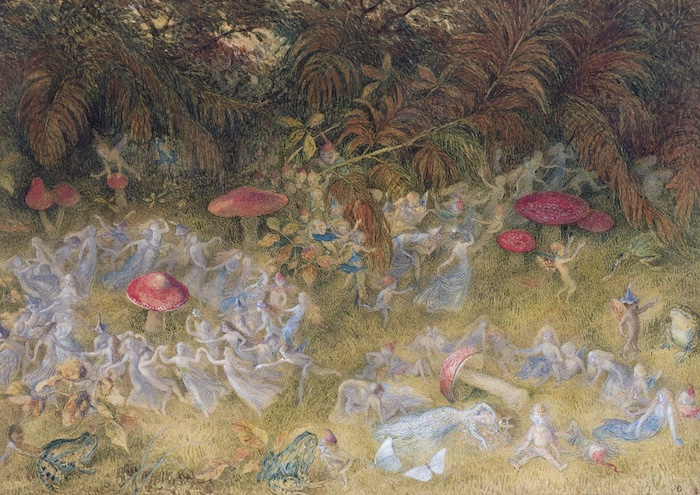
“Their food is specified in Welsh folk-lore as fairy butter and fairy victuals, ymenyn tylwyth teg and bwyd ellyllon the latter the toadstool, or poisonous mushroom, and the former a butter-resembling substance found at great depths in the crevices of limestone rocks, in sinking for lead ore.”
Wirt Sikes, 1880
Cover art by Richard Doyle

Fly Agaric or Amanita muscaria is also called fly amanita, soma, asumer, amrita, pong, pank and pongo. It’s called agairg nan cuileagan in Gaeilge and Scots Gaelic. The Latin name derives from its use as an insecticide to keep flies away or to kill them. Albert Magnus, (1200 – 1280) a German philosopher said of the amanita that, “It is called the fly mushroom because it is powdered in milk to kill flies.”
An alternative origination to the name lends to it referring to the way the mushroom made you ‘fly’, as in, hallucinate. This gloriously magical mushroom with its iconic red cap dotted with white flecks, stands as a striking symbol of enchantment and altered states of consciousness. Amanita is fascinating in that it has at least three subspecies that look nearly identical but have variances in color ranging from a duller red to yellow and orange.
It’s thought by many anthropologists and herbalists alike that the Fly Agaric is one of the oldest and widely used psychedelic mushrooms. From a spiritual perspective, the Amanita has been implemented into the practices and lives of various cultural healers or seers for millennia. The most famous of these cultures are the peoples of Siberia. For example, the Ostyak, Vogul, Chukchi, Koryak and Kamchadal tribes have all been cited as using it as well as Pacific Native Americans, Indians and some groups of Scandinavians.

It was famously said in the Indian Rig Veda that, ‘Aryan’ people came down from the north and brought the mushroom and the cult of soma. It is one of the only psychedelic plants to be thought of as a deity itself. It was quite literally considered the ‘flesh of the Gods’. It was considered so sacred in the Rig Veda that in fact, some 120 hymns were devoted exclusively to soma.
The Vedic poets mentioned certain steps involved in the collection, process and preparation of Soma which is incredibly similar, if not identical to the methods used by Siberian shamans. Firstly, it was gathered and collected during a full moon. It was then pounded, the juices being strained through a woolen cloth. The juice was then mixed with water, milk, honey or a barleycorn infusion. Finally, it was strained again through the human body of which the juice was ultimately pissed out and drank. The main effects are said to be dizziness, twitching, numbness of feet, nausea, hallucinations, both visual and auditory as well as sleepiness. The experience lasts between 4 to 10 hours.

The magical qualities of mushrooms seeped into European folklore and fairy tales up into the present day, where they continue to serve as portals to otherworldly realms. The fact that mushrooms were referenced in folklore as “fairy chairs” or “elf stools” hinted at their potential to transport humans to the hidden spaces of mysterious creatures and beings. Stories of people seeing fairies dancing around mushrooms and tales of journeys to enchanted lands through mushroom ring circles deepened their association with the mystical and the liminal. Lewis Carroll used the mushroom in his famous story Alice in Wonderland to symbolize transformation and altered perception.
With that said, there isn’t much, if any evidence that the druids or other European seers used mushrooms in ritual in groups or on an individual level. That doesn’t mean it didn’t happen, just that we don’t have much concrete evidence for it. What we do have are scant archaeological etchings in tombs that look like mushrooms. Tombs or caves may have been a place that seers were journeying or having other related rituals but there’s also no way to prove a connection. Being etched on tomb walls may have further connected those tombs to the otherworld (being the mounds of the fairies in the isles).
There are ‘magic’ mushroom varieties in Europe of course in addition to the beautiful Amanita such as Psilocybe semilanceata (good ol’ Liberty Cap), Panaeolus cinctulus, Psilocybe cyanescens, Psilocybe stuntzii and Psilocybe hispanica. These all may have hypothetically been used. My own interpretation of everything I’ve read over the years and the mushroom’s relation to fairies is that in having this relation, and being a risky food item ie. ‘poisonous’, they may have been taboo to eat if you were not a skilled spiritual practitioner. Similarly, the Irish fairy doctor was the only person in the community who would have had the cure and successfully been able to heal ailments specifically related to the fairies. It was in essence forbidden for anyone else to even attempt their methods. Everything concerning the fairies and the otherworld had to be done with caution and experience, or carefully guided by someone experienced and rightfully so.

What we do have evidence for in regards to spiritual journeying and receiving prophetical answers is sleeping on sacred ground (sacred sites or ancestor’s graves), interpreting dreams (both their own and their patron’s dreams), studying animal or cloud movements (birds and hares especially) or trance induced by song.
These have been the main methods mentioned collectively throughout European literature, and especially Irish and Scottish literature. Were these experiences sometimes enhanced with certain types of alcohol, herbs or mushrooms? Possibly, depending on the ritual and purpose. If anything, there is a greater chance that propohetical trance was assisted with the use of either homegrown mead and wine or the smoke of mainly, cannabis and opium poppy for which there is much archaeological evidence for. The use of these are proven in the archaeological record in Europe at least to 3,000 BCE.1
There may have been a divergence of methods used… standard methods to find straightforward answers as listed above that would have been recorded for logistical purposes and then, another method using more intense enhancements (mushrooms) when journeying for the sake of it, exactly similar to how we do today… to reset, to heal, to get broader non-specific insight or just to attempt to make connections with sacred energies or beings with no specific agenda. I have found that mushrooms open doors visually and authentically to the local natural world around us that other substances do not. There is also something incredible to be said for the fact that mushrooms are linked to the earth in a very literal way through the mycelium network. The Amanita also tends to grow underneath and have a close relationship with very specific species of trees including, birch, pine, spruce, fir, cedar, and oak… many of which are incredibly sacred and associated with mythical figures in their own right and again, the otherworld. Mushrooms also tend to grow on dying or decaying things lending to another direct connection to the threshold between life and death. This may all further lend to a natural association to the local fairies and land spirits. Of course, this is again, speculation.
I don’t particularly agree that when it was mentioned that druids chewed the ‘raw flesh’ of pork, dog or cat to induce trance in The Senchus Mór, they were referring to a mushroom. I bring this up because it’s been mentioned a few times over the years in facebook groups as a possibility. I don’t perceive enough religious motivation to obscure that fact if it was indeed mushrooms they were actually using. I say that firstly because in the reference they were discussing how it was banned and writers seemed comfortable openly discussing what was banned and why. As is well known, much of the stories in the text seem to be mostly of a symbolic nature although we’ll never know what was real, or at least based on the truth and what wasn’t. Secondly, they were not eating it, but merely chewing it and spitting it out, then placing it as an offering which definitely dilutes any chemical’s impact on the body. There’s zero evidence that the Irish in the old Gaelic world ate dog or cat, however, pork, yes.

Pork is listed first and this was certainly a sacred animal and dish. All three animals were clearly offered for more ritualistic purposes than the literal way in which the chewing of the meat may have aided in prophecy or journeying from a chemical perspective. Dogs and cats were probably more rarely used because they would likely have only been available when someone’s companion pet died however, being a loved companion pet was possibly why they were also an appropriate offering.
Dogs and cats certainly had a connection to the otherworld as they were seen as guardians and protectors. They may have aided in opening the door in the first place or been the protector of the seer on his journey. As this Smithsonian article says about a Celtic Gaulish burial… “Four other burials, from babies to middle-aged men and women, also contain nearly intact remains of dogs and horses—animals not commonly eaten but held in high esteem. Their burials suggest deeper meanings, including religious associations and the status of the animals as companions.” Dogs have been thought of as likely common companion pets in Ireland, Scotland and Britain at least since the Mesolithic and Neolithic periods. Although there were wild cats, domesticated ‘modern’ cats arrived quite a bit later, after the common era began.
Thirdly, if they were worried that people might read the book and try to take the mushroom that was hidden from actual reference, they didn’t have to mention what type of mushroom it was. It could have been written as a generic ‘mushroom’ offering. I do feel they were genuinely chewing meat and it was being used as an offering to the gods or spirits of the land they were wanting to commune with. The meat being an offering to their gods is also the crux of St. Patrick’s issue and banning it. Otherwise, it’s possible he may not have not taken issue at all with the fact they were going into a prophetic trance to find answers irregardless of what they were chewing beforehand… as long as it wasn’t an ‘offering’ to a deity/spirit/energy other than Christ or the one God.
Of course they still may have taken mushrooms but it was simply left out of written records entirely on purpose. I find that more believable than pork, dog or cat being a code name for a type of mushroom. It’s important to always remember these were places steeped in oral tradition. Advanced spiritual practices involving mushrooms would have likely been gate-kept to some extent for safety purposes lest you risk someone harming themselves if they tried it without elders present. I honestly believe and this is merely my opinion, that the druids of old were probably so highly trained, they didn’t need to take anything to successfully journey to retrieve answers. As we go deeper on our own paths, I think we’ll each find this to be true and in reality, it only requires silence and knowing you won’t be interrupted (just as the Senchus Mór quote discusses).
The full Senchus Mór quote…
“The poet discovers through it whatever he like or desire to reveal. This is the way in which it is done : the poet chews a bit of the flesh of a red pig, or of a dog, or cat, and he conveys it afterwards to the flag behind the door, and pronounces an incantation on it, and offers it to idol gods, and he then invokes his idols; and if he obtains not his desire on the day following, he pronounces incantations over both his palms, and invokes again unto him his idol gods, in order that his sleep may not be interrupted; and he lays his two palms on his two cheeks, and falls asleep; and he is watched, in order that no one may interrupt or disturb him, until everything about which he is engaged is revealed to him, viz., in a minute or two or three, or as long as he was supposed to be at the offering; and therefore it is called Imbas, i.e. ‘di bois uimme,’ i.e. his two palms upon him, i.e. one palm over and the other hither on his cheeks. St Patrick abolished this, and the Teinm Laeghdha, and he adjudged that ‘whoever would practise them should have neither heaven nor earth, because it was renouncing baptism.”

Of course, not having concrete evidence doesn’t take away from the magic of the exquisite Amanita mushroom, the healing that often softly unfolds after experiences with it and it’s close association with otherworldly folk in many various European cultures. It’s at minimum a sacred spiritual symbol of our complex relationship with the fairies as well as other sacred and mysterious energies at work in nature.
Fly Agaric is in the Agaricaceae family and native to Europe, Asia and North America. Fly Agaric is a lovely deep red to orange mushroom with white gills that typically fruits in the Autumn and is associated with Samhain or the winter solstice. It’s a perennial in zones 1 through 13, grows up to 30 cm high and 8 cm in width and does well in part shade with moist soil along pine, birch, beech or larch forests. Fly ’Agarics energy is cool and moist. All parts of the plant are poisonous but rarely fatal. It’s most commonly used as a whole food. Fly Agaric is not recommended today medicinally as it is considered poisonous to ingest or use.
References
- M. D. Merlin. 2003. Archaeological Evidence for the Tradition of Psychoactive Plant Use in the Old World. Economic Botany, 57(3), 295–323. http://www.jstor.org/stable/4256701

Isla Skye
Isla is an American Irish mother of 3, teacher, author and herbalist that splits her time between the states and Ireland. She has been studying folklore as well as the druids and related practices for over 20 years. Her hobbies are family time, reading, camping, hiking, spending time with her many animals as well as writing and research.
Leave a Reply