
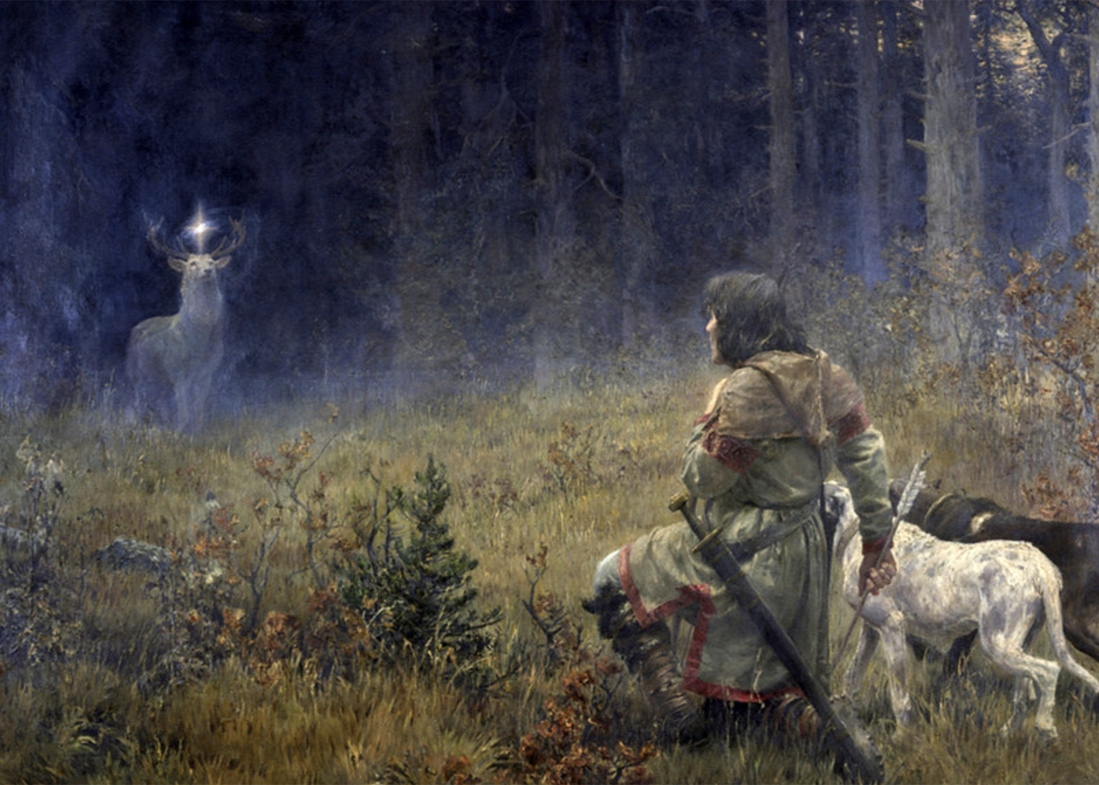
“The fairies are always near, though unseen, and though they pass out of this world into the next, it is said that they have still the power to call up men and women to do their bidding.”
Lady Augusta Gregory, The Kiltartan Poetry Book (1919)
Cover art by Wilhelm Karl Rauber
Mircea Eliade wrote that the sacred tree and the sacred stone are not adored as simply a stone or tree; they are worshipped precisely because they are hierophanies. That is, because they have become something that is no longer stone or tree but sacred or ‘wholly other’. I feel that what Eliade says about forms transcending themselves to become the ‘other’ is very relevant to how Irish ‘fairies’ are portrayed today. Over and over I am reading the idea that a person must go backwards in time to find the true relationship to Irish fairies. Or, that by discarding the worth and purpose of wider culture and experience that ‘the good folk’ can only be found in a frozen-in-time ritualized way of thinking or speaking.
This is a very reductive and damaging path to follow, in my opinion.

If a person is reading this blog then I will assume that the concept of wider and higher consciousness, as well as abstract and complex function, is part of their curiosity and interests. With that in mind, trying to continually shoehorn fairies, (and the Irish examination of them), into a folkloric or ‘spiritual’ framework damages the authenticity, as well as accurately understanding the phenomenon, in my own opinion. It may be uncomfortable to accept it, but quite an amount of rural Irish fairylore is very much a product of a people who were colonised, traumatised, and given a view of themselves, the world and their own environment which lent itself to distortion and inaccuracy.
The opportunity for an unbiased and chaotically-inclusive animism can only emerge through detachment from such imposed tropes and superstition. A wilder paganism outside of the diluted remnants of Christian fearfulness means that the practitioner becomes, as Eliade writes, ‘wholly other’ themselves. In fact, it is the reflexive, natural ‘becoming’ which helps us move past the concept of fairies being somehow more clearly understood as ‘historical’, and instead a cosmological and meta-conscious pathway themselves. Of course, for some, fairies need to be stuck in place, bound to terrain and language in order to be held and tamed. This, though, is never their nature.

Like the Victorians placing wings on the back of diminutive sprites, understanding Irish fairies as living tethered to physical geography is a product of our own limited thinking, more than it is ‘their’ condition and function. That is not to say that geographic areas or native cultures don’t use the lens of geography or place in order to express ritual or create interaction, of course. What, then, are we excluding and including when we consider fairies today? If our understanding is bound to a concept of the eternal, or outside the confines of our current theories of time, then we must also accept that folklore, like religion, like anthropology, and indeed any epistemology, cannot give us an accurate definition of who or what these beings/ forms/ expressions are.
Traditional clichés, and us continually repeating them as if this confers ‘truth’, is only turning our understanding around in a self-referencing loop. The prodding of our conscious evolution by ‘their’ appearance is cancelled by our continuing to return to a way of seeing that we should have moved past. However, by allowing evolving definitions and ways of thinking to become as much a part of our exploration and vocabulary as much as the older touchstones, we may begin to find, as Eliade wrote, that the wholly ‘other’ is never stagnant itself and we need to move with it in order to accurately experience it.

David Halpin
David Halpin is a writer from Tallaght, now living on the Carlow/ Wicklow border. He has been writing about Irish Forteana and spirituality for over thirty years and has had his articles published in magazines and books throughout the world. David’s photographs of Ireland’s sacred sites have been published in journals and articles worldwide and in 2020 were included in An Taisce’s annual report on the Irish landscape.
David is also a reviewer of esoteric writing and as well as publishing for The Occult Book Review, he also contributes regularly to newspapers, magazines and online publications. His articles have appeared in The Wild Hunt, New Dawn Magazine, Coire Ansic, and he is a regular contributor to Ancient Origins. David also runs the blog, Circle Stories, where he focuses his writing upon the topics of consciousness and folklore.

Collaborative online journal on folk belief.
Leave a Reply