
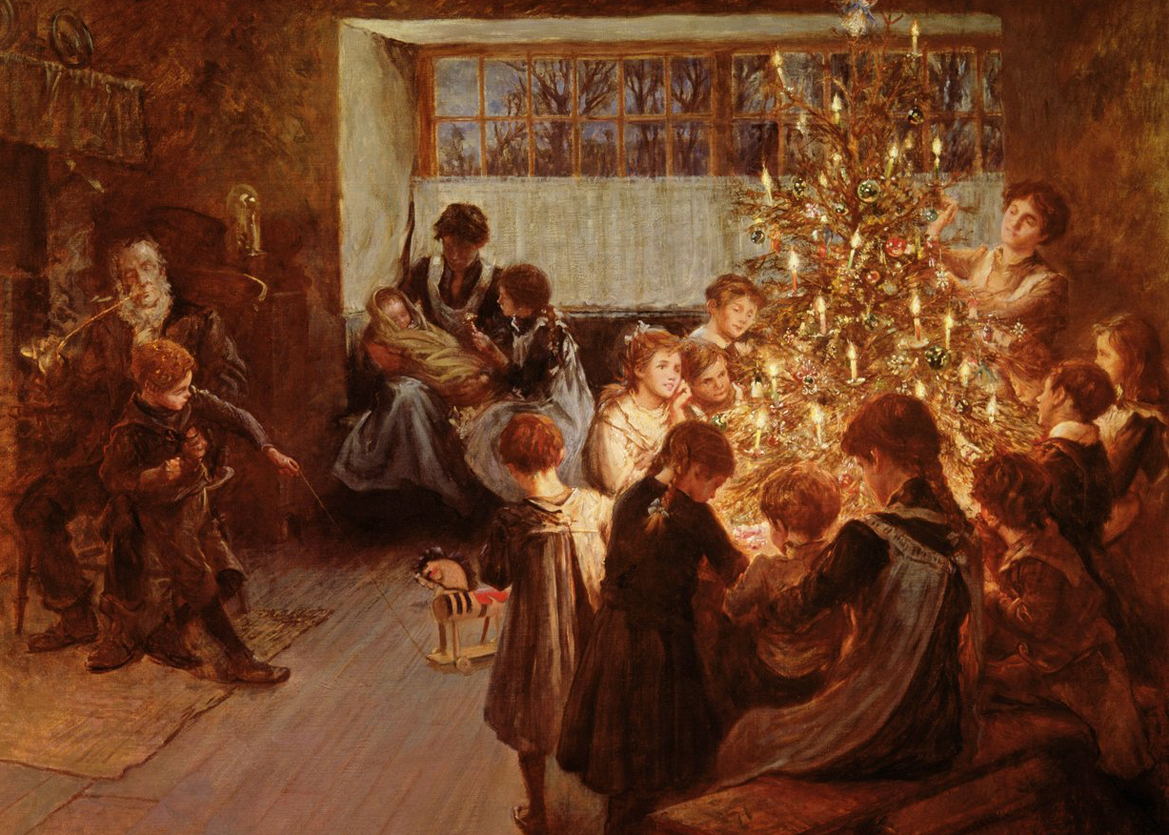
“At the winter solstice, the stillness speaks – whispering of cycles, renewal, and the quiet promise that the light will find us again.”
Angie Weiland-Crosby
Cover art by Albert Chevallier Tayler
December 21 – December 22

The winter solstice is called Grianstad an Gheimhridh (Solstice of the Winter) in Gaeilge which means ‘stopping of the sun’, Latha na Geamhraidh na Grian in Scots Gaelic which means ‘day of the winter sun’ and Alban Arthur in Welsh which means variously ‘light of winter’ or ‘Arthur’s Light’. The native Irish name according to scholar Patrick Joyce is Deiseabhair na grene, ‘going south by the sun’.
The winter solstice is one of the oldest celebrations on earth (along with the summer solstice) and marks the shortest day of the year. The sun appears to be in the same low position on the horizon for three days and by the third day (December 25th/Christmas) the sun is ‘reborn’ and begins it’s slow ascent back into the sky. There have been many gods of ‘light’ written as being born near this day including Horus, Mithra, Krishna and Christ. The famous Welsh bard Taleisin was also born at mid-winter.1 The Roman Saturnalia as well as the Norse Yule are celebrated at this time as well and both of those celebrations represent ‘the light’ and maintaining hope and perseverance during the darkest time of the year.

The story of Christ himself is nearly identical to those told in Egypt and Syria whereby an infant (in this case the god Horus) was used to represent ‘the Sun/Son of God’ or variously a ‘Sun god’ whom was born around this time of year. Horus was said to dispel darkness as was Christ. Horus (Isis) and Jesus’s (Mary) mother were both depicted as virgins. They both have stars that signified their birth. For Horus this was the ‘Star of Sirius’ and for Christ, the ‘Star of Bethlehem’. Their symbolism is both of restoring order and goodness to the world and of good triumphing over evil. Horus had 12 ‘followers or companions’ while Jesus had ‘helpers or apostles’. Some scholars make a further association and connection between the number 12 and the zodiac.
On the ancient Gaulish coligny calendar, the time between November through December was known as dumanios or ‘darkest depths’. Many ancient stone circles and monuments align with the winter solstice including Maeshowe, Newgrange, Douth, Drombeg, Knockroe, Baltray, Long Meg and her Daughters, Stonehenge, Ballynoe, Callanish and Stenness. There are many others to be sure. Regarding folklore surrounding Sí an Bhrú, Newgrange, one of the most famous tales relates to the Irish god, the Dagda. At Newgrange, he seduces the goddess Bóand in which the entire complex of Newgrange, Knowth and Dowth (Brú na Bóinne) are collectively named after. It translates to “Palace of Bóand”. Bóand falls pregnant and because she was already married, to hide their affair, the Dagda caused the sun to stand still for nine months so that she could have their child without her husband’s knowing.

Their son is of course, Óengus, a god representative not entirely but on some level of love and desire. The sun’s beam shining into the chamber of Newgrange at this time of year is thought by some to be representative of the Dagda penetrating the womb of Bóand. Nine months later is of course, the harvest season of much grain and other crops. This also reminds me of a hypothetical and speculative symbology of the triple spiral which is not coincidentally inside of Newgrange as well as on the front entrance stone. This is that the triple spiral represents a cosmological pregnancy, possibly between the climate, the sun and the earth, in that each part of the spiral signifies 3 months of unique development. Pregnancies today are still separated scientifically by 3 distinct phases and trimesters that last 3 months each. In regards to the Dagda, this is all of course not to say that the Dagda was a ‘sun’ god or could be reduced as such. He was more so a wielder of elements. Interestingly, Bóand’s later death created the River Bóinn or Boyne which is also sometimes known as the River of Segais. It was said that she walked counterclockwise around the sacred Well of Segais or in some versions, lifted a stone that protected it. The waters rose over her to drown her and ran down to create the river itself. In some versions of her stories, she is known as Eithne.

There is another interesting aspect of the light that shines in Newgrange… and that is that it lasts approximately 17 minutes. I wondered if that number lended to any other significance. According to Celtic scholar, Peter Berresford Ellis… “Is the figure 17 significant? It certainly is so in Irish mythology. Seventeen days, the seventeenth of the month, seventeen years occur in many contexts. Why did the Druid advise Maelduin to take only seventeen men with him on his fabulous voyage? Mil arrived in Ireland on the seventeenth of the moon and the battle of Tailtiu took place on the seventeenth of the moon. One’s seventeenth birthday was the aimsir togu, the age of consent, when boys became men… Additionally, the Irish reckoned that the seventeenth generation marked the limit to which kin could properly be reckoned to. The examples are too numerous to continue.”2

There are some whispers based off archaeology and folklore of an association of horses with the winter solstice, possibly by way of the horse being the carrier of the chariot of a particular sun god or goddess. As an example, the Norse sun goddess Sól was said to ride daily through the sky on her chariot, pulled by her two horses Arvak and Alsvid. Although, Frey did the same on a boar where the boar’s bristles were said to be the rays of the sun. In Greek mythology, the sun god Helios also rode on a horse drawn chariot as he traveled across the sky bringing daylight. There are in reality numerous examples of this. Epona, a protector of horses was also a Gaulish goddess associated with this time of year and one of the only ones to be adopted by the Romans. Her feast was celebrated typically sometime between December 15th and 19th.

Another famous tradition concerning the horse is the beloved Welsh Mari Lwyd celebration which has had a wondrous revival. This is a wassailing tradition whereby a horse skull controlled by someone under a sheet with other various folk and artistic decorations is paraded around going from house to house.

The Mari Lwyd party would arrive at a house and perform a song requesting to be let inside. The occupants of the house would then respond with various excuses, explaining why they couldn’t grant entry. In turn, the party would sing another verse, and a lively exchange would unfold between the two sides. This musical contest, known as the pwnco, resembles a kind of verbal sparring.
The back-and-forth would continue until the house’s inhabitants ran out of responses. At that point, they were compelled to let the party in, offering them ale and food as hospitality. Ireland has as a similar tradition sometimes called Láir Bhán where a hooded horse accompanies wren boys whom were out to catch the wren, or in the parade ensemble itself, another tradition associated with this time of year.3

Lá an Dreoilín, Wren Day is celebrated on December 26th in Irish and Manx culture whereby men and boys would hunt a wren and place it atop a staff adorned with holly, ivy, and ribbons, or display it in a decorated box. A group of wrenboys, often dressed in straw masks and colorful costumes, parade the bird around the neighborhood, singing songs and playing music in exchange for donations.4
On the Isle of Man, the tradition continued with a mock funeral for the wren, followed by dancing around the wren pole. Wren Day has experienced a revival, though the practice of hunting the wren has ceased. Similar New Year customs concerning the wren once existed in parts of Britain and France. If you failed to donate when visited by the wren boys, you risked the bird being buried outside your house which was considered very bad luck. Hunting in general was more common the days between Christmas and the New Year.

The wren is a very special bird associated with knowledge, wit, the otherworld and the druids. Birds were considered liminal creatures in general but the wren in particular really enjoys inhabiting dark crevices and is a common haunt of tombs and cairns naturally because it can easily navigate into smaller spaces. Normally, it was considered a protected bird where it was incredibly bad luck to kill a wren or even to destroy it’s nest. From this lens, it becomes more clear why you would have donated to the wren boys lest you be left with this bird corpse of ill omen.5

The wren is quite famously known as the ‘King of the birds’ and the bird that was able to be ‘closest to the sun’. It has a beautiful and unique song like none other. The wren’s name in Gaelige of course is dreoilín, which means “trickster.” The famous Irish oral folktale starts with all the birds gathering to elect a king. Each species had its own strengths, making it hard to choose the best, so they decided that the bird who could fly the farthest would earn the title.
When the birds took flight, the small wren cleverly hid herself within the feathers of the mighty eagle, knowing that the eagle could soar higher than any of the others. The eagle flew higher and higher, confident that no bird could surpass its strength and flight. But as the eagle began to descend, certain it had won, it heard a triumphant voice from the sky chanting, “I am the king, I am the king!” The wren had taken a small flight above the eagle while it was unaware, conserving her energy and taking advantage of the eagle’s momentum.

The eagle, feeling robbed of victory, protested, “I used all my strength to win the race!” To this, the clever wren responded, “If the eagle can win through strength, then why cannot I win with wisdom?” She understood that her wisdom was as powerful as the eagle’s strength, and in her mind, both were forms of true power. Thus, the wren’s victory became a symbol of how intellect and strategy can outwit even the most formidable of forces.
Collectively, the various traditions of visiting houses door to door where singing was included is likely where the practice of caroling came from. This was a time in particular that the needy would have been practicing these customs to receive some sort of gift that would sustain them through the harsh winter, whether this was coins or food. This certainly elicits the collective spirit of giving felt this time of year. There was always an aspect with these traditions whereby the house being visited was expected to give the singers and merrymakers a small tip or gift of some kind. This is another tradition that has remained incredibly similar to the past in that it’s often charitable organizations or churches still caroling and visiting door to door asking for donations. In general, as always, when a house failed to contribute, it was considered bad luck on them.

The main animal associated with this time is undoubtedly the deer or reindeer. While male reindeer shed their antlers typically in late November or early December, female reindeer retain theirs representing vivacity and continuity through the harsh winter season. For many cultures, Siberian, Norse and Celtic all included, white deer (often any white animal) or reindeer has significant meaning and symbology attached to it, usually being viewed as otherworldy or sacred because of their rarity… a message of hope from higher powers.

When Siberian shamans (and it is assumed, druids or other spiritual practitioners) would ascend in ecstatic trance, they were often traveling into the ‘upper or sky realm’. Sometimes this was done via psychedelics such as the magic mushroom, Amanita muscaria (Fly Agaric) or more commonly used today, Psilocybe semilanceata (Liberty Cap). Various gods, goddesses and cultural figures alike were known to traverse the sky and drop gifts for their followers below. The Norse god Odin has most prominently been compared to Santa in that for Yule, children leave food in their shoes and Odin is said to replace it with gifts. He also had an eight legged horse named Sleipnir that pulled his sleigh. Santa is clearly a beloved remnant of these various ancient beliefs and practices. David Halpin touches on these traditions in much more detail here about the Midwinter Deer Goddess and the Goddesses of Winter. He also touches on another related holiday celebrating mothers at this time known as Modraniht or Mother’s Night celebrated on or around December 24th, where women ancestors were honored and remembered.

It became common tradition to decorate homes in greenery and in particular evergreens (again representing vivacity) such as, pine, fir, spruce, holly, juniper, rosemary, ivy or mistletoe (which each have their own unique and sacred significance). Herein lies the importance of the Christmas tree and why an evergreen was brought into the house. This imagery of the evergreen tree decorated and covered in lights (traditionally candles) is incredibly impactful during this time of year.

The mistletoe in particular has interesting folklore surrounding it and was of course likely sacred to the druids as is widely known. The mistletoe grew as a parasitic plant on various trees and was thought to have healing properties. It could flourish during the harshest of winters and was therefore viewed as a sign of fertility and continued vivacity. The mistletoe’s associations with fertility continued through the middle ages when it became tradition to kiss under the mistletoe during the winter holidays, sometime around the 18th century. If a woman was caught under it, men were allowed to steal a kiss and refusing was viewed as bad luck. Each time this happened, a berry was said to be plucked until all of them were gone and no more kisses were needed to be given.
A lovely reference to the use of juniper in Scotland during Hogmanay…

“An old Hogmanay (New Year’s) custom in the Highlands of Scotland, which has survived to a small extent and seen some degree of revival, is to celebrate Hogmanay with the saining of the household and livestock. Early on New Year’s morning, householders drink and then sprinkle ‘magic water’ from ‘a dead and living ford’ around the house (a ‘dead and living ford’ refers to a river ford that is routinely crossed by both the living and the dead). After the sprinkling of the water in every room, on the beds and all the inhabitants, the house is sealed up tight and branches of juniper are set on fire and carried throughout the house and byre. The juniper smoke is allowed to thoroughly fumigate the buildings until it causes sneezing and coughing among the inhabitants. Then all the doors and windows are flung open to let in the cold, fresh air of the new year. The woman of the house then administers ‘a restorative’ from the whisky bottle, and the household sits down to its New Year breakfast.” – F Miriam McNeil, Silver Bough
More on saining here.

There is also the importance of the ‘Yule log’ as it is commonly known although, it likely would have had various cultural names. These were special logs for fires used at this time of year. Sometimes they were sprinkled with ritual mead or ale, dressed up with plants or had symbolic imagery carved into them. You would also be lighting candles more often this time of year and of course keeping the fire going more often for heat, which quite literally brings in life and light to sustain us. This practice was quite a unanimous and cross cultural tradition around the entirety of Europe. Additionally, women were cross-culturally nearly always the hearth keepers and tended and kept the fire going throughout the entire year. Speculatively, this is just one of the many reasons why there was a connection with honoring the feminine at this time of year along with the general connection of women to birth and re-birth… being a portal of new life. Even in Christian tradition, Mary naturally plays a heavy part here at this time of year being the mother of Christ and giving birth to him.

Another quite famous story surrounding this time is that of the Welsh Sir Gawain and the Green Knight. It was said that the Green Knight’s head was cut off at Arthur’s Christmas feast which might hold symbolic significance. Sir Gawain was also forced to meet and fight the Green Knight twelve months and a day after his first encounter. Somewhere in here lays the foundations of the seasonal battle between the “Holly and Oak king” associated with this time of year. It’s my understanding there is no official text depicting this battle but it somehow became embedded in oral tradition and embellished from there likely in more modern times.
In Britain, it was said that ghosts gathered on the longest night to elect their king for the coming year.7 In Ireland, onions should be planted on “the shortest day and pulled on the longest.”8 Also, there was leaving the door open Christmas Eve. for weary travelers, making potato cakes or putting a candle light in every window9 as well as leaving the fire on and going all night instead of being raked.10 Decorations were also to be taken down on the 6th of January which was symbolically 12 days after Christmas, again, relating to the 12 companions, apostles or zodiac depending on what you believe.11 There is also Nollaig na mBan, “Women’s Christmas” or “Little Christmas” in Ireland which takes place again 12 days after Christmas and is a time when women are given the day off to relax, have parties or go out and socialize with their friends for the day and into the evening. Finally, in many communities the farmers made a corn dolly out of the final grain harvest, representing the Cailleach. It was kept until Christmas morning and then given to the horse or cattle on the farm. There are in truth, so many varied, unique, layered and most importantly, local holiday customs around this time of year, entire books have been written about it.

Overall, from a more ancient perspective, the winter solstice is ultimately the birthday of our sun where it completes it’s ‘cycle’ and is born again. It’s a time to bring in the ‘light’ both literally and figuratively, largely to stave off winter gloom, darkness and the more negative aspects of life. Many beautiful traditions have been pulled into the modern era that have clearly been celebrated for thousands of years. Knowing this adds immense meaning to everything we participate in this time of year and makes the ‘light’ seem ever so brighter.
References
- Toulson, Shirley. 1981. The Winter Solstice. London, Jill Norman & Hobhouse. p. 30.
- Ellis, Peter Berresford. 1994. The Druids. London, Constable. p. 233 – 234.
- Cawte, E.C. (1978) Ritual Animal Disguise. D.S. Brewer for the Folklore Society.
- The Schools’ Collection, Volume 0180, Page 283
- Day, Brian. 2000. Chronicle of Celtic Folk Customs. Hamlyn. p. 184 – 185.
- Macleod, M. (1937). British calendar customes scotland vol. 1 movable festivals harvest march riding & wapynshaws wellfairs. William Glaisher ltd. p. 63.
- British Archaeological Society. Collecteana Archaeologica Vol 1, 1843. p. 56.
- The Schools’ Collection, Volume 0034, Page 0299
- The Schools’ Collection, Volume 0034, Page 0086
- The Schools’ Collection, Volume 0137B, Page 08_026
- The Schools’ Collection, Volume 0134, Page 496

Isla Skye
Isla is an American Irish mother of 3, teacher, author and herbalist that splits her time between the states and Ireland. She has been studying folklore as well as the Druids and related practices for over 20 years. Her hobbies are family time, reading, camping, hiking, spending time with her many animals as well as writing and research.
Leave a Reply