
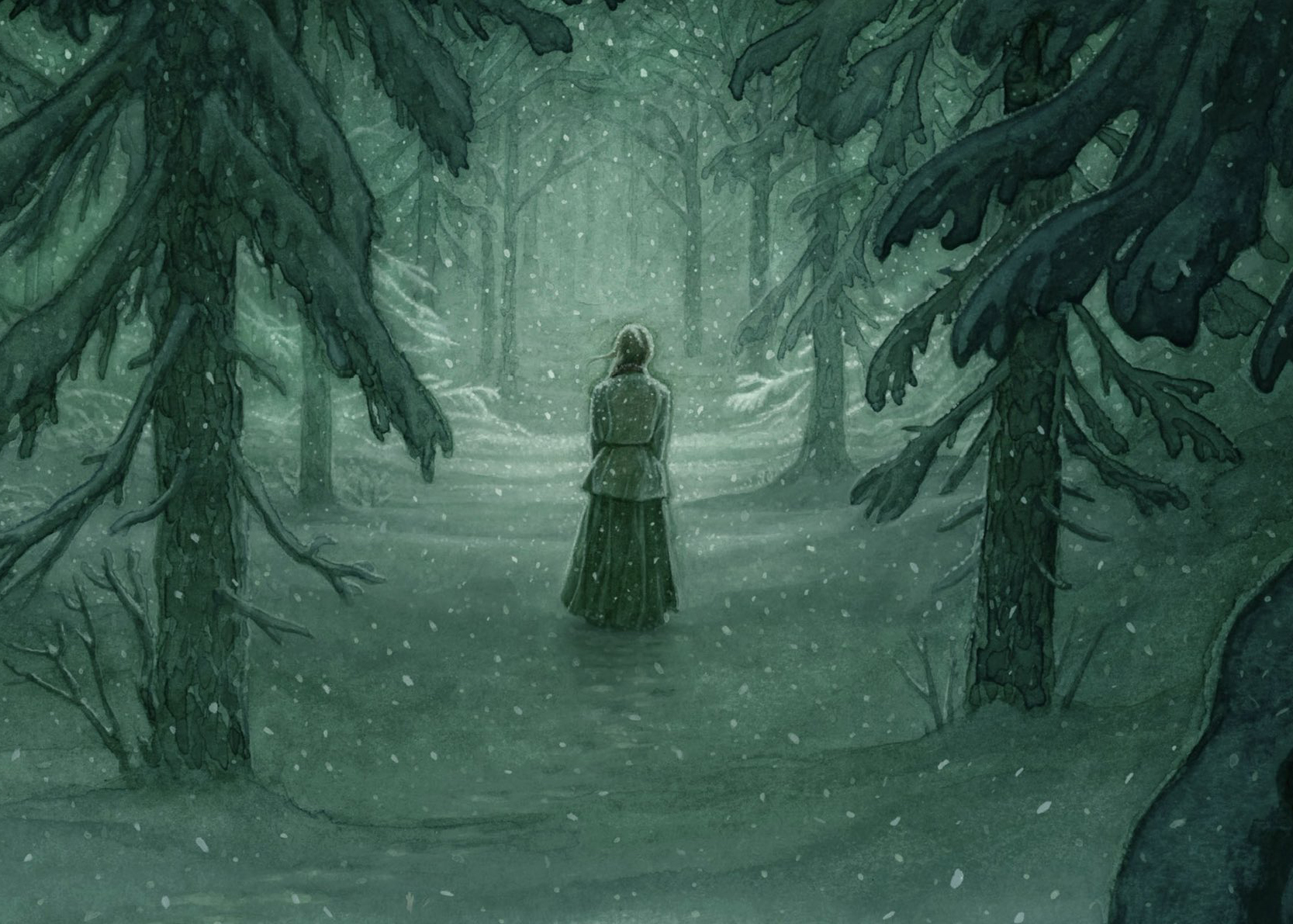
“From Samhain’s dusk to Imbolc’s dawn, the Cailleach’s reign is strong. Her cloak of snow wraps the earth, and her staff strikes down the flowers. Only when the sun grows strong again does she fade into the mists, giving way to spring.”
‘Cailleach Bheur’, translated by John MacInnes
Cover art by P.J. Lynch

The Cailleach (pronounced “cal-yahkh”) is one of the most fascinating and enigmatic figures in both Irish and Scottish folklore (and wider belief) often depicted as a crone or old woman. She is intricately tied to the changing seasons, the land, and the mysteries of the transition of life and death. Her character and role in mythologies stretch back through centuries of oral tradition, and while she has experienced modern reimagining, her function and symbolism in ancient Celtic language cultures were seemingly complex and multifaceted. What I do know is that you can still feel her in the bones of the land just merely laying one’s head on the soil. Protective, fierce, wild and feral. She awakens one’s body and soul in ways only she is singularly capable.
Origins and Early References
The Cailleach’s name is derived from the Old Irish word caillech or cailleach, meaning “veiled one” or “old woman”, “hag” and “witch” in modern times. These are collectively usually terms endowed for a very powerful and wise (yet sometimes troublesome) female figure. Related Irish words include cailleach-dhubh, ‘nun’, cailleach-oidhche ‘owl’, cailleach feasa, ‘wise woman, fortune-teller’ and cailleach phiseogach, ‘sorceress or charm-worker’. Another possibly related word is síle which also means ‘hag’ and has led some to speculate if there is a connection between the Cailleach and Sheela-na-gigs.

I wrote about the reasoning for this possible connection in a separate article about the Sheela, here. In all of my journeys with the Cailleach, both done personally at sacred sites and with teachers, she appears similarly as I recount in my article on the Sheela… she is darkly fierce but, ultimately good towards you (if you are of good character). She demands moral integrity from her followers and pushes us to be our best on a personal as well as societal basis. This also falls in line with her broader role as a sovereignty goddess.
The Cailleach appears overall as somewhat of a personification of winter and the destructive forces of nature but within that function is also healing, rest and rebirth. She is collectively described as a primordial goddess who is often a giantess or can transform into one and formed the landscape into various land forms and waterways. Her most famous act is that of turning the land itself into rugged, wild, inhospitable and often mountainous terrain. She has been said to have other nature based personifying functions such as her breath being the wind and her gaze having the ability to freezing water.

While she has a wide reach with similar cultural meaning, she simultaneously can appear very place specific. There is very famously, both the Cailleach Beara of Cork and Cailleach Gearagáin of county Cavan. Originally, Cailleach Beara appears in Irish mythology as having two sisters, Cailleach Bolus and Cailleach Corca Duibhne. Her other name was Buí and she was said to be the wife of Lugh.1 She is the narrator of a lovely 9th century Irish poem ‘The Lament of the Hag of Beara’,2 in which she bitterly laments the passing of her youth and highlights the ails of her decrepit old age. In Cork, there is the ‘Hag of Beara‘ rock chair. This chair was said to be either her fossilized remains, or the chair in which she sits waiting for the great sea god Manannán mac Lir, variously described in oral folklore as her husband. There is another similar site which is on the southernmost tip of the Cliffs of Moher in Clare called ‘The Hag’s Head’ where the cliffs form an unusual rock formation that resembles a woman’s head looking out to sea. The peninsula of Beara in general is additionally known variously as Beare, Béirre, Béarra and historically named after the Spanish-born wife of Eógan Mor, a legendary king of Munster.

Another site associated with her in Cork is the Leaba Chaillí or Labbacallee, ‘the Hag’s Bed, a wedge tomb where she was claimed to be buried. An adult male and child was found to be buried here along with a woman’s body in which her head was decapitated and placed in a separate chamber. Many archaeologists suspect this practice might have been done to truly incapacitate a witch’s power once they passed away. The very tangible power felt at this site cannot be understated. Masses of crows have also curiously made many nests above and around this site and are nearly constant inhabitants. There are a number of interesting stories associated with the wedge tomb.
In one tale, Mogh Ruith, a powerful druid and the Cailleach’s husband, fell in love with her sister. In a fit of jealously she chased the druid towards the River Funshion. Once he started to cross the river, the hag threw an enormous boulder that landed on the druid pinning him down under the water and drowning him.3 It is not specified in the tale how the hag died but she is believed by some to be buried in the tomb. Further connections to mythology are that Mug Ruith’s daughter was Tlachtga, the powerful druidess who died in childbirth after being raped and created the Hill of Ward which has associations to Samhain. Within her connection to Cork in particular, she is said to be the ancestor of a few prominent families. In Kuno Meyer’s translation of the ‘Lament of the Hag of Beara’, She had fifty foster-children in Beare. She had seven periods of youth one after another, so that every man who had lived with her came to die of old age, and her grandsons and great-grandsons were tribes and races.” Herein lies at least a loose connection to fertility and rebirth as well for in old animistic belief, we are not just born out of our own mother, but we are all born out of the land we reside which nearly always had a female connotation. (another nod to possible Sheela connections)

There is also her association with Sliab na Cailligh or Loughcrew in Meath. Cairn T has a large chair like structure alongside it lovingly known as ‘The Hag’s Chair’ where wishes are said to sometimes be granted. The summit of Slieve Gullion in Armagh features a passage tomb known locally as the ‘Calliagh Beara’s House’. These are just a few of many landscape and sacred site or rock structure associations with her throughout Ireland.
In Scottish tradition, she is similarly portrayed as a winter goddess often referred to as the Cailleach Bheur as well in the Highlands. According to Scottish folklorist Donald Alexander Mackenzie she…
“…was the mother of all the gods and goddesses in Scotland. She was of great height and very old, and everyone feared her. When roused to anger she was as fierce as the biting north wind and harsh as the tempest-stricken sea. Each winter she reigned as Queen of the Four Red Divisions of the world, and none disputed her sway. But when the sweet spring season drew nigh, her subjects began to rebel against her and to long for the coming of the Summer King, Angus of the White Steed, and Bride, his beautiful queen, who were loved by all, for they were the bringers of plenty and of bright and happy days. It enraged Beira greatly to find her power passing away, and she tried her utmost to prolong the winter season by raising spring storms and sending blighting frost to kill early flowers and keep the grass from growing. Beira lived for hundreds and hundreds of years. The reason she did not die of old age was because, at the beginning of every spring, she drank the magic waters of the Well of Youth which bubbles up in the Green Island of the West.“4

She is also associated with deer as they are considered her favored animal and has a staff that can freeze the ground.5 She was often considered a protector of wild animals in general. In oral folklore of both Ireland and Scotland, she is sometimes associated with hares and had the ability to transform into a hare.
This might have lended to a later correlation between witches in general being said to also be able to transform into a hare. Related to her staff and druidry is a lovely folk song and dance from Scotland called the ‘Cailleach an Dudain,’ old woman of the mill dust, which some believe could mean an old woman of the land being awoken…
“It is danced by a man and a woman. The man has a rod in his right hand,
variously called ‘slachdan druidheachd,’ druidic wand,‘ slachdan geasachd,’ magic
wand. The man and the woman gesticulate and attitudinise before one another,
dancing round and round, in and out, crossing and recrossing, changing and
exchanging places. The man flourishes the wand over his own head and over the
head of the woman, whom he touches with the wand, and who falls down, as if dead,
at his feet. He bemoans his dead ‘carlin,’ dancing and gesticulating round her
body. He then lifts up her left hand, and looking into the palm, breathes upon
it, and touches it with the wand. Immediately the limp hand becomes alive and
moves from side to side and up and down. The man rejoices, and dances round
the figure on the floor. And having done the same to the right hand, and to the
left and right foot in succession, they also become alive and move. But although
the limbs are living, the body is still inert. The man kneels over the woman and
breathes into her mouth and touches her heart with the wand. The woman comes
to life and springs up, confronting the man. Then the two dance vigorously and
joyously as in the first part. The tune varies with the varying phases of the dance.
It is played by a piper or a fiddler, or sung as a ‘port-a-bial,’ mouth tune, by a
looker-on, or by the performers themselves.“6
Another reference to the Cailleach from Alexander Carmichael…
“‘Cailleach uisg,’ water woman, water carlin ; akin to the ‘bean nigh,” uraisg,’
‘peallaidh,’ and many other water divinities with which the old Highlanders
invested their lakes, streams, and waterfalls. The term ‘cailleach uisg’ is
applied to a diseased potato containing only water. According to some people,
‘cailleach’ as a period of time is the first week of April, and is represented as
a wild hag with a venomous temper, hurring about with a magic wand in her
withered hand switching the grass and keeping down vegetation, to the detriment of man and beast. When, however, the grass, upborne by the warm sun, the gentle dew, and the fragrant rain, overcomes the’ cailleach,’ she flies into a terrible temper, and throwing away her wand into the root of a whin bush, she disappears in a whirling cloud of angry passion till the beginning of April.”
As far as place specific associations, she is most famously linked in Scotland with Cailleach nan Cruachan, the highest point in Argyll and Bute which are mountains that are quite rough and jagged. This is mentioned by Mackenzie as well where she is additionally credited with creating many other rivers, lakes and islands as well. (read his full description here) She is also associated with The Corryvreckan whirlpool, an oceanic whirlpool where she was said to wash her great plaid. This process was said to take 3 days, an auspicious and sacred number.7 The Ben Nevis mountain was also said to be her “mountain throne”.

One of my personal and most beloved descriptions of her was said by Sir Walter Scott who claimed she was… “the mother witch of the Scottish peasantry.”8 I just feel that description… I suppose in a similar way that the Greeks have Hecate. Some scholars find the use of the word peasantry offensive and I don’t disagree, but I’m also proud to have ancestors associated with peasantry. Additionally, you’ll find in David Rankine’s book where I first read this quote, is an extensive list of sites associated with the Cailleach.
In Scotland, some folklore have the Cailleach and Brigid as two faces of the same goddess, and one transforms into the other throughout the year, while others describe the Cailleach as turning to stone on Bealltainn and returning to her goddess form on Samhainn in time to rule over the winter months.7 Là Fhèill Brìghde or Imbolc is also the day the Cailleach gathers her firewood for the rest of the winter. If she intends to make the winter last a while longer, she will make sure the weather on the festival is bright and sunny, so she can gather plenty of firewood. If the weather is bad, than winter will be over early.

In both Ireland and Scotland, in many communities the first farmer to finish the grain harvest made a corn dolly, representing the Cailleach. The figure would then be tossed into the field of a neighbor who had not yet finished their harvest. The last farmer to finish had to take in and care for the corn dolly for the next year. Along with this, the implication was they’d have to feed and house the hag all winter. Competition was fierce to avoid having to take ‘care’ of the old woman.7 In another related practice, the sheaf was cut and gathered by the youngest person working in the field who was thought to be of the purest of heart. The sheaf was not allowed to touch the ground and it was carried in triumph to the house where it occupied and displayed in an auspicious place. It was kept until Christmas morning and then given to the horse or cattle on the farm.9
Naturally, with the Cailleach being associated so immensely with the land itself, she was also a sovereignty goddess. That is, she was integral to the choosing of a just and true king of the land. She would do this through various tests… the most famous being similar to the Morrigan in that she would ask the willing prospect for a kiss in her hag form. If the man was willing to see past her perceived ugliness and accept her offer, she would transform into a beautiful goddess and he was accepted as a rightful and just heir to the locale.10
In the modern world, the Cailleach has regained her forefront in the collective consciousness of Irish and Scottish culture, especially within the framework of contemporary Paganism. Modern interpretations often emphasize her as a symbol of female power and wisdom, reclaiming her as an archetype of strength and agency in later life, as well as a figure representing deep, transformative magic.

The Cailleach is increasingly viewed through a feminist lens, where her strength as an older woman defies the stereotypical invisibility that society often ascribes to aging women. She embodies the wisdom that comes with age, the raw power of transformation, and the cyclical nature of existence. In some modern spiritual circles, she is seen as an empowering figure for women, particularly those stepping into later stages of life, with her energy being one of resilience.
Some aspects of modern interpretations feel authentic to the core of the Cailleach’s mythology, especially her association with the land, seasonal cycles, and the dualities of destruction and creation. Her role as a wise, powerful crone who governs the natural world and embodies transformation aligns well with the ancient stories passed down through generations. Her connection to the land’s fertility and sovereignty continues to resonate with many modern spiritual practices that emphasize a more animistic, nature-based approach to spirituality.
However, not all modern interpretations necessarily reflect the full complexity of her character. For example, the Cailleach was not always viewed in purely benevolent or empowering terms. Her role was sometimes as a fierce and frightening figure. She could be associated with death, destruction, and chaos—elements that modern reimaginings sometimes downplay.

The Cailleach is one of the most intriguing and beautiful figures in Celtic language folklore. Her role in the ancient myths of both Ireland and Scotland highlights the connection between the cycles of the seasons and the powerful forces of nature. While modern interpretations may soften or romanticize her image, the core of her myth—her deep connection to the land, her wisdom, and her power of transformation—remains as relevant today as it was in the ancient world. Whether seen as a winter goddess, a sovereignty figure, or a symbol of feminine strength, the Cailleach has an enduring legacy. She is the personification of winter’s harshness but also embodies the life-giving potential of the earth as well as the potential within each of us.
If you’re interested in reading more of the Cailleach, I suggest ‘Visions of the Cailleach’ by Sorita d’Este and David Rankine published in 2008. They go into incredible depth of her worship recording the whispers of her from the Iberian Peninsula near Spain to Brittany in France and of course, the entirety of the isles. I have focused here on Irish and Scottish folklore simply because that is what I’m most familiar with but it’s clear through my own research, her belief extends to the Atlantic seaboard of Western Europe.
You could also check out the myriad of references in the Irish Folk Duchas which has many lovely stories and references regarding her belief.
References
- Ellis, Peter Berresford. (1987). A Dictionary of Irish Mythology. Santa Barbara, CA : ABC-Clio. p 53.
- https://celt.ucc.ie/published/G400034/
- Harris, Robert (15 May 2016). “Labbacallee”. Roaringwater Journal. Retrieved 17 October 2022.
- Mackenzie, Donald Alexander (1917). “Beira, Queen of Winter”, in Wonder Tales from Scottish Myth and Legend.
- Briggs, Katharine M. (1967). The Fairies in English Tradition and Literature. University of Chicago Press. p. 40.
- Carmichael, Alexander. (1900) Carmina Gadelica, Volume I. Edinburgh. p 208.
- McNeill, F. Marian (1959). The Silver Bough, Vol.2: A Calendar of Scottish National Festivals, Candlemas to Harvest Home. William MacLellan.
- Rankine, David. (2005). The guises of the Morrigan : the Irish goddess of sex and battle, her myths, powers and mysteries. p 48.
- Macleod, M. (1937). British calendar customes scotland vol. 1 movable festivals harvest march riding & wapynshaws wellfairs. William Glaisher ltd. p. 63.
- Echtra mac nEchach Muigmedóin, The Adventure of the Sons of Eochaid Muigmedón. Edited and translated into English by Whitley Stokes, The Adventures of the Sons of Eochaid Muigmedón, Revue Celtique, 24, 1903, p. 190-203.

Isla Skye
Isla Skye is an American Celtic scholar, a mother of 3, elementary teacher for 21 years as well as an author and herbalist that splits her time between the States and Ireland. She has studied the druids and related practices for over 20 years. She is a published author of children’s books as well as other folkloric literature and is currently working through an M.A. in Celtic Studies. Her hobbies are family time, camping, hiking, reading, writing and research.
Leave a Reply