
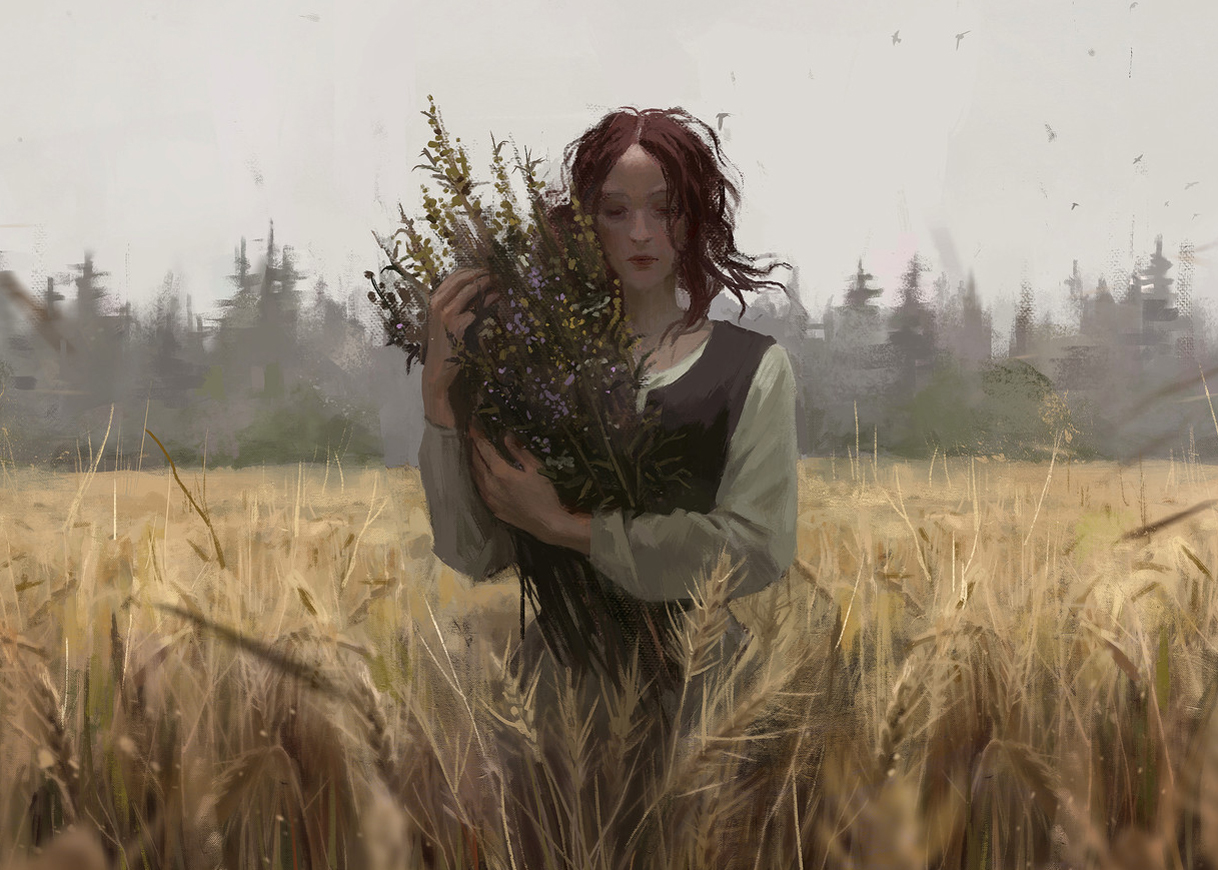
“The fairies are the spirits of the dead, and in their unseen presence, they rule the land of the living. The fairies may charm you, but they can also steal your soul.”
Lady Wilde
All art by Uliya Litvinova, https://litvinova.artstation.com/

Today, popular fairy folklore tends to gloss over descriptions like this is favour of fairies being small, winged, and timid beings. Actual Irish folklore does not describe ‘fairies’ in this way. But what exactly happened in the transmission of stories to gloss over the authentic encounters in favour of much safer descriptions?
There are undoubtedly many reasons, both cultural and practical, to be fair. However, an answer by the Russian Professor and author, Dmitriy Antonov, is interesting. In his essay, ‘Between Fallen Angels and Nature Spirits: Russian Demonology of the Early Modern Period’, he describes how the more ferocious and dangerous spirit-beings of Russian folklore were often Christianised becoming neither good nor bad, much like the Christianisation of Irish fairies into being ‘fallen angels’.
I was going through The Fairy Faith in Celtic Countries again recently and I thought it was interesting to compare an account of Irish fairies and those of Eastern Europe. In the section, ‘The Gentry Described’ we hear that “The folk are the grandest I have ever seen. They are far superior to us, and that is why they are called the gentry. They are not a working class, but a military-aristocratic class, tall and noble-appearing. They are a distinct race between our own and that of spirits, as they have told me.”

Antonov goes on to say that because literacy was low in the rural population, it was the monks and church dignitaries who wrote the folklore. This resulted in a difference between the oral tradition and the stories which were printed in books and texts. While the oral tradition maintained the often demon-like status of many fairy beings, the texts, on the other hand, diluted both the complexity and very nature of fairies. It was only after the 17th century when literacy levels began to rise due to what Antonov describes as “social mobility” (In other words, when those other than church figures began to write down the folklore.) that the old spirits returned to the written tradition.Antonov tells us, “It was only in the second half of the 17th century that new, unusual descriptions of demons began to appear. Some of these were imported from Europe through translation; others, more relevant to the present volume, originated from the oral tradition.”
What is interesting, then, is how the older Eastern European description of fairies often compares to the Irish ‘Gentry’ fairies. It should be noted, of course, that there are many types of fairy beings in folklore but in the context of this post I just wanted to draw attention to how popular fairy folklore often overlooks the beguiling, the cunning, the human-like appearance, and, of course, the danger of the ‘gentle people’.

David Halpin
David Halpin is a writer from Tallaght, now living on the Carlow/ Wicklow border. He has been writing about Irish Forteana and spirituality for over thirty years and has had his articles published in magazines and books throughout the world. David’s photographs of Ireland’s sacred sites have been published in journals and articles worldwide and in 2020 were included in An Taisce’s annual report on the Irish landscape.
David is also a reviewer of esoteric writing and as well as publishing for The Occult Book Review, he also contributes regularly to newspapers, magazines and online publications. His articles have appeared in The Wild Hunt, New Dawn Magazine, Coire Ansic, and he is a regular contributor to Ancient Origins. David also runs the blog, Circle Stories, where he focuses his writing upon the topics of consciousness and folklore.

Collaborative online journal on folk belief.
Leave a Reply