
“The fairies are not, as they are often said to be, merely creatures of a mischievous spirit. They are guardians of the boundary between the real and the unreal.”
J.M. Barrie
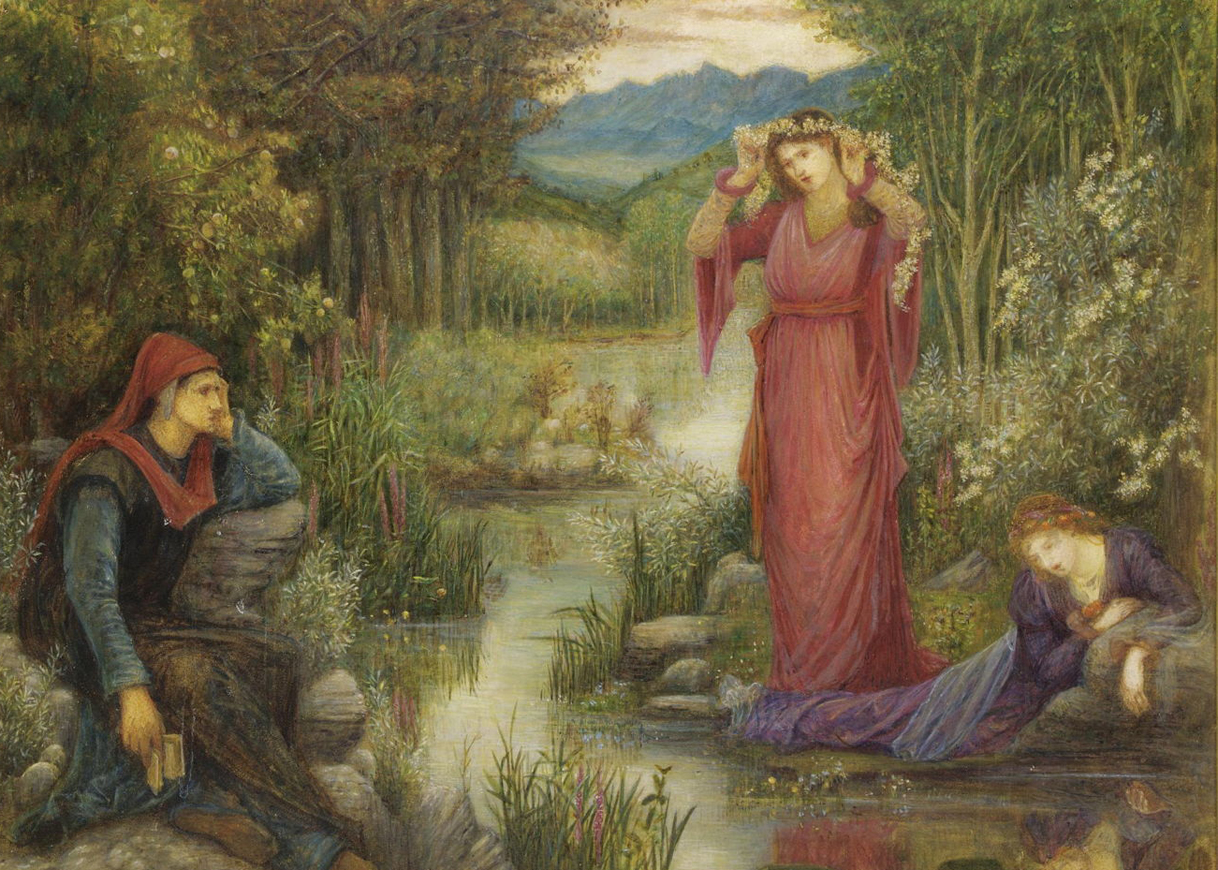
All art by Marie Spartali Stillman
One specific aspect of fairylore which tends to divide those who are prepared to take it seriously are the physical versus non-physical attributes of the encounters. I understand this in some ways. By attributing sights and interactions to altered states of consciousness we can then address the phenomenon without having to believe it really happened.
From a 20th century academic perspective, this had been the preferred method of resolution for many writers. There were some exceptions but in the last two decades very eminent thinkers and philosophers have dared to entertain the possibility that encounters can be both physical and, also, something between states. Professor John Mack, Dr. Barbara Tedlock and Dr. Jeffrey Kripal are three who come to mind with high profiles.

In David Gordon White’s work, Kiss of the Yogini: “Tantric Sex” in its South Asian Contexts, the author draws our attention to the parallels between the night hag and yogini’s. These are strange, fairy women who seem to terrorise those at the border of sleep and wakefulness causing sleep paralysis and often a change of direction in ones life.
So, throughout world cultures we can see that it is not just that the liminal states allow us in, they also allow other ‘things’ out.
The idea of these encounters being all in the mind is appealing, though; perhaps a heightened state of anticipation fires the imagination into overdrive. Wishful thinking and cultural expectations do the rest. Visiting a sacred ancient site at dusk might trigger a swoon where archetypal imagery and lessons of tribal importance occur. Maybe the scent of flowers or a beautiful landscape scene might also provoke such an altered state. After all, art and literature are full of examples where a person is suddenly confounded by a feeling of such intensity that they are enraptured. Some see God in a sunrise, heaven in a wildflower, or feel contact with a presence tethering on the periphery of our existence. Others find the divinity of life and indescribable meaning in such moments. Only by drawing from the symbolic may such feelings become possible to convey. Which might then explain fairy encounters.
But the lore does not bear this out. Firstly, most recordings of fairy encounters are entirely unexpected. While sometimes beautiful, they are more often terrifying. In many examples there are physical scars or injuries following either an escape or a return following an abduction. In other cases the scars are psychological and include madness and complete breakdown. Then we have the apparent changing of physical geography which leads a person to become pixie-led and losing all sense of direction. Is it actually our senses which are being manipulated or the surrounding reality itself? Entire towns vanish only to be replaced with thick, woodlands with strange castles and mountains higher than any known on earth.

The beings encountered are not always strange looking, though. Instead, our accounts describe human-like people in their stature and appearance. Examples of fairies being butterfly-like, in size and behaviour, are few and far-between in old Irish folklore.
There are examples of some being taller and others being slightly smaller but by and large warnings regarding the good people often urge us to remember that they may be next to us and we do not know it. Of course, their otherworldliness may manifest in how we feel around them without us knowing why.
On Benbulbin, the gentry are often cruel if one is unlucky and at other times casually unconcerned with human safety and the repercussions of our interactions with them.
They may warn us to stay away, as recorded by Wentz, or they may toy with us for sport. Again, the accounts do not describe falling into a trance but instead the raw physicality of pain they inflict or injuries they cause. Even the places of the otherworld are described in such minute detail that they evoke a sense of something tangible remembered as opposed to the vagueness of a dream-state. Andrew Lang, in his introduction to The Secret Commonwealth of Elves, Fauns and Fairies by Robert Kirk (1691) in 1893 writes that inside the fairy mounds the light is ‘artificial’ and glows softly.
What an odd detail to specify. Lang goes on to recount an anecdote about a woman, who declared that a number of the gentle people (Sleagh Maith) “occasionally frequented her house; that they often conversed with her, one of them putting its hands on her eyes during the time, which hands she had, to be about the size of those of a child of four or five years of age.” The family were “worn down” with these visits, and from the mention of touches of hands. Even the most ardent argument for fairy encounters being insubstantial and only altered states becomes difficult to sustain when there are multiple witnesses.

Near Dromkeel stone circle in 1992 a local farmer, John McManus, described how he was taken from his home by four small figures. He awoke in a circular ‘room’ where he was given an electric shock and something was put inside him. He then found himself back in his house where the floor was covered in mud and stones. Three years later McManus had another experience where he felt compelled to walk to his window and watch lights appearing to drift across the nearby mountains. He felt as if he had been drawn to witness in order to participate. This is a well documented aspect of fairy lore. In many cases it takes the form of fairies playing a hurling match which they cannot begin until a human interacts with them in some way.
This example of an object being placed inside a person is reported in all indigenous cultures when recounting experiences with fairy-type beings. Sometimes the experience takes the form of a person feeling as if they are being cut into pieces only to be put together again. In other examples the object placed in the body becomes the instigator of new healing knowledge or psychopomp abilities. Again, there is no requirement to deny the physicality of what has taken place except in contemporary Western culture.
So, to repeat a question I asked recently, why does it sometimes seem that people could more easily experience these Otherworld encounters at sacred sites in the past and why was there no question that they were ‘real’? In my view, complex rituals and preparation often create a biological neutral state, a toxic clearance which was normal for people up to less than 100 years ago. Going even further back, a person was much more in sync with their natural environment. We felt stronger effects of the moon and stars, we were more in tune with the cycle of nature, we had less pollution, less distraction.
In fact, people were in a constant state of ritual preparedness which might lead to a spontaneous reception at sacred places.
Every single life-form we see, all of the known physical universe, exists in just one tiny sliver of the electromagnetic spectrum that we can perceive. The idea that life does not form or thrive in the frequencies we can’t perceive seems outrageously naive. Another idea, taking that further, is that what if life, independent life, can also form in the imaginal realms, in dreams and in our projections of events concerning the past and future? How do we separate the psychological from the physical in such contemplations? Often it is the case that those who describe fairy encounters come away with a sense that their visitors know much more about them than they should, sometimes making predictions or reference to events far in the past of a family lineage. Although altered states may well act as a gateway for these encounters, the overwhelming folklore record describes something affecting and physical.

David Halpin
David Halpin is a writer from Tallaght, now living on the Carlow/ Wicklow border. He has been writing about Irish Forteana and spirituality for over thirty years and has had his articles published in magazines and books throughout the world. David’s photographs of Ireland’s sacred sites have been published in journals and articles worldwide and in 2020 were included in An Taisce’s annual report on the Irish landscape.
David is also a reviewer of esoteric writing and as well as publishing for The Occult Book Review, he also contributes regularly to newspapers, magazines and online publications. His articles have appeared in The Wild Hunt, New Dawn Magazine, Coire Ansic, and he is a regular contributor to Ancient Origins. David also runs the blog, Circle Stories, where he focuses his writing upon the topics of consciousness and folklore.

Collaborative online journal on folk belief.
Leave a Reply